Event 1
Spanish Civil War
The [Spanish Civil War](entity:event-recall-event-spanish-civil-war-dafa813888d4) is the foundational conflict of the novel: it destroys the political world in which its Republican characters had lived, and its outcome continues to govern who can remain in [Spain](entity:location-recall-location-0fe76f866976), under what name, and at what risk. The war’s end does not close its history. False documents, clandestine networks, and the unanswered question of international solidarity carry its consequences into the postwar plot.
## Background and International Intervention
In July 1936, German [Nazi Party](entity:organization-recall-organization-bddabb00303b) organizer Johannes Bernhardt seized the opportunity created by the military uprising in Spanish Morocco. On 23 July he met Francisco Franco in [Tetuán](entity:location-recall-location-f7e7d8305dc2) and offered to act as an intermediary with Adolf Hitler. Bernhardt’s journey to [Berlin](entity:location-recall-location-769cdeac2511), alongside Adolf Langenheim and Francisco Arranz Monasterio, helped initiate German assistance to the rebels. The next day, Hitler ordered twenty transport aircraft, with crews and whatever military supplies they could carry, sent to Spain; over the following week, they transported roughly fifteen thousand soldiers from Morocco to Seville. Franco never forgot the favor.
This opening illustrates how the war’s course was shaped by networks that crossed national borders before the postwar escape routes existed. Bernhardt, previously an unsuccessful businessman and a veteran organizer for the [Nazi Party Foreign Organization](entity:organization-recall-organization-d232b255bc81) in Tetuán, converted political access into lasting influence. After the Francoist victory, he became a powerful industrialist, while Clara Stauffer’s [Madrid](entity:location-recall-location-madrid-8acd4123f416) home served as a meeting point for Nazi and Francoist associates. The novel traces these wartime connections into the later protection of fugitives from the [Third Reich](entity:time-recall-time-f3c47f5ce6a4).
## Defeat and the Making of False Identities
The war’s defeat leaves [Guillermo García Medina](entity:character-recall-character-guillermo-garc-a-me-d52c3f18d2cc) in Madrid, alive under a false identity. His survival depends on the papers given to him by [Manuel Arroyo](entity:character-recall-character-3296d1a401b2) Benítez, a Republican diplomat whose life Guillermo had saved in 1937. The documents turn an administrative identity into a means of escape from execution: Guillermo becomes Rafael Cuesta Sánchez, with a fabricated biography designed to pass inspection under the victorious regime. The original identity had been invented for Manuel, and its reuse links the two friends’ lives across the war and its aftermath.
The paperwork’s effectiveness rests on precise details rather than a vague disguise. Manuel explains that the fictional Rafael had been a married UGT member living in [Valencia](entity:location-recall-location-760e70b8ce24), but Guillermo’s version makes him a twenty-five-year-old bachelor, politically unaffiliated, long resident in Madrid, and most recently domiciled in [Salamanca](entity:location-recall-location-2bf64b0b8b8f). Manuel has destroyed the earlier record and prepared a document intended to be indistinguishable from one issued by the Nationalist authorities. When Guillermo later presents it at a crowded police station, the guard directs him to the counter for exchanging documents from the Nationalist zone. The same state machinery that classifies and checks the population can be navigated through a carefully constructed identity.
## The Postwar Continuity of Wartime Networks
Clara Stauffer’s role demonstrates how relationships and institutions formed during the war survive its formal end. In 1939, after returning to Madrid, she maintained a double allegiance, Francoist in Spain and Nazi in [Germany](entity:location-recall-location-a3c24dd56e42), and her house at Galileo 14 became a gathering place for people attached to both movements. After Hitler’s defeat, that established setting acquired a more clandestine function. In 1945, Stauffer renovated rooms for offices, added a telephone line, hired secretaries, and filled new cupboards with men’s clothing and shoes in many sizes.
The visitors were worn-out men who did not speak Spanish. Some were fugitives who had crossed the [Pyrenees](entity:location-recall-location-bca267e59698) or prisoners released from Nanclares; the house provided food, replacement clothes, and help finding lodging or work. Parish envelopes brought forged baptismal records bearing German names. These practical arrangements show the conversion of wartime political connections into a postwar system for helping fugitives evade scrutiny. The war’s legacy is therefore not only the displaced Republican survivor but also the protected former enemy whom the new order allows to disappear into another identity.
## Resistance, Testimony, and Abandoned Hope
The novel also presents the defeat of the Republic through the later fate of young resistance activists. Marcelo Saporta, a Sephardic Jewish refugee who settled in Madrid with his family after obtaining Spanish nationality, joined student opposition to the Francoist order. After arrests in 1947 convinced him that testimony from exile might be more useful than continued clandestine work, he secretly crossed into [France](entity:location-recall-location-4f282e1af8a7) carrying a manuscript written in French. Published in Les Temps Modernes, the work became [La fin de l’espoir](entity:object-recall-object-f5e0feee29ae), a testimony about resistance and abandonment.
Its passage into print is presented as dangerous and mediated: the writer, typist, and person carrying the manuscript across the border each risked death. The novel notes that the Spanish wording readers encounter is not the original, but a Spanish translation of the French version published in 1949, complicating any simple claim to an unmediated text. Jean-Paul Sartre changed the manuscript’s title and supplied a preface when the book was printed in Paris in 1950; Saporta, by then living in France under the name Marc, published it under the pseudonym Juan Hermanos to speak for a collective experience rather than claim an individual literary identity.
The contrast at the heart of this history is between the expectation that the Axis defeat would bring Franco’s fall and the continued dictatorship that followed. The young people represented in the testimony had been children during the war and entered resistance convinced that Allied victory would end Franco’s rule. Their hope is what the book describes as ending. The Spanish Civil War thus remains present not only in the surviving falsified papers and postwar clandestine networks, but in the distance between military victory abroad and political freedom at home.
## Historical and Narrative Significance
The novel identifies itself as fiction built around real events, interweaving fictional characters with historical figures and episodes presented as nonfiction. Clara Stauffer is singled out as a particularly significant figure among those drawn from history. This form makes the war’s aftermath more than background: documentary history and invented lives occupy the same narrative landscape, while the clandestine nature of the Stauffer network underscores how much of that history remained unofficial and difficult to establish.
The conflict’s decisive consequence is the unequal afterlife of defeat. Republican survivors such as Guillermo must make themselves administratively legible through fabricated papers, while fugitives aided by Stauffer’s network receive shelter, documents, and routes onward. At the same time, testimony from the younger resistance attempts to preserve what political power and international indifference would otherwise leave unheard. The war ends as a military struggle, but the novel’s central histories show it continuing through identity, refuge, concealment, and memory.
Event 2
1936 Spanish military uprising
The [1936 Spanish military uprising](entity:event-recall-event-1936-19b5089da59a) is the turning point that transforms Johannes Bernhardt from a failing German businessman in Spanish Morocco into an intermediary between the insurgent officers and Adolf Hitler. Its early significance lies not only in the revolt itself but in how quickly Bernhardt recognizes an opportunity: his audacious offer to carry the rebels’ appeal to [Berlin](entity:location-recall-location-769cdeac2511) helps connect the military rising to Nazi power.
## Background and opportunity
Until July 1936, Bernhardt’s career had been marked by failure. He had emigrated to [Spain](entity:location-recall-location-0fe76f866976) in the first half of the decade without finding success, then moved to [Tetuán](entity:location-recall-location-f7e7d8305dc2) in the Spanish Protectorate of Morocco, where he found only a position at a German import-export company. At thirty-nine, he remained a veteran member of the [Nazi Party](entity:organization-recall-organization-bddabb00303b) and served as its local representative for the Foreign Organization, or AO. His political connections included a close relationship with Hermann Göring, but his business prospects remained poor.
The military uprising in Morocco on 17 July gave Bernhardt the opening he had long sought. He moved quickly to contact the rebel officers. Other Nazis lived in Spain and in the Spanish Moroccan territory, but Bernhardt was the fastest and most daring to act. Without offering any guarantee beyond his own forceful confidence, he volunteered to serve as an intermediary with Hitler. The decision changed the course of his life.
## The journey to Berlin
Bernhardt’s first stroke of luck was that Francisco Franco, then the military commander of the Canary Islands, was in Morocco. Franco was not yet the principal leader of the rebellion: General Mola was directing it on behalf of General Sanjurjo, the rebels’ supreme commander, who had died in a plane crash three days earlier. Even so, Franco agreed to meet Bernhardt in Tetuán on the morning of 23 July.
The next opportunity was a Lufthansa aircraft and a pilot willing to fly it. Bernhardt persuaded Alfred Henke to take him to Berlin with Adolf Langenheim, head of the Nazi Party in the Protectorate, and Francisco Arranz Monasterio, commander of the rebel air forces in Morocco. The party posed for a photograph beside the aircraft before setting out across much of Europe; Bernhardt stood smiling with an envelope in his hand.
The flight was a chain of practical hazards rather than a smooth diplomatic mission. The Junkers Ju 52 left Tetuán at five in the afternoon on 23 July for Seville. At Tablada airfield, Henke risked a forced landing because the runway had no landing lights and one of the aircraft’s engines was faulty. After repairs, the party continued to Marseille to refuel, only to find that the French required payment in francs and the travelers could not exchange money. They eventually resolved the problem and continued to Stuttgart, although Henke initially balked at landing in [Germany](entity:location-recall-location-a3c24dd56e42): as a civilian pilot who had left his base without permission, he feared Lufthansa’s reprisals. From Stuttgart, the final leg to Berlin was straightforward.
## Political consequences and the novel’s wider frame
The uprising’s importance extends through the novel’s later account of the networks that protected Nazi fugitives and collaborators after the war. In the postwar years, the Allied List of 104 pressed Spain to hand over people accused of responsibility for Nazi crimes. The Spanish government delayed and used claims of citizenship, official protection, and missing whereabouts to frustrate those demands. [Clarita Stauffer](entity:character-recall-character-clarita-stauffer-46f541dee867) was the only woman on the list; the Allies identified her [Madrid](entity:location-recall-location-madrid-8acd4123f416) address and described her role in a secret aid association that supplied false papers and sought employment for Germans. Johannes Bernhardt also appeared among the listed men, described as an [SS](entity:organization-recall-organization-bbcdb0ea06e2) general and president of [SOFINDUS](entity:organization-recall-organization-sofindus-28229415b3da), with responsibility for clandestine supplies to German troops in [France](entity:location-recall-location-4f282e1af8a7).
The novel places these evasions beside individual histories of persecution and escape. It recounts how [Jean-Jules Lecomte](entity:character-recall-character-jean-jules-lecomte-2119a7da971a), a member of the Rex Party and the SS, pursued Jewish families in [Chimay](entity:location-recall-location-1a6f836f9fe9), invaded convents where nuns had hidden Jewish children under false identities, and helped send those children toward extermination camps. Lecomte was condemned to death in absentia after the war, but was never captured. The contrast between the verdict and his evasion makes the problem of accountability concrete: a judgment alone could not reach a criminal sheltered beyond the court’s grasp.
The book also follows the longer migration of people fleeing persecution. In 1941, banker Jaime Saporta obtained Spanish nationality for his family through the decree covering people of Sephardic origin. His sons Marcelo and Raimundo, born in Istanbul, thereby escaped [Vichy](entity:location-recall-location-bf97abc3c886)’s anti-Jewish laws and Nazi persecution and settled in Madrid. Marcelo later joined student resistance to the dictatorship and carried his French-language manuscript, Sous peine de mort, into France in 1948. The uprising’s consequences, as the novel frames them, belong to a history of displacement as well as military and political power.
## From wartime impunity to later dictatorship
The novel’s account of state violence does not stop with the Spanish conflict. It connects the experience of repression in Spain to [Argentina](entity:location-recall-location-27e2c37f5c3d) under the military dictatorship established in 1976. Before the coup, President María Estela Martínez de Perón had issued the decree that initiated Operation Independence, ostensibly aimed at guerrillas in Tucumán but used to authorize a wider campaign against civilians, including teachers, students, intellectuals, artists, scientists, and religious figures. Under the subsequent regime, clandestine task groups carried out kidnappings, secret detention, torture, executions, concealment of bodies, and the theft and reassignment of children born to prisoners.
The novel estimates that around thirty thousand people were forcibly disappeared between 1976 and 1982, while noting that the number remains uncertain because many bodies were never recovered. Among the mechanisms described are the death flights, in which living prisoners were drugged, bound, and thrown from military aircraft over the sea. By setting these later crimes beside the Spanish history of secret burial and political impunity, the narrative makes the uprising part of a longer account of how authoritarian power can erase people, evidence, and responsibility. Its opening episode—Bernhardt’s offer to carry an appeal from Morocco to Berlin—thus anticipates a history in which political alliances and practical networks shape who receives protection and who is left exposed.
Event 3
Airlift of Moroccan troops during the Spanish Civil War
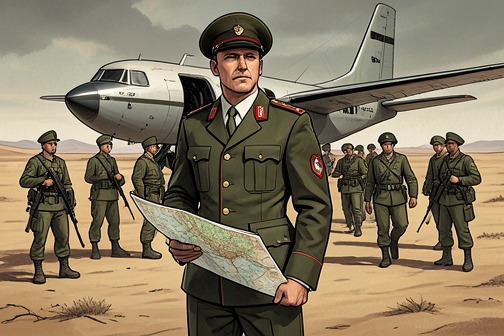
The [Airlift of Moroccan troops during the Spanish Civil War](entity:event-recall-event-5ab156e6514f) began with an improvised diplomatic mission and became an operation of decisive military assistance: on July 23, 1936, Johannes Bernhardt brought Francisco Franco’s appeal to Adolf Hitler, who ordered German transport aircraft and crews to [Spain](entity:location-recall-location-0fe76f866976). Over the following week, twenty Junkers carried about 15,000 soldiers from Morocco to Seville, converting a plea delivered by a little-known intermediary into an intervention that helped the rebellion move its forces across the water.
## Background and the mission
Before the airlift, Bernhardt’s life had been marked by failure. A thirty-nine-year-old German businessman, he had emigrated to Spain in the first half of the 1930s, then sought opportunity in the Spanish Protectorate of Morocco. His employment in a German import-export company in [Tetuán](entity:location-recall-location-f7e7d8305dc2) brought little success. He did, however, have another kind of standing: he was a veteran [Nazi Party](entity:organization-recall-organization-bddabb00303b) member, acted as the party’s representative in Tetuán, and had excellent relations with Hermann Göring.
The Spanish military uprising in Morocco on [July 17, 1936](entity:time-recall-time-1936-7-17-5077779131f1), offered Bernhardt the opening he had long lacked. He quickly contacted the rebel officers and volunteered to act as intermediary with Hitler. He was neither the only Nazi in Spain nor the only one in Spanish Morocco, but the narrative emphasizes his speed and audacity. His first crucial stroke of luck was that the Canary Islands commander was Franco. His next was that Franco agreed to meet him in Tetuán on the morning of July 23, although Franco was not yet the rebellion’s principal leader: General Emilio Mola directed it on behalf of General José Sanjurjo, the rebels’ supreme commander, who had died in an airplane accident three days earlier.
Bernhardt assembled a delegation and a means of reaching [Germany](entity:location-recall-location-a3c24dd56e42). He found an available Lufthansa aircraft and persuaded its pilot, Alfred Henke, to fly him to [Berlin](entity:location-recall-location-769cdeac2511) with Adolf Langenheim, head of the Nazi Party in the Protectorate, and Francisco Arranz Monasterio, the rebel air commander in Morocco. Before departure, the group posed for a photograph in front of the aircraft that would carry them across much of Europe. Bernhardt held an envelope and smiled: the modest-looking document in his hand was the reason for the journey.
## The journey and Hitler’s decision
The flight itself was precarious. The Junkers JU-52 left Tetuán at five in the afternoon on July 23, bound first for Seville. At Tablada airfield, Henke risked a forced landing because the runway lacked marker lights and the aircraft had engine trouble. The plane was repaired at the airfield, and the party continued to Marseille to refuel. The French demanded payment in francs, which Bernhardt and his companions could not obtain; for a time, the shortage threatened to end the mission. They found a way to continue. At Stuttgart, Henke initially refused to land on German soil, fearing punishment from Lufthansa because he had left his base without permission. From there, the final flight to Berlin was uneventful.
In Berlin, Rudolf Hess, the senior Nazi Party official there in Hitler’s absence, received the delegation. Bernhardt presented himself as its leader even though Langenheim held higher party rank. Hess supported the mission, lent them his private plane, and accompanied them to [Munich](entity:location-recall-location-d277927d86b1). A car then took the party to [Wahnfried](entity:location-recall-location-480b6fa736f9), where they arrived on the evening of July 25. Hitler was listening to Wagner from the box of his friend [Winifred Wagner](entity:character-recall-character-winifred-wagner-b9af347753e8), who had arranged a small reception for the visitors.
Hitler was more interested in Bernhardt’s letter than in the reception. Written by Franco himself, the handwritten appeal occupied less than half a page and left room for a translation. Bernhardt had taken the trouble to copy it, but never translated it into German in writing. At the moment that the narrative presents as the height of his life, he read Franco’s words directly in his native language. With the letter he delivered a hand-drawn sketch of the military situation, also made by Franco. Hitler was impressed and kept both documents.
The next day, Hitler ordered that not ten but twenty transport aircraft be sent to Spain, complete with their crews and as much war materiel as they could carry. This decision transformed the purpose of Bernhardt’s risky flight into a concrete military operation. The request had reached Hitler through personal mediation, but its consequences were measured not in the small envelope’s size or the meeting’s ceremony, but in aircraft and troops.
## The airlift and its consequences
Over the following week, the twenty German Junkers transported approximately 15,000 soldiers from Morocco to Seville. The scale of the movement gives the airlift its defining significance: it provided the rebel forces a way to move troops from Morocco to the Peninsula when, as Franco’s appeal explained, rapid transport by sea was severely obstructed by the Spanish Navy’s lack of loyalty. The novel makes this chain of events sharply visible, from the improvised flight and the letter that Franco entrusted to Bernhardt to Hitler’s order and the arrival of the soldiers.
The account also distinguishes the airlift’s immediate military effect from the longer political relationship it established. Franco never forgot Bernhardt’s service. The man who had begun as an unsuccessful businessman in Tetuán emerged from the mission with a powerful connection to the rebel leader, while Hitler’s decision placed German transport capacity and matériel at the rebels’ disposal. The airlift is thus both an operation of troop movement and a turning point in Bernhardt’s fortunes: a daring act of intermediation tied his personal rise to the rebel cause.
## Narrative significance
The episode is presented through a sequence of reversals. Bernhardt’s career had offered little promise; suddenly, the uprising created an opportunity. Each apparent obstacle on the route—an unlit runway, engine failure, an inability to pay for fuel, and Henke’s fear of landing in Germany—threatened to stop the journey, yet the party reached Hitler. The story’s emphasis on luck does not erase Bernhardt’s initiative: he sought out the rebels, offered himself as their intermediary, assembled the party, and carried Franco’s appeal to its intended recipient.
The juxtaposition of small objects and large consequences gives the episode its narrative force. A short handwritten letter and a rough sketch travel in an envelope, yet lead to an order for twenty aircraft, their crews, and military supplies. A photograph of the travelers before takeoff preserves the mission at its tentative beginning; the subsequent movement of about 15,000 soldiers records what that beginning set in motion. The ending looks beyond Bernhardt’s personal success to the bond formed by the favor: Franco would remember who had helped him, and the airlift made that act of service consequential to the course of the rebellion.
Event 4
Siege and bombing of Madrid
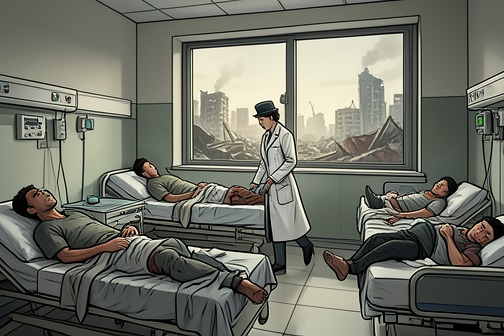
The [Siege and bombing of Madrid](entity:event-recall-event-370b8785a588) is the novel’s defining experience of urban war: sustained bombardment overwhelms medical care, drives families from their homes, and makes survival depend on hurried acts of treatment and solidarity. The siege is seen not from a distant military map but from the hospital ward, the refugee column, and streets where the apparent quiet of one district conceals the destruction of another.
## Bombardment and the overwhelmed hospitals
On 19 November 1936, the narrator recalls that the slaughter had begun three days earlier. A German five-hundred-kilogram bomb struck Puerta del Sol and tore open the street, exposing metro rails strewn with bodies. The bombing continued by day and night. At two in the morning on the nineteenth, the narrator had been confined for nearly forty-two hours in [Hospital de San Carlos](entity:location-recall-location-c9001bda2f25), with only a short spell of sleep on a guardroom cot and many litres of coffee to sustain him.
The hospital’s work had become an uncountable succession of amputations, sutured wounds, and decisions between patients whose injuries could or could not be survived. The narrator describes having to choose which of two shattered bodies might live and which had no hope; by the end, even the effort to lower his voice before giving such a verdict had fallen away. His filthy, blood-soaked coat embodied the cost of that work, stained by the blood of many different people rather than by one identifiable casualty.
The strain did not end when he left the ward. He was so exhausted that he could no longer register his own fatigue, yet sleep did not come. His senses seemed unnaturally heightened, while the world moved both slowly and frantically around the continuing influx of wounded people. Some cried out; others lay silent with their eyes wide open. The stillness of those who seemed to anticipate death stayed with him as one of the worst sights of the bombardment.
## Emergency transport and a city divided
The collapse of ordinary services extended beyond the hospital. When the narrator was finally ordered home, the porter Bernabé explained that the city had commandeered taxis because ambulances could not keep up and hearses were even scarcer. Vehicles shuttled between the wounded and the dead; at the cemetery, workers had begun digging mass graves because there were too many bodies to bury properly. Bernabé stopped a taxi that was heading to the hospital morgue and persuaded its driver to take the exhausted doctor to Hermosilla Street instead. The driver refused payment and asked only that, if the narrator found him on a stretcher the next day, he should treat him well.
The journey revealed the unequal geography of the attack. In the early hours, the narrator saw an apparently ordinary, empty street, with distant detonations and flashes over other parts of the city. He did not yet know that Condor Legion pilots had been instructed not to bomb [Salamanca](entity:location-recall-location-2bf64b0b8b8f), where the city’s wealthiest families lived. That protected area included the home of his grandfather, Guillermo, whose respectable public position as a police commissioner coexisted with concealed income from a secret literary career. The contrast between the devastated districts and the seemingly intact streets of Salamanca makes the city’s exposure to war a matter of both military violence and social privilege.
## Refugees and medical solidarity
The road beyond Moncloa showed what bombardment had done to the people driven out of their homes. On the way toward the [Hospital de Sangre de Aravaca](entity:location-recall-location-29fc8bd9a357), the narrator travelled in a truck with Canadian volunteers wearing the blue overalls of the militia beneath their winter clothes, a public sign of their commitment to the Republic. Past the city’s familiar streets, the road to A Coruña had become a stretch of smoking rubble where houses and garden cafés had been reduced to ruins.
Two slow-moving lines of refugees filled the roadside. People wore as many layers of clothing as they could manage and carried the rest in baskets, suitcases, sacks, and mattresses balanced on men’s backs. Children clung to their mothers’ skirts, while the women carried still smaller children in their arms. The narrator had seen displaced people gradually occupy [Madrid](entity:location-recall-location-madrid-8acd4123f416)’s doorways, courtyards, benches, and pavements, but the procession beside the ruined road changed his perception: from above, he imagined, it would look like ants laboriously carrying crumbs scattered over grass. At Aravaca, a line of the dying bordered the rear courtyard; after seeing the refugees, he resolved to save one soldier from a family like theirs.
The city’s response also included an organized effort to make blood available beyond the immediate donor. Volunteers gave half a litre after confirming they had fasted. Their blood went into bottles containing sodium citrate, each labelled with the blood group, date of extraction, and donor’s identity. Donors received a drink of brandy and a food voucher; later, as the siege tightened and living conditions worsened, each donation brought a tin of beef. Within a little over three days, the bottles filled the largest refrigerator available, while donors continued to queue each morning on Príncipe de Vergara Street. The effort joined experimental medical logistics to practical civilian aid: stored blood was prepared for use where wounded soldiers needed it, while food helped donors endure conditions in the besieged city.
## Hidden violence and the afterlife of the siege
The novel places the bombardment within a broader account of violence that does not end with the immediate assault on Madrid. In one episode, soldiers mistake an injured man for a corpse and carry him to the infirmary. A commander discovers papers identifying him as Rafael Cuesta Sánchez and receives telephone instructions from a police commissioner: if Rafael is dead, he must be buried as an unknown person without registration; if alive, he must be kept out of any hospital under his own name because someone may try to kill him again. The commander is told that the man is vital to the Republic’s interests, but receives no fuller explanation. The episode shows how wartime injury can lead into secret custody and concealed identity, with survival dependent on suppressing the official record.
The novel’s later account of the unidentified dead gives that logic an aftermath. In a subsequent Madrid case, an inspector arranges for a body with a fatal gunshot wound to the neck to be recorded as a routine death and buried without an autopsy. At [La Almudena Cemetery](entity:location-recall-location-ec9d8210f724), the corpse is assigned to a common grave for undocumented people, many of whom have been given the same vague cause of death: cardiac arrest. The gravediggers notice the bullet wound, but the institutional paperwork has already converted violence into an innocuous category. The contrast with the earlier mass graves is sharp: the city’s overwhelmed burial system is followed by a more deliberate apparatus for hiding how particular people died.
The account also sets Madrid’s wartime and postwar practices beside the systematic state terror of [Argentina](entity:location-recall-location-27e2c37f5c3d)’s later dictatorship. It describes the 1975 [Operativo Independencia](entity:event-recall-event-779bd0b4e451) as a campaign whose declared military purpose enabled repression across five military zones, extending to civilians including teachers, students, intellectuals, artists, scientists, and religious people. From 1976 to 1982, the dictatorship forcibly disappeared thousands; estimates place the number of victims at around thirty thousand. Clandestine task groups divided the work of abduction, secret detention, torture, execution, disposal of bodies, and the removal and reassignment of babies born to imprisoned women. The so-called death flights carried living, drugged prisoners out to sea and dropped them from aircraft. The comparison does not make these histories identical: it traces how state violence can move from visible mass death toward secret operations that erase both bodies and identities.
## Meaning of the siege
The siege is rendered through competing forms of visibility. A bomb exposes bodies and the metro tracks beneath Puerta del Sol; the hospital forces the doctor to make decisions he can no longer soften; refugees display, in their clothes and burdens, the homes they have lost. Yet the protected Salamanca district looks almost untouched, and later records can make a bullet wound disappear behind a routine cause of death. War is therefore not simply a spectacle of destruction. It also produces boundaries around who is sheltered, who must flee, who receives scarce medical attention, and whose death can be publicly acknowledged.
Against those divisions, the blood-donation effort and the driver’s unasked-for ride offer limited but concrete forms of mutual aid. They do not stop the bombs or restore the city’s ordinary services, but they preserve possibilities of life: stored blood can reach the wounded, a doctor can get home, and a donor’s contribution can be accompanied by food when hunger intensifies. The novel’s account of Madrid holds these acts beside mass graves and concealed deaths, insisting that care and violence operate in the same besieged city, sometimes within the same journey.
Event 5
Sanjurjo coup attempt

The [Sanjurjo coup attempt](entity:event-recall-event-f6549c72ebba), known as the Sanjurjada, serves as a historical hinge in the novel: its failure does not end the political danger, but it changes the perspective of [Manuel Arroyo](entity:character-recall-character-3296d1a401b2), who begins to look past diplomatic spectacle toward the ordinary world in which political loyalties and threats take shape.
## The Coup as a Turning Point
In December 1932, four months after General Sanjurjo’s failed coup, Manuel was already weary of cocktails, champagne fountains, elegant women, valuable jewelry, and powerful men. The attempted military seizure of power forms the explicit temporal marker for his disillusionment. What had once seemed like the reward for his hard-won education and his work abroad had become a repetitive social circuit, one that left him bored rather than impressed.
The shift is not presented as a sudden conversion to a new political doctrine. Instead, the failed coup supplies the date against which the novel measures a change in attention: Manuel has discovered that life in [Geneva](entity:location-recall-location-634fbb9f6bb2) exists beyond the League of Nations and its diplomatic world, even if that life is small, provincial, and unglamorous.
## Manuel’s Alternative to Diplomatic Society
In his free time, Manuel rows on the lake, takes long walks with his dog, plays chess in a tavern with excellent beer, or escapes to the mountains. These modest diversions matter by contrast with the receptions he is expected to attend. He would gladly exchange the grander social world for these ordinary pursuits, suggesting that the attractions of status and spectacle have lost their hold on him.
The novel also complicates any simple withdrawal from politics. At a Washington delegation’s [Christmas](entity:time-recall-time-0cffe7da2c4d) party, Manuel attends despite his boredom, intending to detect possible enemies of the Republic and strengthen his ties with American personnel. He achieves both purposes at once. The failed coup’s place in his recollection thus connects weariness with continued vigilance: his dissatisfaction with diplomatic life does not mean that he has abandoned the work or loyalties that brought him there.
## Significance in the Novel
The coup attempt is recalled here less as a detailed account of military action than as a marker in Manuel’s political and personal timeline. Its failure precedes his rejection of diplomatic glamour and sharpens the contrast between public ceremony and the quieter life he seeks. Yet the Washington party shows that he remains alert to the Republic’s enemies and attentive to international relationships. The episode establishes a recurring tension in his story: a desire to escape hollow performance coexists with the need to keep acting within political institutions and networks.
Event 6
Establishment of the Second Spanish Republic
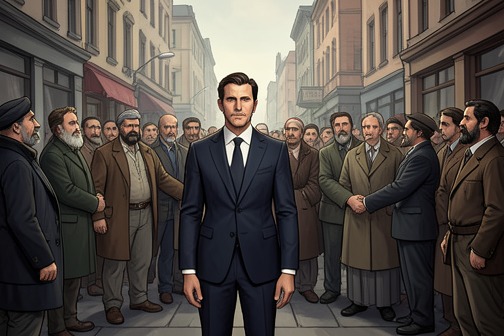
The [Establishment of the Second Spanish Republic](entity:event-recall-event-c792693d43c9) marks the hopeful turning point remembered as the “year of miracles,” but the novel places that promise against a later landscape of war, forged identities, and compromised survival. In the narrator’s private chronology, the Republic’s arrival is both a political event and the beginning of a life whose apparent freedoms and transformations cannot protect anyone from what follows.
## A private year of miracles
The narrator links the Republic’s arrival to the expectation his grandfather had invested in the new year. After welcoming 1931 with grapes, his grandfather raised a solemn toast to the year of the miracle. On 14 April, the Republic seemed to grant the miracle he had awaited. The public change is remembered through its intimate consequences: by then the narrator was the only one among his friends who had not lost his virginity, and the sexual adventures he describes later that spring made the year feel miraculous in a very different, private sense.
The recollection is deliberately double-edged. The narrator concludes that night that this was a miracle, not the Republic, turning a national political transformation into a measure of his own coming-of-age. His account does not deny the event’s importance; it shows how a historical rupture enters ordinary life unevenly, through expectations, friendships, and experiences that have no grand political form.
## Retrospective distance and rupture
The episode is told from a later moment, when the narrator looks back from the period in which he finds Amparo hidden in a service-room wardrobe. By then, he says, [Spain](entity:location-recall-location-0fe76f866976) had changed so much since 1931 that no one would have recognized it, and neither would he. The Republic’s establishment thus becomes the starting point against which the scale of subsequent transformation can be felt: the young man who thought a little theater was enough for him is not the same person who has lived through the war.
This contrast is sharpened by the narrator’s own hindsight. His early sexual inexperience seems remote from the identities and decisions that define his later life. The remembered year of miracles does not lead smoothly toward political progress; it opens a story in which private change and national upheaval coexist, while the meaning of each is revised by what comes afterward.
## From republican promise to assumed identity
The later history makes that reversal concrete. In 1937, [Manuel Arroyo](entity:character-recall-character-3296d1a401b2) Benítez arrived in [Madrid](entity:location-recall-location-madrid-8acd4123f416) using papers issued through the Republic’s security apparatus, but the identity they created was fictitious: Rafael Cuesta Sánchez, a government official with an invented personal and political record. Manuel’s identity was the first of many he would use. The document offered practical protection, yet it also made a person legible to the authorities as someone he was not.
Manuel later gave [Guillermo García Medina](entity:character-recall-character-guillermo-garc-a-me-d52c3f18d2cc) that same assumed identity, with a rewritten biography suited to survival under the victorious Nationalist administration. Guillermo’s papers described a twenty-five-year-old Madrileño who had never belonged to a left-wing party or union. At the police station, the guard saw the document and directed him to the counter for exchanging documents from the Nationalist zone. The ease of that recognition stood against the defeated Madrileños crowded in the other lines, people who had endured years of shortages, bombing, and despair alongside him. The promise of civic belonging associated with the Republic had given way to an administrative order in which a convincing document could separate safety from exposure.
## The event’s afterlife
The novel also sets identity papers within a wider system of concealment and escape. In Clara Stauffer’s house at Galileo 14, fugitives received food, clothes, and assistance; forged or newly obtained records helped them disappear into ordinary institutions. [Jan Schmitt](entity:character-recall-character-jan-schmitt-75ecceb3a91a), a war criminal, became [Johannes Grunwald](entity:character-recall-character-johannes-grunwald-66050772a6e7) through a registration certificate that enabled him to obtain a municipal police job. Later, Adrián Gallardo lived under yet another name, José Pacheco Hernández, while people around him continued to call him Adrián. These histories differ in purpose and culpability, but all show how official identity could be manufactured, concealed, or repurposed.
Against those later uses of documentation, the Republic’s arrival remains a remembered promise rather than a guarantee of lasting liberation. The narrator’s retrospective account moves from the brightness of 14 April 1931 to the long aftermath of defeat, when even the distinction between one’s real name and an assumed one could determine how a life continued. The event matters not as a self-sufficient triumph, but as the first point in a history whose hopes are tested by war and whose consequences persist in the documents people carry.
Event 7
Execution of José Antonio Primo de Rivera
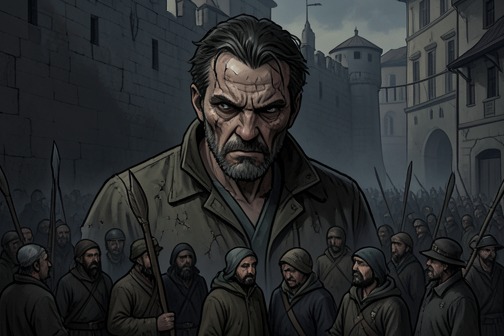
The [Execution of José Antonio Primo de Rivera](entity:event-recall-event-f8a657b33958), founder of the [Falange](entity:organization-recall-organization-falange-0b58ca81d6eb), is a decisive fact in the political history remembered by the novel: his execution in [Alicante](entity:location-recall-location-4001589f2261) prison on 20 November 1936 turns him into the Falange’s “Great Absent One” and a martyr of the Crusade. The event also stands beside later scenes in which the dead are buried without names or records, exposing how political power can shape not only who lives and dies but whether a death is publicly acknowledged.
## Identity and Political Legacy
José Antonio Primo de Rivera was the younger brother of [Pilar](entity:character-recall-character-pilar-8a2ad262e179) Primo de Rivera, who became the Falange’s first, last, and only National Chief. The novel links his family status to the movement’s posthumous political language: after his execution in Alicante prison, he is elevated as a martyr of the Crusade and remembered as the “Great Absent One.” His death thus becomes more than a biographical endpoint; it supplies a potent symbol for the organization and its followers.
That legacy appears in the account of the Falange’s women’s organization. Its National Chief, Pilar Primo de Rivera, is described both through her place in the Primo de Rivera family and through her relationship to her executed brother. The juxtaposition shows how the movement’s leadership and memory are bound to family lineage, political martyrdom, and the public construction of a dead founder.
## Death and the Concealment of Identity
The book’s later episodes echo the execution’s political significance through a different kind of death: a wounded man found with a credential from the Public Order Council of the Defense Junta must not be entered into any hospital under his own name. A police commissioner instructs the military commander to save him if he is alive, or to bury him as an unknown person if he is dead, without registering the body. The explanation is withheld; the man is described only as vital to the Republic’s interests. In this scene, concealment is not merely a consequence of death but an order imposed in advance, designed to prevent another attempt on the man’s life and obscure his identity from those seeking him.
The same logic becomes starkly visible when the narrator returns to his home after [Madrid](entity:location-recall-location-madrid-8acd4123f416)’s defeat. The house has been ransacked and the gold stolen, while family papers lie scattered under the footprints of those who searched it. Amid the destruction, he checks that a sealed envelope left by Manolo remains untouched. The episode places the protection of documents beside the erasure of people: papers can preserve a hidden history, while authorities and armed forces can strip a dead or endangered person of a name and a public trace.
## Burial, Bureaucracy, and State Violence
A later account of a body recovered from [Casa de Campo](entity:location-recall-location-b8c44b15fb99) shows how official procedure can disguise violence. The coroner records death in the afternoon of 29 December and agrees that the autopsy can be skipped; the only injury is a fatal gunshot to the neck. The police report is attached to the death certificate, and the inspector’s superior assures him that he will handle the rest of the paperwork. By the next day, the body has already been buried. The inspector reflects that nothing makes police work easier than a good dictatorship.
At La Almudena, the corpse is assigned to a common grave for unidentified people. The cemetery official notes that, across the preceding decade, many people in Madrid had supposedly died from the same cause: cardiorespiratory arrest, with no further details. The grave workers see the bullet wound in the dead man’s neck, but the official explanation has already reduced him to an anonymous body and a routine cause of death. Their attention then turns to the dead man’s new-looking coat, which they decide to take and gamble over. The mundane theft sharpens the scene’s indictment: the machinery of concealment has made a killing administratively ordinary, and even the corpse becomes an occasion for casual exploitation.
## From Political Martyrdom to Disappearance
The book also sets Spanish wartime and postwar concealment against [Argentina](entity:location-recall-location-27e2c37f5c3d)’s later state terror. It describes the [Operativo Independencia](entity:event-recall-event-779bd0b4e451), launched under María Estela Martínez de Perón’s decree of 5 February 1975, as an intervention nominally directed at guerrillas in Tucumán but used to divide the country into five military zones and give their commanders sweeping authority. General Acdel Vilas framed its objective as cultural as well as military; the resulting terror struck civilians, including teachers, students, intellectuals, artists, scientists, and religious figures. The account presents this campaign as a prelude to the more systematic repression of the Argentine military dictatorship.
Between the spring of 1976 and the autumn of 1982, that dictatorship forcibly disappeared thousands of people; the estimated toll is about 30,000, although many bodies were never recovered. Its clandestine apparatus divided repression into specialized tasks: abduction, secret detention, torture, execution, disposal of bodies, and the removal and reassignment of children born to detained women. In the “death flights,” living prisoners were drugged, bound, and thrown from military aircraft into the sea. These practices extend the novel’s concern from the posthumous elevation of José Antonio Primo de Rivera to the destruction of identity and evidence: political violence can turn a person into a martyr, an unregistered corpse, or someone whose disappearance leaves no body to bury.
Event 8
First successful refrigerated-blood transfusion in Madrid
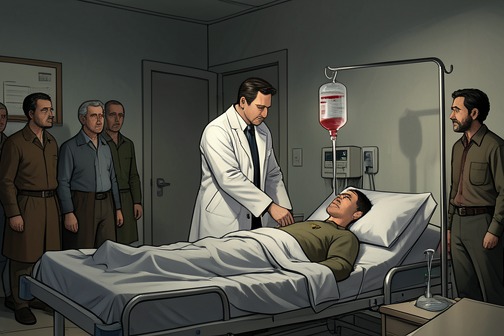
On [23 December 1936](entity:time-recall-time-1936-12-23-af9e81b7bd0d), at the Hospital de Sangre de la [Casa de Campo](entity:location-recall-location-b8c44b15fb99), [Norman Bethune](entity:character-recall-character-norman-bethune-ec3ec1d82b27) performed the first successful refrigerated-blood transfusion in [Madrid](entity:location-recall-location-madrid-8acd4123f416), reviving a soldier whom the hospital doctor had given up for dead. The breakthrough made transfusion portable: stored blood could reach the wounded at the front without requiring a donor to be physically connected to the recipient. In the novel, the clinical demonstration becomes a scene of shared survival, with the unnamed soldier’s return to life answered by the joy of those around him and, finally, by his own cry of “¡Viva yo!”
## Preparation and the front-line trial
The transfusion was the culmination of an organized blood-donation effort. Volunteers gave half a litre of blood for the Republic; each donation was put into a bottle with a small amount of sodium citrate and labeled with the blood group, date of extraction, and donor’s identity. The Institute’s collection quickly outgrew the largest available refrigerator. Donors still queued each morning on the even-numbered side of Príncipe de Vergara Street, while Bethune acknowledged uncertainty about how long citrated blood would remain usable in cold storage. The supply was not an abstract reserve: it was blood collected, identified, chilled, and prepared for use where the fighting made immediate treatment difficult.
Early on 23 December, Bethune’s team filled portable equipment with bottles representing all blood groups, loaded their packs into a truck, and drove to the Hospital de Sangre de la Casa de Campo, close to the front. There Bethune examined soldiers lying on the floor, many of them considered beyond help. He chose a young man suffering from hypovolemic shock after a massive loss of blood. The Spanish doctor responsible for the patient regarded him as a lost cause, as he had regarded others who had arrived in similar condition.
## The transfusion and its immediate result
The patient’s breathing was weak; his skin was pale, damp, and cold, stretched over sunken cheeks, and his lips had no color. Bethune could not speak Spanish, so his interpreter asked the hospital director for permission to let the Canadian doctor try to revive the soldier. The director’s skepticism did not prevent him from authorizing the attempt: he expected the patient to die regardless and stayed to watch.
Bethune pricked the soldier’s finger and collected a sample on a glass rod. After two minutes, once he had identified the blood group, he inserted a needle and began transfusing the first bottle. The soldier moved and opened his eyes, but Bethune judged that one bottle was not enough after so much blood loss and gave him a second. Before the transfusion was fully over, the patient looked at Bethune and smiled. What the hospital staff had treated as an inevitable death had turned into a recovery unfolding before them.
## A portable technique and its reach
Bethune’s success established, in the novel’s account, the first occasion on which refrigerated stored blood brought a hopelessly wounded patient back to life. The practical change was as decisive as the immediate rescue. Transfusion no longer depended on bringing a donor to the bedside and connecting donor and recipient with two needles and a length of tubing. Blood could be collected in advance, preserved, transported, and administered where it was needed—a method described as making transfusions easier, more convenient, practical, and effective.
The scene also emphasizes that the first rescue was not an isolated demonstration. That same morning at the Casa de Campo hospital, Bethune’s intervention revived twelve soldiers. The method would save thousands of soldiers in the People’s Army of the Republic during the [Spanish Civil War](entity:event-recall-event-spanish-civil-war-dafa813888d4); beyond the war, its beneficiaries would number in the millions. The passage links those later consequences to a specific gift to besieged Madrid: a Canadian, communist, internationalist doctor brought a new form of medical support to the people resisting there.
## The unnamed survivor and the scene’s meaning
The first survivor’s name is never established. His anonymity keeps the moment from belonging to a single celebrated patient, while the details of his return give it a sharply individual human scale. His comrades put a lit cigarette in his mouth before anything else. He draws on it eagerly as unexpected joy and hope spread through the bleak field hospital. The response grows into cheers for Canada, Bethune, the Republic, working-class struggle, and international solidarity.
Then the revived soldier makes his own contribution, shouting “¡Viva yo!” Bethune does not understand the words, but recognizes the moment as a source of happiness. The line’s humor does not diminish the danger he has just escaped; it makes survival audible as the survivor’s own claim. The transfusion changes the scene’s governing fact from impending death to returned life, and the patient is not merely the object of a medical achievement: he asserts himself within its public celebration.
## Echoes beyond the hospital
The transfusion’s significance persists in the novel through objects and family memory. Years later, a folder recovered from a hidden compartment contains the narrator’s medical degree, a union card, and a photograph of him posing with Bethune for the cover of El Heraldo. The photograph places the doctor and the Canadian side by side in the history of the transfusion effort, while the degree recalls the narrator’s medical work within a wartime landscape shaped by rescue and loss.
The episode also echoes indirectly through the narrator’s concealed relationship with his son. The boy grows up under the name José Antonio Urbieta, believing that the young Falangist in a prominent portrait is his father, a hero who died in [Russia](entity:location-recall-location-e36341713c23). As a child, he is treated during a serious illness by the doctor who visits him and teaches him chess; only much later does he connect that doctor to the hidden family documents and recognize him as his father. These later events are not part of the hospital operation, but they return the medical figure to the novel’s central pattern: acts of care can preserve life and establish bonds even when identity, history, and kinship remain obscured. The first transfusion thus stands both as a concrete medical turning point and as an early instance of the book’s wider concern with what rescue leaves behind.
Event 9
Canadian Blood Transfusion Institute blood-donation drive in Madrid
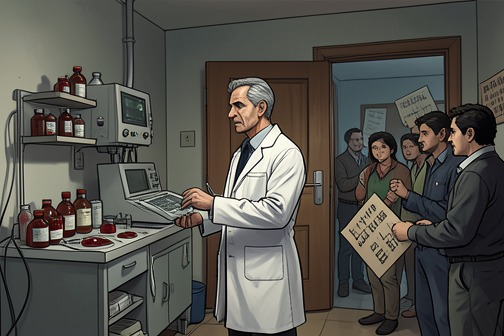
The [Canadian Blood Transfusion Institute blood-donation drive in Madrid](entity:event-recall-event-2a7d4e715176) brought together [Norman Bethune](entity:character-recall-character-norman-bethune-ec3ec1d82b27)’s portable transfusion system and an extraordinary response from civilians in a besieged capital. Beginning days after Bethune’s arrival in December 1936, the drive collected and refrigerated donated blood for delivery to wounded Republican soldiers. It was more than a campaign of public generosity: it made stored blood and mobile transfusion units available at the front, and its work continued after Bethune departed for other fronts.
## Arrival and establishment
Bethune reached [Madrid](entity:location-recall-location-madrid-8acd4123f416) on 14 December 1936, after weeks of arrangements with the Canadian government and fundraising that extended from government offices to popular collections. His journey had taken him across the Atlantic, overland through [France](entity:location-recall-location-4f282e1af8a7), and along a difficult route through a [Spain](entity:location-recall-location-0fe76f866976) divided by war. At Príncipe de Vergara 36, the Institute’s quarters became the operational base for a project that joined Canadian medical aid to the Republic’s immediate wartime needs.
The authorities housed Bethune and his collaborators in a fifteen-room apartment formerly occupied by a German diplomat who had stayed away after the military uprising. The [International Red Aid](entity:organization-recall-organization-c98c5b5bf961) headquarters occupied the floor above. Within hours, the team removed furniture, paintings, and rugs to make room for a laboratory equipped with an Electrolux refrigerator, a large autoclave, sterilizers, and shelves of bottles, blood containers, syringes, microscopes, and surgical instruments. Among the equipment was a set of fifteen portable packs, each supplied with additional bottles, saline and glucose solutions, and a sterilized box containing basic instruments and sutures. The unfamiliar apparatus filled rooms once furnished as a diplomat’s home; the arrangement made Madrid the site of a medical system with no precedent anywhere in the world at that time.
## Recruiting donors and storing blood
The Institute began its appeal the day after Bethune arrived. Newspaper advertisements and radio broadcasts over three days invited volunteers to donate blood for soldiers at the front. The request was a departure from direct, arm-to-arm transfusions, the only method then available. Bethune’s team hoped to collect and store blood for later use, but they did not know how the public would respond or how long citrated blood would remain usable in refrigeration. Their appeal came from a new institute rather than an established hospital, making the scale of the response uncertain.
On the morning of 19 December, before the Institute had opened, Bethune looked down from the balcony and saw a queue that already stretched around the corner. People of different ages and occupations, civilians and soldiers, had come to give blood; women consistently outnumbered men on the treatment couches. The turnout answered the organizers’ uncertainty with immediate, visible commitment. Although Bethune could not speak the language of many patients who would fill the rooms, he began to feel at home in the city whose residents had taken up the call.
Donors had been repeatedly instructed to arrive fasting. Each gave half a litre of blood, which flowed into a bottle containing a small amount of sodium citrate. Once full, the bottle was labelled with the blood group, date of extraction, and donor’s identity. Donors received a voucher to buy food and were invited to take a drink from a bottle of brandy kept for the occasion. As the siege tightened and living conditions worsened, each donation could also earn a tin of beef. The exchange connected a technically organized medical effort to the material pressures of wartime Madrid without diminishing the significance of the blood freely given.
In little more than three days, donations filled the largest refrigerator then available, while the queue continued to form each morning on the even-numbered side of Príncipe de Vergara Street. Bethune reported his uncertainty about how many weeks the citrated blood would remain in good condition in the refrigerator. The stocked bottles were not simply a reserve: they were the essential supply for the mobile equipment the Institute was preparing to take to the front.
## From collection to the front
On [23 December 1936](entity:time-recall-time-1936-12-23-af9e81b7bd0d), Bethune’s team filled the portable-unit bottles with blood of all groups, loaded the packs into a truck, and drove to the Hospital de Sangre de la [Casa de Campo](entity:location-recall-location-b8c44b15fb99). At the front, Bethune examined soldiers who were dying on the floor and chose a young man suffering from hypovolemic shock after massive blood loss. The Spanish doctor treating him considered the case hopeless. A translator explained that the bald Canadian, who spoke no Spanish, wanted permission to try to revive the soldier. The hospital director authorized the attempt skeptically, remaining to watch because he expected the patient to die regardless.
The drive’s purpose thus extended beyond assembling a stock of blood in Madrid. It created a means to move that stock, with the instruments and fluids needed for transfusion, directly to front-line casualties. Its practical force depended on the whole chain: volunteer recruitment, blood grouping and labelling, preservation in a refrigerator, portable equipment, and a truck journey to a hospital near the fighting. The evidence establishes the effort and the choice of a patient regarded as beyond recovery; its importance lies in bringing a new, organized method of transfusion into that emergency setting.
## Continuation after Bethune
Bethune’s departure did not end the Institute’s work. On 11 January, after visiting [Guillermo García Medina](entity:character-recall-character-guillermo-garc-a-me-d52c3f18d2cc) at the [Hospital de San Carlos](entity:location-recall-location-c9001bda2f25) to say goodbye, Bethune asked him to take charge of the mobile service. Bethune planned to tour other fronts with his team, while Spanish personnel would keep the Institute operating in Madrid. The request passed responsibility from the Canadian organizer to a doctor already working in the city’s hospitals.
García Medina later described how an article in El Heraldo, together with pressure from Dr. Quintanilla, helped persuade the hospital administration to support the service. Bethune’s method was so straightforward that García Medina trained half a dozen mobile units in less than a month without leaving his hospital post. When the units began visiting the fronts around Madrid, Dr. Quintanilla appointed him head of the transfusion service established at San Carlos with a refrigerator donated by Canadians. The operation therefore persisted in two connected forms: mobile units carried transfusions toward the fighting, while the hospital maintained a fixed service and storage capacity.
The drive also left consequences beyond its medical organization. García Medina’s rescue of José Moya at Aravaca brought him repeated visits from Moya, who often arrived bearing what he could obtain: apples, cigarettes, or a tin of Russian meat. García Medina tried to stop these gifts because acquiring them cost Moya more effort than the doctor’s need warranted, but he could not stem the gratitude. The story presents such exchanges as one consequence of the rescue alongside the public attention given to the transfusion work.
## Significance
The Institute’s work linked an international mission to local participation. Bethune’s arrival depended on Canadian government arrangements and fundraising; the service then relied on Madrileños who donated blood, Spanish staff who helped run it, and hospital personnel who adopted and extended the mobile method. A transformed apartment, a refrigerator filled within days, and a line of volunteers each morning mark the transition from an ambitious plan to a working operation.
The episode’s significance also rests in continuity rather than in a single arrival or demonstration. Bethune moved on, but the Institute remained active, García Medina organized additional mobile units, and the transfusion service at San Carlos continued with Canadian-donated equipment. The drive made cooperation tangible: blood given in Madrid could be preserved, labelled, and carried toward soldiers in immediate danger, while the organization built around that process survived its founding doctor’s departure.
Event 10
First National Congress of the Spanish Falange’s Women’s Section
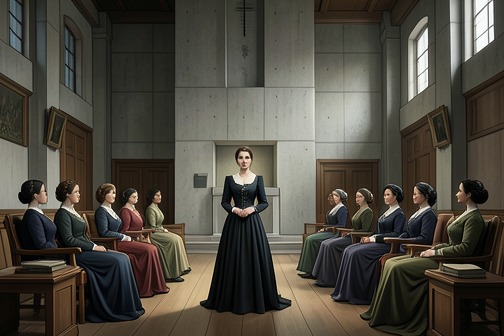
The [First National Congress of the Spanish Falange’s Women’s Section](entity:event-recall-event-215f3aa2859b), held in [Salamanca](entity:location-recall-location-2bf64b0b8b8f) on 6 January 1937, marked the transition of a women’s organization founded for limited assistance into a more influential political institution. Its public leadership placed [Pilar](entity:character-recall-character-pilar-8a2ad262e179) Primo de Rivera at the top and Marichu de la Mora in a prominent national post, but Clara Stauffer’s carefully staged retreat from office did not mean a retreat from power: she continued to shape the organization’s propaganda and became an important link between the Francoist government and the [Third Reich](entity:time-recall-time-f3c47f5ce6a4).
## Background and Political Setting
The Women’s Section had been founded in June 1934, before the Civil War, with comparatively modest, mainly charitable purposes. Its members visited imprisoned [Falange](entity:organization-recall-organization-falange-0b58ca81d6eb) supporters and accompanied their families, in keeping with Pilar Primo de Rivera’s principle that women’s role was to serve. The war changed the organization’s importance. By the time of the Salamanca congress, delegations had come from every province in the Francoist zone, and the expanded political circumstances justified a national gathering.
The congress took place while [Madrid](entity:location-recall-location-madrid-8acd4123f416) remained outside Francoist control. That absence had an institutional consequence: the Madrid leadership, headed by Pilar, was the sole provincial delegation not present. The meeting was therefore national in scope but bounded by the front lines, a wartime distinction reflected even in the publication of the Women’s Section’s official book the following year: it appeared without an imprint because Madrid was still in Republican hands.
## Leadership and the Public Arrangement
Pilar Primo de Rivera remained the organization’s first, last, and only National Chief. She was the daughter of General Miguel Primo de Rivera, who had ruled [Spain](entity:location-recall-location-0fe76f866976) as a military dictator from 1923 to 1930, and the sister of José Antonio Primo de Rivera, Falange’s founder. Executed in [Alicante](entity:location-recall-location-4001589f2261) prison in November 1936, José Antonio had been elevated by the movement to the status of a martyr of the Crusade. His family’s political standing lent the congress’s leadership a dynastic dimension.
At the congress, Marichu de la Mora appeared to be its great winner after Pilar: she held the post of National Delegate, while Stauffer placed herself in the lower-sounding position of Central Assistant for Press and Propaganda. De la Mora was also said to have been José Antonio’s only known fiancée, although the account notes that this claim rested on her own testimony and lacked corroborating evidence. The public arrangement gave de la Mora prominence, but it did not transfer the organization’s propaganda machinery to her.
## Clara Stauffer’s Influence Behind the Title
Stauffer, known affectionately as Clarita, was thirty-three in 1937. Born in Madrid in 1904 to a German father and a Madrileña mother, she had been educated in [Germany](entity:location-recall-location-a3c24dd56e42) and still held German nationality. Her foreign status did not obstruct her prominence in Spanish women’s sport, where she excelled in swimming and skiing, or her political advancement within the ultranationalist Falange. It instead helped make her useful in relations between Burgos and Nazi Germany.
Her formal demotion at the congress functioned, in effect, as a political display: she appeared to yield the National Delegate’s place to de la Mora while preserving practical control of communications. Stauffer wrote the unsigned texts and edited the signed contributions in the Women’s Section’s official book, first published in 1938 and frequently reissued in the early 1940s. Beginning in January 1937, she also contributed to the Salamanca newspaper El Adelanto as a spokesperson for Falangist women. The congress thus revealed the gap between visible rank and the work through which influence was actually exercised.
## From Congress Leadership to German Connections
Stauffer’s responsibilities extended beyond Spanish propaganda. She travelled frequently to Germany, where she used the name Klara, and acted as guide and interpreter for Falange and Francoist-government representatives through the end of the Civil War and afterward. Mercedes Sanz Bachiller, founder of [Auxilio Social](entity:organization-recall-organization-5dcee1a4e36f), and her close collaborator Carmen de Icaza travelled under Stauffer’s guidance, usually to Hamburg, to study [Nazi Party](entity:organization-recall-organization-bddabb00303b) welfare programs. The Winterhilfe, or Winter Relief, provided a model for their own organization.
Stauffer also took part in less public and sometimes secret missions. Francoist military representatives negotiated German military assistance and, in return, offered wolfram and other raw materials; Stauffer participated in this sphere of contacts as well. Her position at the congress therefore belongs to a larger pattern: a leader who could appear to step aside in the domestic hierarchy while carrying political, propaganda, and diplomatic influence across national borders.
## Significance
The congress makes visible both the gendered limits and the political reach of the Women’s Section. Its founding principle assigned women a subordinate role of service, and its leadership continued to organize authority through a hierarchy headed by Pilar. Yet wartime expansion gave the organization a national platform, while Stauffer’s authorship, editorial control, and diplomatic work show how women could exercise consequential power within that structure.
Its central reversal is the difference between office and influence. De la Mora received the prominent title; Stauffer took the lower-ranking post, but the texts, public voice, and German connections remained substantially in her hands. The congress was not merely a ceremonial debut for the Women’s Section. It was a public arrangement of authority that also concealed how that authority operated.
Event 11
Francoist victory in the Spanish Civil War
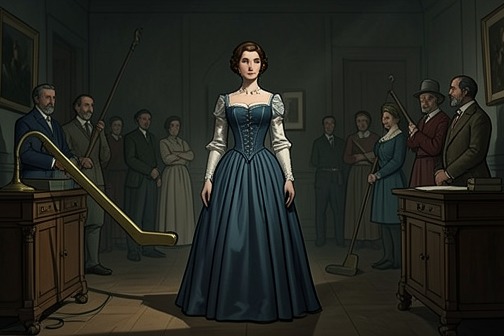
The [Francoist victory in the Spanish Civil War](entity:event-recall-event-e0568e8dc07e) is the decisive rupture behind the novel’s postwar lives: it leaves [Guillermo García Medina](entity:character-recall-character-guillermo-garc-a-me-d52c3f18d2cc) in [Madrid](entity:location-recall-location-madrid-8acd4123f416) under a false identity, turns [Manuel Arroyo](entity:character-recall-character-3296d1a401b2) Benítez’s earlier rescue into a debt repaid with forged papers, and creates a [Spain](entity:location-recall-location-0fe76f866976) in which both political fugitives and Nazi war criminals can survive through networks of concealment. Its consequences outlast the fighting by decades, shaping intimate family histories as well as the state’s control over who can be recognized, arrested, or allowed to live.
## Defeat and the New Order
The victory does not appear as a single battlefield scene in the available evidence; it is registered through what becomes possible afterward. In spring 1939, Clara Stauffer returned to Madrid and continued a double allegiance, Falangist in Spain and Nazi in [Germany](entity:location-recall-location-a3c24dd56e42). Her house at 14 Galileo Street became a meeting place for supporters of Hitler and Franco, and a conduit between the German embassy and the new government. The change of regime thus established not only a victor and a defeated population but also new channels of influence and protection.
Johannes Bernhardt, a frequent visitor to Stauffer’s home, had headed [HISMA](entity:organization-recall-organization-hisma-9ded5ff2e359), a front company used by the [Third Reich](entity:time-recall-time-f3c47f5ce6a4) to channel economic and military aid to Franco’s side during the war. After the victory, he founded [SOFINDUS](entity:organization-recall-organization-sofindus-28229415b3da) in December 1939. The consortium of German companies came to dominate Spanish foreign trade and channelled Spanish raw materials to the German army during the Second World War. Francoist victory therefore continued to shape relations between the two countries well beyond the end of the Spanish conflict.
The defeat of Hitler later tightened Stauffer and Bernhardt’s ties still further. In summer 1945, Stauffer applied for the nationality of the country where she had been born and lived since adolescence, giving up her parents’ nationality. The change of passport did not end her Falangist or Nazi commitments. In the novel’s account, political identity and practical allegiance prove more durable than official nationality.
## Papers as Instruments of Survival
For Guillermo, victory means the danger of being identified as one of the defeated. The identity papers that saved him were given by Manuel, a Republican diplomat whose life Guillermo had saved in 1937. Manuel had used the name Rafael Cuesta Sánchez himself, under documents issued by the Republican security directorate; the details were fabricated, including birthplace, employment, union affiliation, marriage, and residence. He later adapted that identity for Guillermo, making him a single man of twenty-five, with no left-wing party or union history and a recent address in [Salamanca](entity:location-recall-location-2bf64b0b8b8f). Manuel had destroyed Guillermo’s union card and prepared a document designed to pass as a Nationalist-zone identity card.
When Guillermo presented it at a Madrid police station to exchange his papers, the guard directed him to the counter for documents from the Nationalist zone. At window seven, he stood apart from the crowded lines of Madrid residents who had endured the siege, shortages, and bombardment with him. The official processed his details without much attention. Administrative routine completed the disguise: the same document that concealed a former Republican allowed its bearer to move through a system sorting people according to the new order.
The victory also supplies the setting for a different traffic in identities. By 1945, Stauffer had converted part of her home into an office, installed a new telephone line, hired secretaries, and filled new cupboards with men’s clothes and shoes in a range of sizes. Escaped prisoners and fugitives arrived exhausted, received food and clothing, and were apparently helped with lodging or work. German baptismal records were delivered in sealed parish envelopes. The house that had once brought Francoist and Nazi circles together now served as a practical node in an escape network.
The uses of false identity were not confined to the defeated Republicans or fugitives crossing into Spain. [Jan Schmitt](entity:character-recall-character-jan-schmitt-75ecceb3a91a) obtained municipal employment in Schöneberg as [Johannes Grunwald](entity:character-recall-character-johannes-grunwald-66050772a6e7) by means of a false residence certificate, then disappeared into the routine of patrolling in uniform. His new identity hid his status as a war criminal from the people he had known in [Berlin](entity:location-recall-location-769cdeac2511). The postwar world produced opposing forms of concealment, but each depended on making a fabricated identity legible to official institutions.
## A Victory Rewritten Inside the Family
Political defeat also determined what Guillermo’s family could know about itself. Years after the war, a hidden envelope yielded his Republican family book, the birth certificate of his son [Guillermo García Priego](entity:character-recall-character-guillermo-garc-a-pr-e7c1392141a0), a wedding photograph, and a brief note dated 28 March 1939 in which Amparo apologized. The documents had survived inside a leather folder concealed in a trunk. Their belated recovery made private papers an alternative archive to the official identities imposed after the victory.
The regime’s reordering of names extended into the boy’s upbringing. Amparo’s son was called José Antonio Urbieta, after the Falangist leader known as the Great Absent One, and was taught to believe that the young man in a framed photograph—a Falangist in blue shirt and belt—was his father, a hero who had died in [Russia](entity:location-recall-location-e36341713c23). Guillermo watched the boy grow from a distance, seeing him arrive with scraped knees and his shirt untucked. What had been hidden as political and familial necessity became, for the child, a public family story built around a false father.
The truth emerged through material traces and questioning. As a young man, José Antonio found his birth certificate, a Republican family book, and photographs while searching his mother’s underwear drawer for money. He had already pressed [Experta](entity:character-recall-character-experta-bd538c3c6d2e) for information and promised not to expose her. She told him that Guillermo was his father, that he was a Republican, and that he had hidden Amparo and lived with her until 1939. The boy’s discovery overturned not only an official version of his parentage but also the political meaning attached to the household’s past.
A later child named Manuel connected the two families’ histories in another way. Guillermo and Rita gave their son the name shared by their parents’ best friends. As the baby grew, his gestures and milestones recalled the son Guillermo had lost from his daily life; the new child’s survival gradually transformed that memory into a gentler nostalgia. The old separation remained present, but it no longer held the same shape.
## The Long Aftermath
In 1946, Manuel returned from exile on a secret mission to infiltrate Stauffer’s organization, while Guillermo, still living under a false identity, allowed himself to be recruited. Their renewed partnership grew out of the victory’s unresolved consequences: a Republican survivor could move within the postwar order only by working through the identity and clandestine systems that had helped him survive it. Meanwhile, the same network sheltered fugitives from European prisons and helped men evade recognition as criminals.
The friends’ first embrace came much later, at the arrivals entrance of [Barajas Airport](entity:location-recall-location-7a656fc6993f) on 30 December 1976. Guillermo’s hair had turned grey; Manuel’s was white, and Manuel was the thinner of the two. Their children did not bear their fathers’ surnames, and neither man used his real name in public, though each called the other by his authentic name. Their bodies carried scars, and Guillermo’s hands had once stitched Manuel’s wounds. The reunion brings the novel’s identity motif to its clearest human expression: the state and its aftermath had made false names instruments of survival, but the friends could still recognize one another beyond them.
## Significance
The victory’s reach is measured less by a declaration of triumph than by the systems and silences it leaves behind. Papers classify people, make fabricated lives credible, and determine who can safely pass through an office or find work. Homes and personal objects preserve what public identities erase: a family book, a photograph, a note, a name held in confidence. In this account, the postwar order can conceal both those it has defeated and those it protects; its paperwork does not simply record identity but helps produce the conditions under which people can live.
The long delay between defeat and disclosure gives the event a generational afterlife. A son grows up believing in a dead Falangist father, then discovers a Republican parent through documents hidden in a household drawer. Two old friends meet again after decades of exile, assumed names, and separation. The war’s ending, for them, is never simply over: it persists in the identities they must perform, the family histories they cannot initially tell, and the reunion made possible when those histories are finally shared.
Event 12
July 1936 Spanish coup d’état
The [July 1936 Spanish coup d’état](entity:event-recall-event-1936-7-38167d0d4e61) is the rupture that gives the novel’s wider history its force. Its consequences reach beyond the battlefield: the rebellion reshapes institutions and families, gives political organizations new power, and leaves people navigating a world where survival may depend on obedience, concealment, or flight.
## The coup and the war it unleashes
The coup places individuals inside a conflict that is neither distant nor abstract. On 19 July 1936, Teodoro Garrote joins the rebel army, the only force he considers available to him, under the traditional cry of “[Dios, Patria y Rey](entity:expression-recall-expression-dios-patria-y-rey-c20777dafb81).” He imagines that his family’s history as local military leaders will matter. Instead, the rebel command ignores his claims to an officer’s place: in Franco’s army, he is nobody until [Antonio Ochoa](entity:character-recall-character-antonio-ochoa-1e1d925155de) makes him his brigade’s boxing champion. The reversal exposes the distance between inherited ideas of honor and the modern military hierarchy created by the rebellion.
The coup also divides people who share a family or political world. Antonio Ochoa’s first symptoms of the hereditary illness that has afflicted his family emerge against the war’s anniversary, as he feels a creeping numbness descend from his shoulder into his right arm. His anger at the military’s solemn parade and mass is entangled with dread about the disease he had believed would spare him. The public commemoration of the uprising thus meets a private sense of impending loss.
## Institutions remade by force
The rebellion changes who controls civic life. At a [Madrid](entity:location-recall-location-madrid-8acd4123f416) hospital, Guillermo’s superior, Quintanilla, tells him that a committee led by Francisco Arrieta has seized the building in the name of the National Army. The committee entered without warning; its members wore blue shirts beneath their medical coats, and Arrieta carried a pistol. Quintanilla has been dispossessed of his office and belongings, and the presence of so many Falangists inside the hospital is a shock even to him. The episode makes the coup’s institutional reach tangible: a medical workplace becomes a site of political takeover.
The new order also elevates organizations whose roles expand under wartime conditions. Founded in June 1934 for modest welfare work, the Women’s Section of the [Falange](entity:organization-recall-organization-falange-0b58ca81d6eb) becomes important enough to convene its first National Congress in [Salamanca](entity:location-recall-location-2bf64b0b8b8f) on 6 January 1937, with delegates from the provinces held by the Francoist side. Its leadership is concentrated in [Pilar](entity:character-recall-character-pilar-8a2ad262e179) Primo de Rivera, Marichu de la Mora, and Clara Stauffer, who serves as Delegate for Press and Propaganda. The growth of the organization illustrates how the war enlarges the political influence of groups that had previously been confined to narrower functions.
## War’s afterlife in private life
The coup’s consequences continue well beyond the fighting. Agneta’s political ambitions and her mother’s expectations are shaped by the Nazi system’s gendered demands: Agneta hopes her work in the BDM will take her into its leadership, while her mother expects her to leave the movement for marriage and motherhood. After an accident leaves [Beate Müller](entity:character-recall-character-beate-m-ller-9a48ef4b2a13) dependent on two crutches at home and a wheelchair outside, she makes Agneta her nurse and servant. Agneta’s absences damage her standing in the organization, and she yields to her mother’s demands. The conflict shows how political commitment and domestic care can become competing forms of duty, with the burden falling on a daughter whose ambitions are constrained by her mother’s dependence.
In the aftermath of [Germany](entity:location-recall-location-a3c24dd56e42)’s defeat, the same political loyalties reappear as clandestine protection. Agneta hides [Jan Schmitt](entity:character-recall-character-jan-schmitt-75ecceb3a91a), believing him to be an ordinary soldier with no criminal responsibility; she has never heard of [Klooga](entity:location-recall-location-klooga-b8e6411e3c62). Her father agrees to help on the condition that this is true, and her mother supports the decision because sheltering a fugitive offers her one last way to serve the Reich she had loved. Jan repays the family’s aid by repairing their home, though his work is rough and his efforts to find employment are hampered by his lack of documents. The episode extends the coup’s political history into private rooms, where allegiance, ignorance, and practical need shape what people are willing to do.
## From rebellion to impunity
The novel connects the coup’s victory to a postwar system that protects people implicated in Nazi crimes. In the 1947 Allied List of 104, Clara Stauffer is the sole woman named. The Allied account identifies her as a principal organizer of a secret aid association, involved in supplying false documents and finding work for Germans; it says she received a special German Embassy permit to obtain Spanish nationality after the war so she could continue those activities. Her address is given as [14 Calle Galileo](entity:location-recall-location-14-021d84809dfc) in Madrid. The list’s specific accusation places the organization’s work within the larger problem of how a state can shield fugitives from accountability.
That protection is shown not as an isolated exception but as a method. Spanish authorities delay responding to Allied demands and produce documents to claim that listed Germans are already Spanish citizens, are protected for their services to the Francoist army, or cannot be found. The narrator describes retroactive naturalization paired with authentic documents for false identities as a procedure used for decades to protect Nazis seeking refuge in [Spain](entity:location-recall-location-0fe76f866976) or passage onward. The political order born of the coup thus survives in a postwar form: international pressure meets bureaucratic obstruction, while political advantage takes precedence over extradition.
The same networks cross borders. Clara Stauffer’s Madrid organization collaborates with [Die Spinne](entity:organization-recall-organization-die-spinne-9184ac79210d), founded by [Otto](entity:character-recall-character-9f54aedde4b4) Skorzeny, and both help fugitives reach [South America](entity:location-recall-location-93067fb0ae2c), where [Argentina](entity:location-recall-location-27e2c37f5c3d) offers them refuge. The account distinguishes these real escape networks from the reputedly all-powerful [ODESSA](entity:organization-recall-organization-odessa-c706862dc8c9), whose existence scholars reject, while noting that the Stauffer organization and its [Vatican](entity:location-recall-location-416dda4866db)-linked counterpart were effective enough to resemble the popular myth. The coup’s significance therefore lies not only in the immediate military seizure of power but in the durable political arrangements it makes possible: institutions are captured, loyalties are carried into domestic life, and the pursuit of justice is obstructed long after the war has ended.
Event 13
Barcelona May Days
The [Barcelona May Days](entity:event-recall-event-c66602557502) were a six-day armed revolt within the Republican camp in May 1937, pitting anarchists and Trotskyists against the forces of the Generalitat and the Republican government. Its defeat left more than two hundred antifascists dead and exposed a divided rear at a moment when the Republic was fighting Franco’s forces. In the novel, the episode is not merely a past confrontation: its unresolved political violence shapes Juan Negrín’s distrust of his own institutions and the mission he entrusts to [Manuel Arroyo](entity:character-recall-character-3296d1a401b2) Benítez.
## Causes and Course
In early May, anarchists and Trotskyists clashed with the security forces of the Generalitat and the Republican government in [Barcelona](entity:location-recall-location-fcf889cebf1e). They proclaimed a revolution; government forces defeated them after six days of street fighting. The toll—more than two hundred bodies in the city—was especially bitter because the dead were antifascists, killed not by Franco’s side but amid conflict among those resisting it.
The event is presented through the crisis it left behind. Negrín tells Arroyo that the Barcelona uprising had been grave and that the Republic could not afford another. If its factions continued killing one another, he warns, they would lose the war. His alarm does not erase the political causes of the conflict; it expresses the peril of a Republican coalition whose members could agree on opposing Franco while remaining divided over authority, revolution, and the conduct of the war.
## Political Consequences
The crisis helped bring down Largo Caballero and preceded Negrín’s rise to the presidency of the government. When Arroyo returned to [Madrid](entity:location-recall-location-madrid-8acd4123f416) in June, the consequences extended beyond the change of leadership. The leadership of the Workers’ Party of Marxist Unification had been arrested in retaliation for the Barcelona fighting, though officials avoided openly describing the arrests that way. Andrés Nin, the party’s leader, had disappeared on 18 May and remained missing even to civilian intelligence bodies within the Republican government.
Nin’s disappearance sharpened the anger of the few POUM supporters in Madrid, who had the backing of many local anarchists. The wider political field was fractured: socialists were divided among themselves, while socialists and communists together outnumbered the anarchists. Their shared support for the government in [Valencia](entity:location-recall-location-760e70b8ce24) and Madrid’s Defense Council was almost the only point of agreement, and even that unity was incomplete. The Barcelona conflict thus continued in Madrid as distrust, factional competition, and secret detention rather than a settled political reconciliation.
## Negrín’s Intelligence Problem
The episode directly conditions Negrín’s decision to call on Arroyo. He says he trusts him precisely because he trusts very few people, and admits that he cannot rely on his own side until he establishes order in Republican territory. The [Military Intelligence Service](entity:organization-recall-organization-3d877dd96ce1), he tells Arroyo, is compromised by competing interests: Soviet advisers exert influence, communists turn a blind eye, and members of Negrín’s own Socialist Party obstruct one another. Anarchists and Trotskyists, meanwhile, continue pursuing their revolution independently, even at the risk of losing the war.
Negrín’s predicament is not simply a choice between political factions. He resents Soviet influence but believes expelling the advisers would mean losing the Soviet Union’s support—the Republic’s only source of aircraft, tanks, and heavy weapons. Breaking with Moscow, he argues, would amount to handing [Spain](entity:location-recall-location-0fe76f866976) to Franco, an outcome he will not accept. The May fighting therefore stands behind a coercive and morally compromised wartime calculation: restoring order is urgent, but the Republic’s dependence on its allies and the violence within its own camp narrow the available choices.
## Longer Shadow
The novel connects the May Days to Arroyo’s later understanding of the Republic’s defeat and its aftermath. In exile, he has heard too many declarations of loyalty from people who then betrayed the Republic, and he continues his intelligence work despite wanting relief from the strain. His experience sustains pressure on those who know more than they admit; it also leaves him distrustful of political assurances. The memory of internal division is one part of a wider postwar disillusionment, as the Western powers’ priorities shift toward anticommunism and away from the Republic’s claim to justice.
The Barcelona fighting also frames a recurring danger in the story: political language that treats repression as necessary for security can obscure who is being detained, whose disappearance is being ignored, and which political interests are being protected. The revolt’s defeat did not end the conflict within Republican society. Its consequences—arrests, Nin’s disappearance, and Negrín’s anxious reliance on intelligence—show how a struggle against fascism could be weakened by violence and suspicion within the antifascist camp itself.
Event 14
Juan Negrín becomes president of the Spanish Republican government
[Juan Negrín becomes president of the Spanish Republican government](entity:event-recall-event-5b55142cc2af) in May 1937 at a moment of factional crisis, and his accession both exposes the cost of governing and redirects [Manuel Arroyo](entity:character-recall-character-3296d1a401b2) Benítez’s life. Unable to rely on the official channels around him, Negrín turns to Arroyo for a dangerous inquiry into the Republic’s own rear: who is operating illegal detention centers, how far Soviet influence has penetrated the intelligence service, and whether [Madrid](entity:location-recall-location-madrid-8acd4123f416) may repeat the bloodshed of [Barcelona](entity:location-recall-location-fcf889cebf1e).
## Accession amid crisis
Negrín’s rise follows the [Barcelona May Days](entity:event-recall-event-c66602557502), when anarchists and Trotskyists fought the forces of the Catalan and Republican governments. Six days of fighting left more than two hundred dead, all antifascists, and the crisis brought down Francisco Largo Caballero and elevated Negrín to the presidency. Arroyo knew of the clashes before returning from [London](entity:location-recall-location-1bfd335cdd1b), but not that the leadership of the Workers’ Party of Marxist Unification had been arrested in reprisal or that its leader, Andreu Nin, had been missing since the eighteenth. The news gives Negrín’s new administration a setting in which political disorder and the suppression of political opponents cannot be cleanly separated.
Arroyo’s earlier work had already depended on private trust rather than a secure official chain. He had carried information between [Pablo de Azcárate](entity:character-recall-character-pablo-de-azc-rate-a0624bf814b0) and Negrín, then the finance minister, because the two trusted each other and neither trusted their shared superior, Largo Caballero. Azcárate warned that if the parallel channel were exposed, Arroyo would be disowned and left to bear the consequences alone. Arroyo accepted nonetheless, and the assignment continued until Negrín’s elevation to the premiership ended that particular arrangement.
## A private cost of government
On May 29, less than fifteen days after taking office, Negrín summoned Arroyo to his office in the Palace of Benicarló. Arroyo saw a man markedly changed from the forty-five-year-old minister he had met only six weeks earlier: older and more tired, with swollen eyelids, a grave expression, and the signs of too little sleep and irregular eating. The narrative treats those changes as the physical price of taking responsibility for the Republic. Negrín asks not to be congratulated; the situation, he says, offers no reason for celebration, especially once Arroyo hears what he is about to request.
The request grows directly from Negrín’s distrust of the institutions he must govern. He says he cannot trust almost anyone until he has established order in Republican territory. The [Military Intelligence Service](entity:organization-recall-organization-3d877dd96ce1) is described as compromised by competing forces: Soviet agents dominate it, Communists look away, Socialist colleagues obstruct one another, and anarchists and Trotskyists continue their own revolution. Although the [Madrid Defense Council](entity:organization-recall-organization-e616bdf60130) had closed the city’s checas at the end of the previous year, illegal detention centers remained in operation; when one was shut, another opened. Negrín wants a firsthand account of this hidden system, not a reassuring report passed through the same institutions under suspicion.
## Arroyo’s mission and assumed identity
Negrín asks Arroyo to return to Madrid and enter the Public Order Department of the Madrid Defense Council under a false identity. His formal cover is an otherwise undefined appointment as a government representative before the council, a post created for Arroyo and not continued after his service. The substantive task is to discover how many uncontrolled brigades remain active, who is conducting purges in the Republican rear on their own authority, how far the intelligence service has ceased to be Spanish and become an arm of the Soviet secret police, and whether another Barcelona-style upheaval is possible. Negrín makes clear that this is a wager of Arroyo’s life, more dangerous than fighting at the front, and urges him to consider the risk before answering.
The false identity is prepared as an administrative instrument as well as a disguise. A government appointment naming Rafael Cuesta Sánchez had appeared in the official bulletin on June 21, while Arroyo was still in London packing up his affairs. On June 28, he registered at a Madrid hotel using impeccable papers issued by the Republic’s Directorate-General of Security but wholly fictitious personal details: Cuesta was represented as a Home Ministry official, born in [Talavera de la Reina](entity:location-recall-location-685f9cd38a0c) on January 12, 1904, a member of the General Workers’ Union since 1929, married, and resident in [Valencia](entity:location-recall-location-760e70b8ce24). None of those particulars was true. Arroyo had grown a black beard and moustache and obtained round neutral-lensed glasses in London to make himself look older; he deliberately chose frames that did not conceal the long bald mark across his right eyebrow.
On July 1, Rafael Cuesta Sánchez took up his office in the Public Order Department. His first act was to greet Commissioner Basilio Rodríguez, who welcomed his help and offered assistance without asking questions. The official title gave Arroyo access, but the work depended on secrecy and on the trust of people willing to act without being told the whole story. When a wounded man later came into military custody with Cuesta’s credentials, Rodríguez instructed the commander to bury him as unidentified if dead, or save him without registering him under his assumed name if alive. The commander received orders, not an explanation; Rodríguez justified the secrecy by saying only that the man was vital to Republican interests. The incident shows how the clandestine mission itself operated through selective knowledge and unofficial protection.
## Afterlife of the identity
The name Rafael Cuesta Sánchez outlived the mission and became a means of survival after the Republic’s defeat. Years later Arroyo gave the identity papers to [Guillermo García Medina](entity:character-recall-character-guillermo-garc-a-me-d52c3f18d2cc), explaining that Negrín had ensured the original identity could never be checked. The version prepared for Guillermo differed from Arroyo’s own cover: Cuesta would be a twenty-five-year-old bachelor with no history in left-wing parties or unions, a Madrid resident whose last address was in [Salamanca](entity:location-recall-location-2bf64b0b8b8f). Arroyo had destroyed the union membership record, and the document was made with matching paper, a copied seal from Burgos, and the signature of a real official. In the new regime, the same invented name could be adjusted to make its bearer less suspect.
The document’s later use reveals the reach and limits of the protection Negrín’s covert apparatus had created. During the Nationalist takeover of Madrid, Guillermo returned to his ransacked home and found the family safe broken open and [Don Fermín’s gold](entity:object-recall-object-89a619c4fb0a) stolen; family papers lay scattered and trampled, while a separate envelope from Arroyo remained locked in a desk drawer. Later, when Guillermo presented Cuesta’s papers at a police station to exchange them for documents of the Nationalist zone, the clerk directed him to the appropriate window without questioning the identity. A false record could pass through official procedure precisely because it looked administratively complete.
The novel sets that survival tactic against the very different uses of records under dictatorship. At Galileo 14, Clara Stauffer’s network provided fugitives with clothes, food, lodging, employment, and forged or newly obtained papers; in [Berlin](entity:location-recall-location-769cdeac2511), [Jan Schmitt](entity:character-recall-character-jan-schmitt-75ecceb3a91a) disappeared into a local police job after being documented as [Johannes Grunwald](entity:character-recall-character-johannes-grunwald-66050772a6e7). These episodes extend the problem Negrín confronted in 1937: official records can make people legible to institutions, but a fabricated identity can also conceal them, while secret detention and political violence operate by removing people from ordinary legal recognition. The mission launched by Negrín therefore becomes part of the novel’s larger history of identity papers as both instruments of state control and fragile tools of escape.
Event 15
Andreu Nin disappears
[Andreu Nin disappears](entity:event-recall-event-7a0e3321760d) during the Republican government’s internal crisis, after the leadership of the Workers’ Party of Marxist Unification (POUM) is arrested. His fate remains unknown even to the government’s civilian intelligence services. The novel makes that absence more than a missing-person case: it marks how clandestine detention and factional violence can erase both a political opponent and the evidence needed to account for him.
## Background: repression after [Barcelona](entity:location-recall-location-fcf889cebf1e)
Nin’s disappearance follows the May 1937 fighting in Barcelona, where Trotskyists and anarchists clashed with forces of the Generalitat and the Republican government. The six days of fighting left more than two hundred dead, all antifascists, and the crisis contributed to Largo Caballero’s fall and Juan Negrín’s rise to the premiership. Before [Manuel Arroyo](entity:character-recall-character-3296d1a401b2) returned from [London](entity:location-recall-location-1bfd335cdd1b), the POUM leadership had been detained in reprisal, though no one dared to describe the arrests publicly in those terms.
Nin, the POUM’s leader, had been missing since 18 May. The novel stresses the breadth of the silence around him: even civilian intelligence bodies belonging to the Republican government did not know where he was. His disappearance therefore sits at the intersection of open factional conflict and concealed state violence, rather than appearing as a publicly acknowledged arrest with a traceable legal process.
## [Madrid](entity:location-recall-location-madrid-8acd4123f416): a divided rear and an unknown fate
The crisis in Madrid was more volatile than the bleak picture Negrín had described at the end of May. Nin’s disappearance enraged the city’s small POUM community, which had the backing of many Madrid anarchists. The anarchists were numerous, though fewer than the socialists; the socialists themselves were deeply divided. Socialists and Communists together supported the government in [Valencia](entity:location-recall-location-760e70b8ce24) and Madrid’s Defense Council, but their agreement was limited and incomplete.
The political fragmentation gives the disappearance its immediate force. Nin’s absence could intensify anger among groups already at odds, while the lack of reliable information left those groups unable to distinguish what was known from what was suspected. The episode’s uncertainty is not resolved by a later confirmation in the supplied account; instead, the persistent absence becomes evidence of how little control or transparency the Republican authorities possessed over clandestine detention.
## The machinery of disappearance
A later account of a wounded man identified as Rafael Cuesta Sánchez shows the mechanics of concealment that the novel associates with the period. Guards initially took him for a corpse and sent him to the infirmary. When a commander found a credential from the Defense Council’s Public Order Department, a police commissioner ordered that, if Cuesta was dead, he be buried as an unknown person without registration; if alive, he had to be saved without entering a hospital under his own name, lest someone try to kill him again. The commissioner offered no explanation beyond saying that Cuesta was vital to the Republic.
This episode does not establish what happened to Nin, but it clarifies the narrative world in which his disappearance occurs: a person could be hidden from records even while officials claimed to be protecting him, and orders could be enforced without reasons or public accountability. The contrast between a named political leader who vanishes and an injured man whose identity must be suppressed makes disappearance legible as both a threat to life and a method of controlling information.
## A pattern of erased identities
The novel later widens the frame to other forms of political disappearance and concealment. At the end of the war, an unknown body is sent to a mass grave at [La Almudena Cemetery](entity:location-recall-location-ec9d8210f724) under the familiar false explanation of cardiac arrest, despite a bullet wound in the neck. The episode belongs to a later setting and does not resolve Nin’s fate; its relevance is the recurring conversion of political violence into an unrecorded death, an anonymous body, or an officially empty explanation.
The account also describes the Argentine dictatorship’s systematic forced disappearances: thousands of people were estimated to have vanished between 1976 and 1982, while clandestine task groups divided the work of abduction, secret detention, torture, execution, disposal of bodies, and the concealment of stolen children’s identities. These later events are distinct from Nin’s wartime disappearance, but the novel’s juxtaposition gives the earlier episode a wider resonance. Across different regimes and decades, disappearance attacks not only the person taken but also the possibility of naming the perpetrators, locating the victim, and preserving a reliable record of what occurred.
Event 16
Manuel Arroyo is kidnapped and shot in Madrid
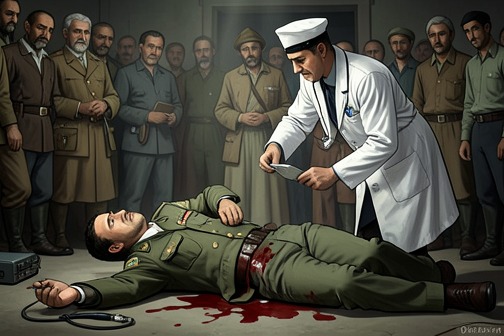
[Manuel Arroyo is kidnapped and shot in Madrid](entity:event-recall-event-53d1c52b348f) after his covert work and assumed identity place him within reach of people who appear to know that he is dangerous. The attack nearly kills him, but he survives because a military doctor treats him and follows orders to keep his identity out of official records. His escape from death is also a lesson in the political world around him: suspicion travels through institutions, while survival depends on secrecy, improvised care, and documents capable of making one person appear to be someone else.
## Background and the threatened identity
In June 1937, [Manuel Arroyo](entity:character-recall-character-3296d1a401b2) registered at a [Madrid](entity:location-recall-location-madrid-8acd4123f416) hotel under the name Rafael Cuesta Sánchez, using credentials supplied through the Republic’s Directorate-General of Security. The paperwork was convincing but the life it described was invented: this Rafael was said to be a government employee born in [Talavera de la Reina](entity:location-recall-location-685f9cd38a0c), affiliated with the UGT, married, and resident in [Valencia](entity:location-recall-location-760e70b8ce24). None of those biographical details was true. It was the first of many identities Arroyo would use.
The false identity belonged to an assignment entrusted to him by Juan Negrín, who had become head of government after the [Barcelona](entity:location-recall-location-fcf889cebf1e) fighting and the fall of Largo Caballero. Negrín tells Arroyo that he trusts him precisely because he trusts very few people, and connects the need to restore order in the Republican zone with the danger of further internal conflict. Arroyo’s cover is therefore not merely a private disguise: it enables sensitive work in a climate where political factions are watching one another and the government fears further upheaval.
By November, Madrid’s atmosphere has changed. Arroyo notices that conversations in corridors, shared coffees, shouted instructions, and jokes have disappeared; he has no proof that anyone suspects him, but sees that people suspect one another. He becomes more cautious. At a commemoration of the defense of Madrid on November 7, police commissioner Rodríguez warns him obliquely that whoever is behind the activity under discussion lacks the resources for the intended attack. Arroyo realizes that Rodríguez has pieced together the relationship between his own denunciations of Trotskyist and anarchist groups and the information reaching Valencia about them. Rodríguez, he concludes, will not expose him—but the cover has become unsafe, and Rafael Cuesta must leave Madrid.
## Abduction and shooting
After the ceremony, Arroyo leaves the Junta de Defensa de Madrid’s offices with an ordinary farewell, as though he expects to return the next day. He considers leaving the city immediately, then risks going to his home in [calle Infantas](entity:location-recall-location-a3bbfa57fe7f) to retrieve a paperback edition of Bailén published by the [Fifth Regiment](entity:organization-recall-organization-2056ae2a6c4b). The book serves as a cipher for his messages and might save him if his flight becomes difficult. He walks there without seeing anyone follow him, but does not make it past the entrance.
Someone strikes him on the head as the door closes, knocking him unconscious. When he comes to, his hands are bound and a sack covers his head. He listens to at least three Spanish captors arguing about whether to take him away or interrogate him. Focused first on identifying their organization, he then recognizes that he may be about to die and that a dead man cannot pass on information. The car stops; one captor protests that this is the wrong place, while another silences him. Arroyo is pulled out while the engine is still running, thrown to the ground, and shot. He feels fire in his side and thinks he is dying; then consciousness gives way.
The attackers leave him at the entrance to a military barracks. A soldier later recounts that a black car pulled up at speed shortly before eight in the evening and stopped without switching off its engine. A passenger dragged out the sack-covered man, fired three shots, climbed back into the car, and shouted an insult as he left. The account makes the attack’s brutality plain, but not its authorship: Arroyo’s captors are Spanish, yet he never gets the information he was trying to extract from them.
## Rescue and concealed treatment
The guards alert the medical staff, who carry Arroyo to the infirmary believing him dead. The doctor establishes that he is still alive. Meanwhile, the commander finds in his wallet a credential issued by the Junta de Defensa’s public-order office and telephones for instructions. He is told to remain at his post; a few minutes later, Basilio Rodríguez calls back with detailed orders and no explanation. If Rafael Cuesta is dead, he must be buried as an unknown person and entered in no register. If he is alive, he must be saved at any cost, without admission to a hospital under that name, because someone may try to kill him again.
Rodríguez tells the commander that the injured man is vital to the Republic’s interests, but the doctor understands that there is another essential fact: the attacker’s target is not simply a wounded official but a person whose identity must remain hidden. The orders make medical care and concealment inseparable. A hospital admission under the name on Arroyo’s papers could expose him to a second attack; official registration could turn the record intended to identify a patient into a route to find him.
The doctor takes control of the patient’s care, asks the others to leave, and insists that Pepe remain because he trusts him. The injured man’s blood type is recorded as B negative; the information is copied onto a separate sheet, and the credential attached to his shirt is removed and kept. When the commander doubts that there is any point in making such arrangements, the doctor assures him that the patient will live. Arroyo opens his eyes at that moment, as if his return to consciousness confirms the doctor’s authority. The doctor remembers [Norman Bethune](entity:character-recall-character-norman-bethune-ec3ec1d82b27), but also recognizes how much he has learned from [Fortunato Quintanilla](entity:character-recall-character-fortunato-quintanil-32c57e86fe47): seal the wounds, prepare the patient for transfer to an operating theatre, and keep him calm. Arroyo can answer when asked whether he is able to speak.
## Consequences and the continuing use of false papers
Arroyo survives the shooting, but the attack makes clear that his Madrid mission cannot simply continue under the same conditions. His vulnerability is heightened by the very documents that have enabled him to work: Rafael Cuesta’s papers establish a usable identity, but a name and credential can also direct hostile attention toward the person carrying them. The order to withhold him from hospitals and registers recognizes that official visibility may be lethal.
Later, Arroyo passes the fictional Rafael Cuesta identity to his rescuer, [Guillermo García Medina](entity:character-recall-character-guillermo-garc-a-me-d52c3f18d2cc). He explains that the identity was constructed so thoroughly that its original owner could not be investigated: Talavera de la Reina lay in the opposing zone, and the town had been bombed, destroying the church records that might otherwise test the story. Arroyo gives Guillermo a new version of the identity, with a different age and personal history, and explains that the papers have been fabricated to resemble documents accepted by the victorious authorities. The transfer turns a disguise once used for Republican intelligence work into protection for a man facing the changed dangers of defeat.
The episode’s later echoes sharpen its political significance without making the two situations identical. In Madrid, an attacker leaves an unregistered, apparently dead man at a barracks, and a commander is instructed to bury him without a name if he has died. In the later dictatorship, an unidentified body from the [Casa de Campo](entity:location-recall-location-b8c44b15fb99) is sent to a common grave under a routine death explanation, while evidence of the gunshot remains visible. The novel also places this earlier concealment beside the Argentine dictatorship’s organized system of clandestine detention, forced disappearance, executions, and disposal of bodies. The contrast is one of scale and system: Arroyo’s attempted killing is a covert attack amid Republican factional suspicion, while the later examples show disappearance operating as an instrument of state terror.
The shooting therefore links bodily survival to the struggle over who can be named, recorded, or erased. Arroyo lives because the doctor refuses to treat him as a corpse and because the commander follows instructions that keep the false identity from becoming an official trail. The episode leaves the attackers unidentified, but its consequences are specific: a near-fatal wound, a concealed recovery, and a newly urgent need to move through political danger under papers that can both save and expose their bearer.
Event 17
The boxing match arranged by Antonio Ochoa
[The boxing match arranged by Antonio Ochoa](entity:event-recall-event-4ec23e55785e) is a rigged military contest that Adrián Gallardo experiences as the crowning achievement of his life. Ochoa engineers the conditions for an Army victory over [Falange](entity:organization-recall-organization-falange-0b58ca81d6eb) champion [Alfonso Navarro](entity:character-recall-character-0a9dcf648ac2), including a deliberately unnoticed low blow; Adrián, however, carries away the roar of the crowd and the conviction that the triumph belongs to him alone. The scene makes the distance between a manufactured result and a cherished memory the match’s decisive consequence.
## The Contest and Its Stakes
At the weigh-in, Navarro shook Adrián’s hand in front of the photographers, smiling broadly. As they embraced for the cameras, he murmured an insult and predicted that Adrián would not last two rounds. Adrián could not see his face, but sensed that Navarro was still smiling when they separated. The taunt turned the contest into more than a public test of skill: it planted fear in the man who would soon be celebrated as its winner.
Half an hour before the fight, alone in the dressing room and without his scapular, Adrián’s fear became panic. His grandfather was waiting in the front row for him to behave like a true Garrote, while Navarro was the better boxer: faster, more elastic, and technically superior. For four rounds Adrián defended himself better than his protector expected, but Navarro was giving him a severe beating. Had judges decided the result on points, Navarro would almost certainly have won. The contest’s apparent sporting logic was therefore set against the result Ochoa had already arranged.
## Ochoa’s Arrangement
Captain [Antonio Ochoa](entity:character-recall-character-antonio-ochoa-1e1d925155de) sat beside Adrián, put an arm around his shoulders, and spoke softly. When Adrián promised to do everything he could, Ochoa made clear that effort was not the issue: Adrián had to win, and Ochoa had taken care of the necessary conditions. The crowd was on the pier; both corners would have their backs to it; and boats moored in the estuary would not see the ring clearly because the barge stood higher. Ochoa’s instructions transformed the physical layout into cover for a result that could not safely be produced in plain view.
After the fourth round, as Adrián’s cut eyebrow and lower lip were treated with vaseline, Antonio Ochoa held his face between his hands, looked into his eyes, and gave him a single word: “Now.” In the fifth round, Adrián moved toward the side of the ring facing the estuary. Navarro followed, trying to trap him against the ropes. Adrián escaped, clinched, and turned quickly when the referee separated them. Unaware that Ochoa had maneuvered him into position, Navarro threw a right hand; Adrián ducked it. Garrote stepped forward, using his body to hide the action, and struck Navarro in the groin as instructed. Navarro fell at once.
The referee counted to ten, waved away Navarro’s trainer when he came to ask what had happened, then raised Adrián’s right arm. The choreography depended not only on the concealed foul but on the referee’s performance and the officials’ willingness to sustain the fiction of a legitimate knockout.
## Victory and Its Uneasy Memory
For Adrián, the raised arm and the crowd’s response eclipsed the arrangement behind them. He walked toward the center of the ring with his arms aloft as hundreds of voices shouted his name. In that moment he felt as though all his ancestors were applauding from heaven. A boat carried him back to land; on the pier, the crowd’s roar overwhelmed him as the generals congratulated him. Ochoa stood beside him, as exultant as Adrián’s grandfather, sharing in the success discreetly.
The victory was thus both real as an experience and false as a sporting achievement. Adrián’s happiness, the acclaim, and the public gestures of celebration genuinely happened, but his opponent’s defeat had been secured by collusion and a foul. The scene’s tension rests on that split: the same act that makes Adrián a celebrated winner also gives him grounds to doubt the honor attached to the win.
## What Adrián Chooses to Keep
At the height of the celebration, Adrián did not remember what he and Ochoa had discussed in the dressing room. He forgot that the referee was a provisional second lieutenant, the son of an artillery general who wanted the Army champion to defeat the Falange champion. He forgot Ochoa’s assurance that the referee would not see the final blow, however close he stood; that the judges were military men and involved in the scheme; and that Navarro would have no opportunity to protest. Most pointedly, Adrián did not remember that he had won by hitting below the belt.
Instead, Adrián felt that the victory was his and that nobody could ever take it from him. The narrator identifies this as the only version of the match he would be willing to remember for the rest of his life. The contest therefore endures less as a sporting result than as a protected memory: public triumph is preserved by leaving its cause out of consciousness. Ochoa’s manipulation secures the immediate win, but Adrián’s selective recollection gives it a lasting personal meaning.
Event 18
Guillermo García and Amparo Priego marry
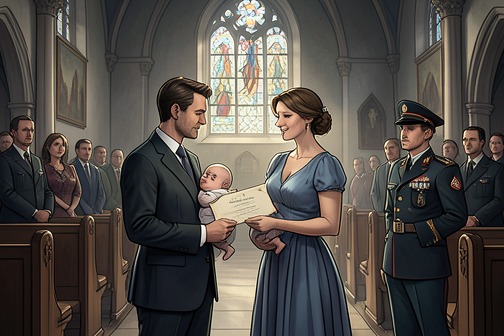
[Guillermo García and Amparo Priego marry](entity:event-recall-event-aa0d8379ccfe) on May 6, 1938, while Amparo is pregnant and the war makes their future precarious. The civil marriage begins as a practical measure to protect their child’s identity and family ties, but Amparo gives the hurried ceremony a meaning beyond paperwork: she wants their son to know that his parents were married. The wedding turns a legal precaution into a deliberate claim to family life under threat.
## A marriage proposed for the child
Amparo’s concern is specific and fearful. She is certain she is carrying a boy, and imagines what might happen if she died in childbirth while Guillermo were shot or imprisoned. Her sisters, she says, could raise the child, but they do not know she is pregnant. Without a family record, a son born to an unmarried mother might be placed in an institution, where his maternal relatives could lose track of him. The prospect makes the marriage less a declaration of romance than a safeguard against war’s capacity to separate a child from his family.
The marriage is arranged by [Experta](entity:character-recall-character-experta-bd538c3c6d2e), who handles the paperwork and serves as one of the two required witnesses. Guillermo supplies the other witness: his employer, who drives him to the town hall. Guillermo understands the wedding as a formality, and his employer’s cheerful manner seems to him almost comically out of keeping with that understanding—or perhaps an acknowledgment of how beautiful the bride looks.
## A brief ceremony made visible
Amparo is not yet five months pregnant, and her figure is still modestly changed. Experta has made her a new outfit by combining two black garments, shaping the front with a pleat that flatters her while leaving the pregnancy visible. Amparo also carries a bouquet of three mauve hydrangeas, which sets her apart from the other brides waiting at the town hall. The contrast between the black dress and the flowers gives the practical occasion a ceremonial brightness that Guillermo does not initially understand.
The ceremony lasts only as long as it takes an official to read three articles of the Civil Code and four people to sign a document. Before Guillermo can lift his pen, however, Amparo asks him to look at the photographer. The photographer is a young soldier earning a few pesetas while on leave, using a foreign camera given to him by an International Brigades volunteer; its old tripod is so unsteady that he has to hold it with one hand as he takes the picture. Amparo’s attention to the photograph ensures that the wedding will survive as more than an entry in a register.
## Paperwork, memory, and family
When Guillermo asks why she wants a photograph, Amparo answers aloud that their son will want to know his parents were married. Her explanation makes the picture a message to a child not yet born: evidence of a bond created in a time when imprisonment, death, and separation are not remote possibilities but imaginable outcomes. The official record and the photograph perform different work. One establishes the marriage legally; the other makes it visible to the future family Amparo hopes they will have.
After the official congratulates them and urges them to make room for the many couples waiting, Guillermo leaves with the family record in his pocket. He thinks of the money spent on the wedding in terms of how much food it might have bought. That calculation preserves the strain of wartime scarcity, but it does not cancel the significance of Amparo’s choices. She has insisted on the flowers and the camera even as Guillermo treats the event as an administrative necessity.
## Significance
The marriage gathers together protection, care, and public recognition. Amparo anticipates the risks that might leave a child unclaimed, and secures a legal bond before those dangers can become real. Guillermo’s practical outlook and her insistence on a photograph reveal different responses to the same insecurity: he counts the cost and completes the formalities; she makes sure the family they are establishing can be seen and remembered.
The scene also gives a formal beginning to the child’s place within their family. What could have remained a private arrangement becomes a recorded marriage, witnessed by others and preserved in an image. The ceremony is brief, the dress is made from reused fabric, and the photograph is taken with a precarious tripod; within those limits, Amparo makes the occasion unmistakably theirs.
Event 19
Guillermo García Priego is born
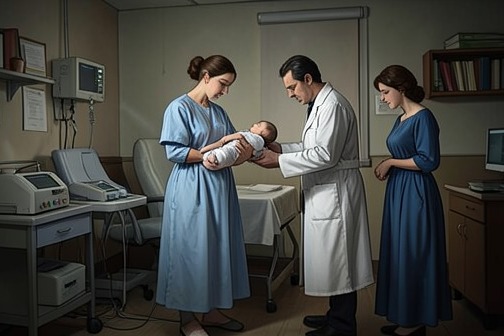
The birth of [Guillermo García Priego](entity:character-recall-character-guillermo-garc-a-pr-e7c1392141a0), on 11 September 1938, gives wartime love and concealment a lasting human consequence: [Guillermo García Medina](entity:character-recall-character-guillermo-garc-a-me-d52c3f18d2cc) delivers a child who is not biologically his, then recognizes him as his son without qualification. The child’s identity is subsequently concealed behind false records and an invented father, and the separation that follows makes the birth a secret whose effects reach into the next generation.
## Birth and recognition
In the early hours of 11 September, [Amparo Priego Martínez](entity:character-recall-character-amparo-priego-mart-df70c977aedc) woke Guillermo with a scream at a quarter to three. Her waters had broken. When he tried to get up, she caught his wrist and demanded to know where he thought he was going; [Experta](entity:character-recall-character-experta-bd538c3c6d2e), who had been living with them since Amparo entered her eighth month, took charge and sent him to do what was needed elsewhere.
The labor was long but easy. For Guillermo, the child’s arrival was at once ordinary in its medical demands and extraordinary in its emotional force. At first he was a doctor at work, concentrating on the pressure of his hands and examining the newborn. Once he had checked that the baby was healthy, wrapped him, and held him, that professional distance gave way to certainty: he would always be the child’s father, and the child would always be his son. Amparo asked whether the baby was a boy; Guillermo recovered from his absorption enough to answer that he was.
## A family made under pressure
The child was named Guillermo, after his father, grandfather, and great-grandfather. The name suggests continuity, but the circumstances around his birth were anything but secure. Guillermo’s attachment was intensified by his isolation: his parents and grandfather were dead, he had heard nothing from his grandmother for more than two years, and Amparo and the baby had become, in his experience, a single source of connection. He wondered whether the bond might have been different in peacetime, or if his relationship with Amparo had begun by choice rather than through a war provoked by the generals’ uprising.
Amparo knew that Guillermo’s real name was not Rafael Cuesta Sánchez, but she did not know that he had sought her out to help [Manuel Arroyo](entity:character-recall-character-3296d1a401b2) Benítez, who had assumed [Adrián Gallardo Ortega](entity:character-recall-character-adri-n-gallardo-ort-65f564eff7c8)’s identity to infiltrate a Nazi escape network and reach [Argentina](entity:location-recall-location-27e2c37f5c3d). In the same period, the real Adrián was begging in [Berlin](entity:location-recall-location-769cdeac2511) and using papers belonging to [Alfonso Navarro López](entity:character-recall-character-alfonso-navarro-l-p-c83845fb86be). The child’s birth thus takes place within a world where names and identities are already instruments of survival; the family itself would later be subjected to the same kind of concealment.
## Separation and the invented father
When Guillermo later recovered a hidden family file, it contained the documents that established his birth and his parents’ marriage: a family record in the names of Guillermo García Medina and Amparo Priego Martínez, the birth certificate of their legitimate son, Guillermo García Priego, and a wedding photograph. The file also held Amparo’s brief apology, dated 28 March 1939, saying she was sorry and had not wanted what happened. The papers preserve the family fact, but they do not prevent the child from being removed from his father’s life.
Amparo’s son was raised as José Antonio Urbieta. Experta explained that he had been given the name of the Falangist movement’s absent leader and the randomly chosen Basque surname Urbieta. In his mother’s home, a photograph showed a young Falangist in a blue shirt and ammunition belt. The boy believed this man was his father, a hero who had died in [Russia](entity:location-recall-location-e36341713c23); the story was supported by documents arranged through Amparo’s connections. Guillermo, meanwhile, watched his son grow from a distance, sometimes seeing him arrive with scraped knees and his shirt untucked. The birth’s immediate declaration of fatherhood endured privately even as the child was taught a different account of who his father was.
## The secret returns to the son
The concealed history resurfaced when José Antonio, then a university student, searched his mother’s underwear drawer for money and found a packet of family documents. He had wanted forty duros to take a girl dancing; instead, he discovered his birth record, a Republican family book, a photograph of his mother pregnant beside the doctor who had visited him during an illness, and an image of an apologetic note. The ordinary motive for opening the drawer brought him into contact with the history his mother had kept from him.
José Antonio had already questioned Experta. After promising not to expose her, he learned that Guillermo was his father, that he was a Republican, that he had buried his great-grandfather, and that he and Amparo had lived together until 1939. He also knew that Guillermo had once lived in the apartment opposite. One detail remained unknown to him: as a child, José Antonio had painted [Guillermo’s wooden toy train](entity:object-recall-object-a3a9015e2e04). The gap between the facts he uncovered and the small, intimate memory he did not know underscores how much of their relationship had survived only at a distance.
## Reunion and the birth’s continuing legacy
Years later, after Guillermo had married [Rita Guillermina Cuesta Velázquez](entity:character-recall-character-rita-guillermina-cu-556b1dce0f9c) and become a father again, the birth of another son, Manuel, revived his memory of the first baby. The new child’s gestures and development recalled Guillermo García Priego, whom he had lost from his daily life. As Manuel passed infancy and grew beyond the age at which Guillermo had feared losing him, the memory of his first son softened into a gentler nostalgia, without erasing the original bond.
On 30 December 1976, Guillermo and Manuel Arroyo Benítez embraced for the first time at the arrivals door of Barajas International Terminal. Their bodies bore the marks of their shared history, and neither man used his true name, though each called the other by it. The reunion belongs to the wider story of forged identities and political defeat, but it also frames the lasting consequence of the birth: Guillermo’s fatherhood was formed amid imposed separations and concealed names, yet the son born in 1938 eventually became part of a family truth that could be recovered and spoken.
Event 20
Francoist forces enter Madrid
[Francoist forces enter Madrid](entity:event-recall-event-59f36198dfa0) in March 1939, ending the Republic’s control of the city and turning a military defeat into a struggle over homes, records, and identities. As the hospital is seized and the streets fill with jubilant supporters of the victors and departing refugees, [Guillermo García Medina](entity:character-recall-character-guillermo-garc-a-me-d52c3f18d2cc) understands that the new order will not merely replace one government with another: it will decide who can remain, who must run, and under what name anyone can hope to survive.
## The hospital changes hands
On the morning of the takeover, Guillermo is still making his rounds when Dr. Quintanilla summons him aside. Their conversation takes place in a first-floor bathroom rather than the doctor’s office. Quintanilla has no office left: half an hour earlier, a committee led by Francisco Arrieta had entered the hospital without knocking and announced that it was taking possession in the name of the National Army. Its members wore blue shirts under their white coats; Arrieta had a pistol at his belt. The abrupt seizure puts the new authority inside the very institution where Guillermo had been working, and makes clear that the change of regime is already being enforced at close quarters.
Quintanilla admits that he had not known there were so many supporters of the victors inside the hospital. His loss of the post is thus not simply a matter of a formal transfer of authority. The committee’s arrival reveals how suddenly familiar institutions can be occupied and how little warning even their staff may have. Guillermo and his former chief part in different directions: Quintanilla heads towards Legazpi, while Guillermo walks towards Cibeles and then takes Alcalá, skirting [Retiro Park](entity:location-recall-location-556da7557de2) on his way to Velázquez Street.
## A city divided between celebration and flight
The streets present two competing scenes. Francoist supporters crowd balconies and pavements, raising their right arms in noisy celebration. Refugee families, many of whom had occupied empty apartments in the district since the summer of 1936, move away carrying all they own. Guillermo threads between the cheering crowds and tries to advance close to the building fronts, using the departing refugees as cover. The victors shout their salute at him, but have not yet begun to challenge him for failing to answer. In this brief interval, the danger is palpable precisely because it has not fully declared itself.
At the corner of Hermosilla and Núñez de Balboa, Guillermo recognizes a worn, tawny leather travel bag being placed in the back of a car. Only after recognizing the bag does he identify the man carrying it. The man smiles at him before rejoining what he has taken; by the time Guillermo can see who is sitting in the passenger seat, the car has disappeared. He cannot establish the passenger’s identity, but the sight is enough to make the military outcome intimate and irreversible. Before the victors have officially proclaimed their triumph, Guillermo feels that he has lost the war.
When he reaches home, [Amparo Priego Martínez](entity:character-recall-character-amparo-priego-mart-df70c977aedc) has already left, and the house bears the disorder of a hurried search and departure. Clothes lie in a heap in the entrance; the available surfaces in the sitting room are crowded with objects apparently removed from cupboards for sorting. The damage in the hall does not surprise Guillermo, who had left at eight that morning and has returned before two. In the study, intruders have smashed the wall around his grandfather’s safe with a sledgehammer, tried unsuccessfully to prise off its lock with a blowtorch, and ultimately had a locksmith open it. The safe stands empty. They have taken only [Don Fermín’s gold](entity:object-recall-object-89a619c4fb0a), but family documents, including copies of the grandparents’ wills and the deed to the house, lie trampled on the floor. The occupation reaches into the private home through theft and desecration as well as through the public seizure of the hospital.
## A false identity becomes a means of survival
Guillermo’s vulnerability in the new [Madrid](entity:location-recall-location-madrid-8acd4123f416) is sharpened by the false papers prepared for him through [Manuel Arroyo](entity:character-recall-character-3296d1a401b2) Benítez. The identity of Rafael Cuesta Sánchez had first been devised for Manuel, who registered under that name in Madrid in June 1937. Its administrative detail was convincing, but none of the personal facts behind it was true. Manuel later gives Guillermo a different version of the same invented identity: Guillermo is to be a twenty-five-year-old bachelor, with no left-wing party or union membership, who has lived in Madrid and most recently in [Salamanca](entity:location-recall-location-2bf64b0b8b8f). The story is made harder to disprove by the claim that his birthplace’s church burned in a bombing along with its baptismal register.
Manuel explains that he destroyed Guillermo’s UGT record and made the identity papers resemble those issued by the Francoist authorities. He filled them in himself, imitated a real official’s signature, and copied a Burgos seal. This is not merely concealment by an assumed name; it is an attempt to manipulate the administrative machinery by which the new regime sorts, registers, and recognizes people. Guillermo keeps the envelope Manuel gave him in the locked desk drawer he had reserved for it. After returning to the ransacked house, he checks that the envelope remains intact and examines its contents again before locking them away. Preserving the papers becomes one of the few deliberate acts he can still perform in a home others have searched.
When Guillermo finally leaves the house, he has been without food for a day and a half. He eats two of Franco’s bread rolls, left untouched on the kitchen table since Amparo’s departure, then puts on his grandfather’s coat, which is both too wide and too short. He takes his briefcase and walks out without locking the door. On Calle Ayala he learns that the boy who had carried messages to [Experta](entity:character-recall-character-experta-bd538c3c6d2e) has been absent from work for three days, but receives the address of the boy’s home. When Guillermo passes his former home again, four Falangists are standing outside the entrance. One holds a typed paper. Guillermo crosses the street and continues without stopping to discover whether his name is on it. The false identity offers a route through bureaucracy, but the typed list makes the threat of identification immediate.
## The city’s new paperwork
Guillermo spends the early period after the takeover in hiding, staying first at Facundo’s boarding house and later at Doña Enriqueta’s. His walks are less a purposeful search than an effort to persuade himself, and his landlady, that he is doing something. He avoids going beyond the western edge of the Castellana. A woman crying in a doorway or a group of armed soldiers or police can abruptly end a walk. At times he imagines surrendering to Paco Arrieta, but recognizes that he will not do it; the knowledge itself torments him.
When he eventually goes to a crowded police station, the Rafael Cuesta Sánchez papers produce a sudden change in how an official treats him. The guard at the entrance asks for his documentation; on seeing it, he softens his manner and directs Guillermo to window seven, where documents from the Nationalist zone are being exchanged. The contrast between that courteous service and the exhausted people waiting in the first six lines is stark. Guillermo sees them as fellow inhabitants of the Madrid that endured almost three years of deprivation, bombardment, and despair. He regards them as his equals, yet must approach the new administration through a document that disguises his political past and separates him from them.
While waiting, Guillermo has time to observe the crowded rows before him. When his turn comes, he hands over the identity card with a smile that conceals his inner turmoil. The clerk pays little attention as he fills in a form with Guillermo’s details. The scene completes the immediate consequence of the occupation: authority has changed hands, but survival now depends on passing through its offices under an identity deliberately made to look as though it belongs to the victorious side. The paper that Manuel devised for a Republican operative becomes Guillermo’s means of remaining legible to the new regime without revealing who he is.
Event 21
Bilbao boxing match: Adrián Gallardo vs. Alfonso Navarro
[Bilbao boxing match: Adrián Gallardo vs. Alfonso Navarro](entity:event-recall-event-c578c68c1980) is the decisive contest that makes Adrián a public champion but not, in his own mind, an unambiguous victor. The bout’s apparent triumph conceals a military fix: Adrián’s knockout of [Alfonso Navarro](entity:character-recall-character-0a9dcf648ac2) was not simply the result of his boxing ability. Its consequences follow him long after the crowd has dispersed, shaping his professional ambitions and turning a celebrated win into a debt he hopes to repay fairly.
## The victory and its public afterlife
By the spring of 1938, Adrián had become famous enough that, in [Bilbao](entity:location-recall-location-00ac960a262f), diners rose to applaud and chant his name when he entered a restaurant. The match’s renown was reinforced by the scale of its public reception: the decorated barge, the generals in the front row, and the pride in his grandfather’s eyes. When Adrián later returned to his home town during the summer of victory, a crowd filled the station at [La Puebla de Arganzón](entity:location-recall-location-13b190f1137f); the municipal band played the Francoist anthem, and the mayor waited with the councillors. The triumph gave the young boxer public standing and the appearance of a secure future.
The match also drew Adrián into the orbit of Captain [Antonio Ochoa](entity:character-recall-character-antonio-ochoa-1e1d925155de), who had arranged the contest. In [Madrid](entity:location-recall-location-madrid-8acd4123f416), at the beginning of 1940, Adrián sought Ochoa out at his residence in Velázquez Street and asked for help pursuing boxing as a career. He explained that his family’s farms were secure but that he had no interest in rural life; he had savings and wanted to keep boxing. Ochoa initially reacted as if he might remind Adrián of an unfair blow, but checked himself and agreed to help. He found him a place at [Gimnástica Ferroviaria](entity:organization-recall-organization-gimn-stica-ferro-b08cc5bbcd52), then the best gym in Madrid, where professional and amateur boxers trained. Their long association there revived the earlier camaraderie of Portugalete, though Ochoa did not return to the ring.
## A victory under suspicion
The match’s public story obscured the circumstances that made Adrián’s knockout possible. Years later, his trainer Pirulo knew the Bilbao fight had been fixed, though no one had told him directly. He inferred it from what he knew of Adrián, Alfonso, and Ochoa, and from the implausibility of the knockout given the condition in which Adrián had come under his care. Adrián, Pirulo concluded, could not have accomplished it unaided; the likely intervention came from Ochoa, whose military connections mattered in a contest between officers and Falangists.
Pirulo’s inference rested on the match’s officiating as well as his personal knowledge. The referee was a provisional second lieutenant, the judges were infantry officers, and Adrián had knocked Alfonso down with his opponent against the ropes on the estuary side. The fight therefore carried a political arrangement within its sporting result: the military side had tilted the conditions against a Falangist boxer. Adrián never confirmed Pirulo’s suspicion, but his silence did not erase it. The win remained famous in public while becoming increasingly difficult for Adrián to inhabit as a clean personal achievement.
## The debt returns
After the war, Adrián’s memory of Alfonso changed from an episode he had tried to forget into an expectation he could neither dismiss nor satisfy. Ochoa had once reassured him that he would never see Alfonso again, and for a few weeks Adrián believed the danger had passed. But as his early success faded into ordinary routines, he began both to fear and to desire Alfonso’s return. He continued boxing because of him, turning a compromised victory into the reason for a professional career. His motives remained divided: perhaps he hoped to redeem himself through a fair contest, or perhaps he wanted a final peace with the past. He could not tell which aim mattered more.
That unresolved history surfaced when Pirulo asked whether Adrián had really knocked Alfonso out in Bilbao. Adrián answered firmly that he had done so in the fifth round and pointed to the crowded port as a place where witnesses could be found. Yet he avoided his trainer’s gaze. Pirulo, who knew Alfonso as a good boxer and a bad-tempered man, did not accuse Adrián outright; he admitted that he had wondered whether the blow had been fair, then said he was glad Alfonso had gone down. For Adrián, the question itself was a reversal: the support of the trainer who should have been on his side brought the old rival back to the table, as though Alfonso had returned in Pirulo’s voice.
## From ring to mess hall
The unresolved contest eventually reappeared far from Bilbao. At the Pokrovskaya officers’ mess, Alfonso shoved [Jan Schmitt](entity:character-recall-character-jan-schmitt-75ecceb3a91a) to the floor, and Adrián saw an opportunity to end the confrontation. He came out from behind the table and struck Alfonso on the head with a right straight, knocking him down for the second time since they had known each other. The officers present read the punch as an instinctive defense of a friend, and Adrián repeated that account. It was not the truth: he had thought through the action, intending to escape the dining room at any cost, even if it meant detention.
The setting changed the meaning of the blow. Adrián says that, if he had been alone with Alfonso, he would have welcomed a fight in which he could box with his whole soul as well as his fists. But in a room with half the division’s officers watching, striking him was the only solution Adrián could see. Most of the witnesses accepted Jan’s version that Alfonso could not take defeat and sided with Adrián, the Spanish runner-up. The public interpretation again offered Adrián a usable story, while the private reason remained bound to the old match and the desire to escape its renewed danger.
## Meaning within Adrián’s arc
The Bilbao bout is both an origin and an unfinished reckoning. Its acclaim opens a path into professional boxing, yet the hidden intervention at its centre makes Adrián’s achievement feel unstable. He is famous for a victory that he cannot confidently claim as his own, and his years of effort do not settle whether he seeks athletic redemption or relief from the rival whose defeat defined him. The match’s afterlife is measured less by the result than by its recurrence: first in the suspicion Pirulo voices, then in Adrián’s insistence that the knockout happened in the fifth round, and finally in the renewed violence at Pokrovskaya. A celebrated win becomes an enduring question of honor, agency, and whether a clean contest can repair a victory made crooked.
Event 22
Spanish Heavyweight Boxing Championship final (Barcelona)
The Spanish Heavyweight Boxing Championship final in [Barcelona](entity:location-recall-location-fcf889cebf1e) is the turning point at which Adrián Gallardo’s promise as a professional boxer collapses under the weight of an old debt. He arrives after a powerful run through the tournament, but fights the final with his attention fixed on whether [Alfonso Navarro](entity:character-recall-character-0a9dcf648ac2) is watching rather than on Oñate, the opponent in the ring. Knocked out in the eighth round, Gallardo suffers his first professional KO defeat; afterward, he withdraws from boxing and sinks into a passivity that makes the loss consequential far beyond the championship.
## Background and the road to the final
Gallardo enters the championship as a boxer transformed by relentless training. After winning a new title, he has acquired the visible signs of success—his own rented flat, new clothes, taxi rides, public praise, and interviews—but he cannot enjoy them. His daily work in the gym is driven by what the narrative distinguishes from a mere obsession: a firm promise to meet Navarro again and pay his debt. He trains to earn a clean chance to beat the man he fears facing between the ropes, and in doing so becomes a formidable combination of power, technique, and muscle.
That preparation carries him through the tournament with relative ease. None of the opponents he eliminates before the semifinal lasts more than one round. The semifinal against the Canary Islands champion is harder: Gallardo needs four rounds to knock him down, since the opponent is less powerful but much more adept at feinting, evading, bending at the waist, and moving his feet. Gallardo absorbs the punishment, waits for an opening, and wins. The fight is the greatest professional beating he has yet taken, but his rapid recovery gives trainer Pirulo nearly a week to prepare him for the Barcelona final.
## Navarro’s absence becomes the real opponent
During the days before the final, Pirulo shifts from caring for Gallardo after the semifinal to intensifying his training. Their walks and conversations bring the underlying problem into view. Pirulo warns him that Oñate is the best boxer he has faced: as strong as Gallardo, but faster. Gallardo’s response is not to ask how to counter Oñate. He asks whether Navarro will come to watch.
The question exposes how completely the old [Bilbao](entity:location-recall-location-00ac960a262f) fight has taken possession of the coming contest. Gallardo’s earlier victory over Navarro was compromised by the circumstances: the referee was a provisional lieutenant, the judges were infantry officers, and Navarro had been knocked down against the ropes on the estuary side. Gallardo has not discovered the full depth of his fixation until the walk around [Montjuich](entity:location-recall-location-09757fb75812), when the thought of Navarro’s possible presence overwhelms discussion of the championship itself.
Pirulo tries to bring him back to the actual stakes. More than three years have passed since their winter 1938 fight. Gallardo was then an amateur with little knowledge of the profession; Navarro, though boxing for amusement, had learned professional techniques and tricks. Now Gallardo is pursuing the Spanish championship, and Pirulo believes he could knock Navarro out in the first round. He argues that Navarro knows this and has no reason to leave his father’s estates to seek him out. Gallardo seizes instead on the news that Navarro’s father is ruined, as if that detail makes a visit more plausible. Pirulo restrains his frustration and insists that Gallardo concentrate on Oñate.
## The final and the first professional knockout
As the fight approaches, Gallardo’s spirits steadily fade. Pirulo alternates encouragement and scolding, tending to him and trying to shake him out of what appears to be a fictional collapse. But he recognizes that the boxer’s fear weighs as heavily as his guilt. There is no practical training for an opponent who is not in the ring: Navarro’s power in Barcelona lies in his absence, a shadow with no fists, legs, or body that nevertheless threatens to undo years of work.
At the dressing-room door, Pirulo takes Gallardo’s face in his hands, kisses his cheek, embraces him, and urges him to fight Oñate without thinking. He calls him a champion and tells him the word belongs to him. Gallardo nods, but does not fix his gaze on the trainer. On the stairs and through the preliminary bouts, he searches the stands for Navarro. For seven rounds, his attention is more occupied by that search than by the opponent he has come to defeat. In the eighth, he falls to the canvas. The final is Gallardo’s first professional defeat by knockout—and, as the narration pointedly adds, not his last.
## Aftermath and significance
Pirulo tries to contain the damage by placing the loss within the ordinary history of boxing. He invokes Schmeling, Dempsey, and Joe Louis, reminding Gallardo that champions have been knocked out and that he is still [Spain](entity:location-recall-location-0fe76f866976)’s runner-up, with more fights, victories, money, and glory ahead. Gallardo no longer talks with him. The contrast between the trainer’s practical reassurance and the boxer’s silence marks the beginning of a withdrawal that cannot be reversed by encouragement alone.
Gallardo spends the money he earned in Barcelona on fortune-tellers, card readers, miraculous spells, and protective rituals against Navarro’s influence. He begins going out at night and drinking alone; he takes up smoking, gains weight, and loses his conditioning, strength, and reflexes. Finally, he discovers the pleasures of failure: the calm of complete apathy and the poisonous satisfaction of staying in bed with no obligation beyond waiting for another day of inactivity. The championship final thus does more than end a winning run. Gallardo’s defeat in the ring is followed by his surrender to the imagined reckoning that had motivated his training: the absent Navarro has already shaped the fight, and afterward continues to govern Gallardo’s choices without ever appearing.
Event 23
Battle of Stalingrad and surrender of the German Sixth Army
The [Battle of Stalingrad and surrender of the German Sixth Army](entity:event-recall-event-1bac45d5cff2) are a military reversal whose significance reaches well beyond the battlefield: they change the course of [Germany](entity:location-recall-location-a3c24dd56e42)’s war in the east, expose the distance between events and their public presentation, and help kindle hopes that Franco’s dictatorship may not outlast the Axis. The novel returns to the defeat through sharply contrasted vantage points: a soldier waiting on the Leningrad front, [Hans Lazar](entity:character-recall-character-hans-lazar-bdc10f3f12a4) shaping [Madrid](entity:location-recall-location-madrid-8acd4123f416)’s news, and a clandestine opponent imagining a democratic future after the war.
## The military reversal and its effects
Adrián Gallardo arrives on the Leningrad front while German forces are maintaining their offensive pressure on the city. He expects to encounter Lieutenant Navarro, a fellow boxer, but the men are assigned to different sectors. The fighting and the long wait for a decisive encounter leave Gallardo with a persistent dissatisfaction; he begins as an alférez, the rank he held at the end of the Spanish war, and eventually becomes a lieutenant without gaining further distinction beyond his reputation as a professional boxer.
His promotion comes only days before the assault on Stalingrad fails. The novel presents that failure as the first major setback suffered by German forces in the Soviet Union. Hitler abandons the advance on Leningrad, choosing instead to maintain pressure on the city. With the front stabilized, Gallardo returns to headquarters at Pokrovskaya for a week’s leave. He enters the officers’ mess and is addressed by a pair of black eyes belonging to someone he does not recognize, a moment that connects the distant consequences of the eastern campaign to the novel’s continuing personal entanglements.
## Surrender and the struggle over the news
In Madrid, the defeat is narrated through Hans Lazar, the press attaché at the German embassy, who knows that the Sixth Army has surrendered at Stalingrad. Hitler had elevated Friedrich Paulus to field marshal on 30 January, a promotion that carried an unmistakable expectation: no German field marshal had ever surrendered, and Paulus was expected to kill himself rather than be captured. Instead, Paulus surrendered what remained of the Sixth Army to the Soviet Union. The army had lost close to two hundred thousand men, nearly two-thirds of them dead.
Lazar understands the scale of the disaster and suspects that the war may have been lost at Stalingrad. His immediate concern, however, is that Spanish readers should not learn the truth. In the 3 February issue of [ABC](entity:organization-recall-organization-abc-548aaae226e1), a photograph shows the city’s ruins, while a short item titled simply “Stalingrad” compares German resistance to the stand at Thermopylae and to the Spanish nationalist legend of the Alcázar of Toledo. The report omits the words surrender and capitulation, and does not name Paulus. On 4 February, the newspaper falsely claims that the Sixth Army is rapidly regrouping after the setback. On 5 February, its front page turns to photographs of what it describes as a triumphant Axis submarine campaign in the Atlantic.
These successive presentations make the press itself part of the event’s consequences. The defeat is not merely softened: its central fact is withheld, and a retreating army is recast through heroic analogy and claims of recovery. The narrator likens the Spanish press to an innocent children’s chorus conducted by Lazar, emphasizing how effectively one official’s direction can make a public version of the war sound coherent while excluding its decisive truth.
## Lazar’s machinery of influence
Lazar’s control over the news is not explained by bribery alone. Allied diplomats later describe the German advantage in [Spain](entity:location-recall-location-0fe76f866976) as a matter of buying influence, and Lazar does reward prominent journalists. Yet the novel stresses that he is unusual even in a country where Francoist generals are already receiving supplementary payments in British pounds: the journalists he has cultivated do not simply sell themselves to whichever side offers more. His influence depends on personal allegiance as well as money.
The Lazar household extends that influence into social life. Hans is presented as cosmopolitan, multilingual, exceptionally cultivated, elegantly dressed, and unfailingly courteous; his wife, the Baroness Petrino, is known for her cooking. Carefully selected Madrid journalists dine in their home with senior Francoist officials and Nazi diplomats, gaining a sense of access to power that binds them more closely to their hosts. Such hospitality, the novel argues, buys more loyalty than envelopes of cash alone.
The same social and political reach allows Lazar to infiltrate the newly founded EFE news agency and spread [Berlin](entity:location-recall-location-769cdeac2511)’s perspective in Latin America. He also works through Spanish organizations in ways that leave no provable trace of the embassy or its government. His effort to conceal Stalingrad thus belongs to a larger practice of constructing favorable opinion for the Axis in a supposedly neutral country. Even after the war, Lazar remains an indispensable figure in the German embassy’s operations: on 5 June 1945, when Allied representatives finally enter the Madrid embassy after Francoist authorities have delayed access, the building has been stripped of documents, money, gold, antiques, and artworks. The novel presents this empty building as a later measure of the reach and durability of the system Lazar served.
## Political hope after Stalingrad
The military reversal also changes how opponents of Franco imagine Spain’s future. In a conversation with the narrator, a clandestine communist argues that, after Stalingrad, everything will be different: once the Allies defeat the Axis, Franco’s fate will be sealed. He describes a plan to unite democratic forces, from Basque nationalists and anarchists of the CNT to non-fascist monarchists and conservatives, and to restore the Republic and civil liberties. The proposed Spanish National Union is to work underground until democratic forces can return to power.
The narrator is moved by the speaker’s sincerity and confidence, and recognizes in the cause something he has long wanted to hear expressed. The appeal is practical as well as idealistic: the speaker asks him to join because a man who saves lives and works at a transport agency can observe people across social and political lines, gather information, and interpret what remains unsaid. Stalingrad therefore functions in the novel not as an automatic guarantee of liberation, but as a turning point that makes such expectations newly imaginable and gives underground political organizing a concrete horizon.
## A defeat whose truth arrives unevenly
The novel places military fact, official reporting, and private expectation alongside one another without treating them as interchangeable. On the eastern front, Stalingrad changes German strategy and stabilizes the immediate situation around Leningrad. In Madrid, the same defeat is rendered nearly unrecognizable by selective headlines, heroic comparisons, and false claims about the Sixth Army’s recovery. Among anti-Franco opponents, it becomes evidence for a hoped-for Allied victory and a possible restoration of republican government.
That contrast gives the battle its larger narrative force. Its consequences are not confined to the front: they pass through newspapers, diplomatic competition, clandestine alliances, and the choices people make while waiting for political change. The defeat is decisive, but knowledge of it is contested; hope follows, but the novel records it as an expectation rather than a result already secured.
Event 24
Battle of Krasny Bor
The [Battle of Krasny Bor](entity:event-recall-event-90eb0d8afef7) is the ordeal that shatters Adrián Gallardo’s hope of returning to professional boxing and forces him to recognize the war’s violence as part of his own life, not a nightmare cut off from it. He survives the February 1943 battle and returns to Pokrovskaya, but a letter about his imprisoned trainer turns survival into a reckoning with the dead, the wounded, and the future he thought awaited him in [Madrid](entity:location-recall-location-madrid-8acd4123f416).
## Background and Adrián’s Hope of Return
Before the battle, Adrián had asked Captain Junquera whether he could resign and return to [Spain](entity:location-recall-location-0fe76f866976) to box professionally. Junquera explained that he had volunteered for the war and could not simply leave; he would return when his turn came, though Junquera privately doubted that the wait would be long. Adrián accepted the setback and, after the doctors’ prescribed week of convalescence, went back to his post in good spirits.
Before departing for the front, he wrote a long letter to Pirulo, apologizing for his mistakes and recounting his reunion with Navarro, the fight, and his suspension. Most importantly, he described rediscovering himself as a boxer and wanting to return to professional competition. He sent the letter to the [Gimnástica Ferroviaria](entity:organization-recall-organization-gimn-stica-ferro-b08cc5bbcd52) gym on Calle Barbieri in Madrid, convinced that he had already overcome the hardest part. The narrative makes that confidence a sharp prelude to Krasny Bor: the battle would take away the future he had been writing toward.
## The Battle and Its Cost
The Division Azul fought to halt the Soviet offensive and maintain the siege of Leningrad. In only eleven days in February 1943, its casualties amounted to half the troops who took part, while a thousand men were taken prisoner. Adrián was among those who made it back to Pokrovskaya. He was received as a hero, but even the most optimistic considered defeat only a matter of time.
His return was marked not by celebration but by exhaustion, hunger, cold, and dirt. He went first to the post office. There he found two letters: his own, returned with a notice that Pirulo was absent or unknown at the address, and another from the gym’s owner, Don Fernando. Don Fernando explained that Pirulo was in prison. The former legionnaire who had fought for Franco had been arrested after police found propaganda in his home; he had said he was only trying to help a friend by keeping it. The letter ended with a warning to be careful about one’s friends and a promise to find Adrián another trainer when he returned to Madrid.
## The News That Makes the War Real
The news of Pirulo’s imprisonment brought Adrián down. At Krasny Bor his body had fought almost without his awareness, like a machine stripped of spirit and reduced to a small cog in a larger, indifferent mechanism. An inward voice had persuaded him that the battle was a nightmare, a stage set, a counterfeit hell detached from real life—the real life he expected to resume on Calle Barbieri. The letter exposed that comforting division as false.
His awakening comes through the bodily return of what he has witnessed: the blood fills his vision, the screams press on his hearing, and the cold in which he survived seizes him again. The dead, the mutilated bodies, the fear, and the desperation of fighting at twenty-five degrees below zero return with the force of captivity. He had crossed through that hell and escaped it while thinking of a future; now that future has vanished, leaving him alone with a war that had never mattered much to him and has become the only thing he has.
## Consequences and Significance
In the darkness of despair, Adrián reviews his mistakes and sees his life as one enormous error, without knowing how to prise it open and inhabit it differently. The question of what he has done receives no answer. As conditions worsen, even his confusion loses importance: the Tiger of Treviño ceases to fight for Christian civilization, the glory of the Reich, or the destruction of communism. He fights to stay alive in a lost war, reduced to a blurred outline among an army of shadows.
The battle’s decisive consequence is therefore both military and inward. Adrián survives, but survival strips away the story he had told himself about a brief interruption before his return to boxing. The letter from Madrid binds the front to the life beyond it: a friend’s imprisonment makes the battlefield’s violence impossible to relegate to an unreal realm. On 12 October 1943, he sees [Alfonso Navarro](entity:character-recall-character-0a9dcf648ac2) again in the courtyard at Pokrovskaya, a later encounter that follows this period of disillusionment without undoing the change Krasny Bor has made in him.
Event 25
Blue Division dissolved and Blue Legion formed
The dissolution of the Blue Division and formation of the Blue Legion mark a change of name without an escape from the war: Francisco Franco disbanded the Spanish volunteer force on 12 October 1943, only to announce another Spanish unit under German command. For Adrián Gallardo, the announcement turns a public military retreat into a private choice. He cannot imagine returning to [Spain](entity:location-recall-location-0fe76f866976), has lost the desire to resume boxing, and cannot bear to face [Alfonso Navarro](entity:character-recall-character-0a9dcf648ac2) again. [Jan Schmitt](entity:character-recall-character-jan-schmitt-75ecceb3a91a)’s invitation to join the Flemish Legion offers a route forward that Adrián mistakes for a route out.
## Background and the end of the Blue Division
The date Franco chose was laden with national symbolism: the anniversary of the conquest of Granada and the discovery of America. That calendar’s grandeur could not disguise the defeat. The Blue Division was dissolved, but the announcement that a new Spanish volunteer corps, the Blue Legion, would serve in the Wehrmacht under German command offered no real reversal of fortune. To the division’s men, the new formation tasted like a bitter consolation: the prospect of martyrdom and continued resistance far from home, with little to show for it.
The call for volunteers separated those willing to remain from those with reasons to go home. Men with love, longing, money, family, a vocation, or a future they still valued stayed where they were when the colonel called for volunteers. Adrián was not among those who stepped forward. Alfonso Navarro was the first to do so, making the military transition inseparable, for Adrián, from the sight of the man he could not escape.
## Adrián’s choice
Seeing Alfonso standing apart from the troops, still as arrogant as before and darkened by the look of someone with nothing to lose, makes Adrián hesitate. He has no emotional attachment to [Germany](entity:location-recall-location-a3c24dd56e42) and does not identify with Nazism. His hatred of [Joseph Stalin](entity:character-recall-character-de344fc3a118) comes from the suffering Stalin has caused him and from his opposition to the God his mother taught him to pray to; it does not give him a reason to embrace the German cause. Nor does home beckon: he expects only the dull life of a farmer, a life he had already refused once.
The prospect of returning to the boxing ring has lost its appeal as well. Adrián no longer wants to train, rebuild himself, or resume a professional career without Pirulo’s guidance. He recognizes that his trainer’s misfortune is not enough to justify giving up, but lacks the will even to argue with himself. War has left him with injuries he had not anticipated and a sense of defeat he cannot turn into a fresh purpose. Against this general weariness, Alfonso remains the exception: Adrián knows that above all he does not want to be anywhere he might meet him again.
## Jan’s offer and the mistaken escape
As Adrián remains in place, fighting the impulse to step forward into what the narration figures as an unbroken fall toward death, Jan appears beside him and invites him to go to the Flemish Legion. The offer is framed as companionship as much as enlistment: they can go together to Ukraine and continue fighting the Russians; the war, Jan insists, is not over. Adrián accepts because he believes the move will let him escape his fate and the man who has pursued him ever since he boarded a barge in the port of [Bilbao](entity:location-recall-location-00ac960a262f).
That hope is the event’s bitter reversal. Joining another German-commanded volunteer formation does not end the war or deliver Adrián from the past; it carries him onward under a new banner. The Blue Legion’s creation therefore registers both a political and a personal continuity: the Blue Division’s dissolution cannot restore the future its volunteers have lost, and Adrián’s decision to remain cannot free him from the pursuit that shapes his choices.
Event 26
Austria's annexation by Nazi Germany (Anschluss)
Austria's annexation by Nazi [Germany](entity:location-recall-location-a3c24dd56e42), or the Anschluss, is the decisive turn in [Hans Lazar](entity:character-recall-character-hans-lazar-bdc10f3f12a4)'s career: selected to help preserve Austrian independence, he instead became one of the annexation's most effective propagandists. The episode establishes a pattern that would carry into his later work in [Spain](entity:location-recall-location-0fe76f866976), where press influence and political loyalty proved more consequential than diplomatic titles.
## Lazar before the Anschluss
Born in Istanbul in 1895 to an Austrian diplomat and an Albanian mother of partly Jewish ancestry, Lazar moved to Austria as an adolescent. The outbreak of the First World War interrupted his education; he served in the Austro-Hungarian army, where severe wounds left him with chronic pain and a lasting morphine dependency. After returning to civilian life, he became a correspondent for Germany's official news agency in Bucharest in 1927, and married the Romanian aristocrat Elena Petrino Borkowska in 1937.
In 1938, Lazar moved with his wife to [Berlin](entity:location-recall-location-769cdeac2511) to take up a press attaché post at the Austrian embassy to Hitler. The Austrian government had chosen him for his public sympathy toward Nazism, believing his contacts might help protect the country's independence. That expectation was overturned almost at once: from Berlin, he worked against the very independence he had been appointed to safeguard.
## Propaganda for annexation
Lazar had been a member of Hitler's party for years, despite his ancestry's conflict with Nazi racial laws. His background did not obstruct his rise. Working under Joseph Goebbels from the Austrian embassy, he became a fervent advocate of the Anschluss. When the annexation was completed, he announced in Vienna to foreign correspondents that the country of his ancestors had become another region of Hitler's Germany.
The reversal is central to the episode's significance. The Austrian government's attempt to use Lazar's sympathies and connections in the service of national independence instead placed a committed Nazi in a position from which he could help make annexation appear accomplished and legitimate. His work for the Reich brought him a debt that, the narrative observes, could never be repaid.
## From Berlin to Spain
After his success in Austria, Hitler sent Lazar to Spain, where he would spend the rest of his life. In June 1938 he presented himself to the government in Burgos as a correspondent for [Transocean](entity:organization-recall-organization-transocean-7204e585e6b4), a German news agency established to spread the ideas of the new Germany in Spain and Latin America. After Franco's victory, Lazar became press attaché at the German embassy.
In [Madrid](entity:location-recall-location-madrid-8acd4123f416), his influence reportedly grew until it exceeded that of the ambassador, Eberhard von Stohrer. Lazar's later work there—using news coverage and relationships with journalists to advance German interests—extends the method already visible in the Anschluss: political power exercised through the management of information, even when the official setting is a press office rather than a battlefield.
## Narrative significance
The Anschluss is not narrated as a battlefield episode but as the outcome of political work conducted through diplomacy and propaganda. Lazar's appointment, his reversal of purpose, and his announcement to foreign correspondents make the annexation legible through the career of a single intermediary. The personal contradiction is sharp: a man of partly Jewish ancestry could prosper within a regime whose racial laws excluded people like him, while his political usefulness outweighed that contradiction.
The episode also foreshadows Lazar's importance in Spain. The official role and the actual work do not coincide: the press representative becomes an instrument of ideological expansion, and the diplomatic post becomes a base for influence. The annexation thus marks both Austria's loss of independence and the beginning of Lazar's longer service to the Nazi cause abroad.
Event 27
Kristallnacht
[Kristallnacht](entity:event-recall-event-57c2b9beff84), the Nazi pogrom remembered for the smashing of shop windows and the burning of stores, enters the novel through a story told about the boxer [Max Schmeling](entity:character-recall-character-e92d1f7e9ad0). In the account, the violence marks the moment when Schmeling’s Jewish wife, Anny, and her Jewish trainer were sent to safety in the [United States](entity:location-recall-location-5d55e9152db1), and when the champion put his career and life in [Germany](entity:location-recall-location-a3c24dd56e42) at stake to challenge their exclusion.
## Recounted in a boxing gym
The episode is not presented as a scene witnessed directly by the protagonist. Pirulo tells it to his disciple [Adrián Gallardo Ortega](entity:character-recall-character-adri-n-gallardo-ort-65f564eff7c8) after bringing up Spanish police officers who had come with the Nazis and trained at the neighboring gym. Two of those officers, Pirulo says, went pale and fell silent when he raised the subject; afterward, the one closest to him confided the story. The layered telling connects the German pogrom to the uneasy presence of collaboration close to home, while keeping the historical violence in the form of a remembered anecdote.
## Anny, her trainer, and Schmeling’s ultimatum
Pirulo explains that Anny was Jewish and had become a film star in Germany. When the Nazis began persecuting Jews, Max Schmeling managed to send her to the United States with her trainer, who was Jewish as well. He later demanded that the authorities allow his wife to return to Germany and live with him, warning that otherwise they would lose their world champion. He was prepared to leave for America and continue boxing as an American. His fame thus became leverage: rather than treating his success as separate from the danger facing his family, he made his continued presence in Germany conditional on her return.
## The story’s effect on Adrián
Pirulo offers the episode as a lesson to Adrián: reaching the top does not require becoming a cruel person. A champion can care for others and take risks on their behalf. Adrián does not forget the story, but, as he leaves the restaurant, pushes it into the back of his mind. The next day, on the train to Miranda, his immediate concern is that he has no photograph of [Alfonso Navarro](entity:character-recall-character-0a9dcf648ac2) and no way to find one. The contrast between Pirulo’s moral example and Adrián’s consuming pursuit of Navarro gives the recollection its narrative force: it briefly makes ethical courage imaginable, even as Adrián turns away from it to follow his own purpose.
Event 28
Franco's victory in the Spanish Civil War
Franco’s victory in the [Spanish Civil War](entity:event-recall-event-spanish-civil-war-dafa813888d4) is experienced not as a clean ending but as the beginning of a dangerous postwar life. In [Madrid](entity:location-recall-location-madrid-8acd4123f416), [Guillermo García Medina](entity:character-recall-character-guillermo-garc-a-me-d52c3f18d2cc) survives under the false identity of Rafael Cuesta Sánchez, and ordinary encounters with police, officials, and neighbors turn defeat into a continuing test of concealment. The victory changes who can move through the city without attracting suspicion, while leaving Guillermo to confront the moral cost he attaches to choosing survival.
## The first days after defeat
On 1 April 1939, Guillermo returns to Madrid and takes shelter with [Experta](entity:character-recall-character-experta-bd538c3c6d2e). She closes the kitchen blind, gives him her only armchair and a glass of water, and tells him not to worry because she will take care of everything. Her practical help continues a pattern of protection: she retrieves belongings from his home and arranges for them to be transported in two trunks and a suitcase, reasoning that a man arriving with only a doctor’s case would not seem credible.
Before moving to a more suitable lodging, Guillermo tests whether his papers can pass official scrutiny. He leaves early, walks for more than an hour before finding a taxi, exchanges a five-pound note for Republican pesetas, and presents his document at a bank on Calle de Alcalá. The employee records its number and returns it without visible suspicion. Yet even this routine acceptance has a bitter consequence: in a central café, Guillermo realizes that his newly grown moustache and untroubled presence would lead others to read him as a supporter of the victors.
At the hostel, Facundo greets him with the Falangist salute and Experta nudges him to answer. Guillermo raises his arm almost mechanically. Experta does not imitate the gesture; she remains beside him, visibly apart from the greeting. Her composure makes the difference between outward compliance and inward allegiance impossible for him to ignore. Guillermo understands that the war is lost, but this encounter is when he begins to glimpse the price survival will demand.
## A defeat carried into private life
After Experta leaves, Guillermo is alone in a dim room with a large crucifix above the bed. He first tries to remove it, then puts it back. His thoughts return to the earlier decision to accept the doctor’s help rather than surrender himself as Franco’s forces entered the city. He imagines going to the hospital, allowing himself to be arrested, and joining the people with whom he had shared the struggle; for a moment, imprisonment and death appear to him as a way to recover dignity.
The impulse does not overcome his desire to live. That night, he measures his losses: his vocation, his work, his home, his lover, and the possibility that his son will ever know he is his father. He is only twenty-five, but he understands that he would rather continue under a false name than reclaim his own and face the consequences. The choice keeps him alive, yet he experiences it as a betrayal of the integrity associated with his grandfather. Survival is therefore not presented as simple relief; it becomes a source of lasting shame.
The compromise takes on a daily ritual. Each night Guillermo removes the crucifix and hides it under the bed, then replaces it in the morning. He walks through Madrid for hours, careful not to cross to the east of the Castellana. The avenue becomes a boundary in his mind between Guillermo García Medina’s lost life and the existence he is constructing as Rafael Cuesta Sánchez. The repeated routine gives physical form to the division imposed by the victory: he remains in the city, but cannot inhabit it openly as himself.
## Documents and the making of a new identity
The false identity originates before the final defeat. On 28 June 1937, [Manuel Arroyo](entity:character-recall-character-3296d1a401b2) Benítez registered at a Madrid hotel using papers issued through the Republic’s Directorate-General of Security, but the papers identified him as Rafael Cuesta Sánchez. They described a man born in [Talavera de la Reina](entity:location-recall-location-685f9cd38a0c) on 12 January 1904, a UGT member since 1929, married and resident in [Valencia](entity:location-recall-location-760e70b8ce24); none of those biographical details was true. The identity was created for Manuel’s clandestine work, not for Guillermo, and the novel later makes that earlier administrative fiction the means by which Guillermo can survive the change of regime.
When Manuel gives the identity to Guillermo, he explains how it can be adapted. The documents had been manufactured on paper matching the originals, with a copied official signature and a seal copied from Burgos. Manuel has destroyed the record linking the identity to its earlier political history; Guillermo is to use his real age and a different account of his past. The document’s usefulness depends on the absence of a verifiable record as much as on its appearance. Under the new authorities, a name and supporting paperwork can determine whether a person is exposed or allowed to pass.
At a crowded police station, the same logic is made explicit. Guillermo presents Rafael’s papers at a designated window for exchanging documents from the Nationalist zone. The guard’s manner softens when he sees them and directs him to window seven, where he does not have to wait long. Guillermo watches the exhausted people in the first six lines, recognizing them as the people who defended Madrid with him through nearly three years of scarcity, bombing, and despair. He smiles as he submits his papers, even as he feels the encounter testing him once more. His document grants him access to the new system by separating him from those whose defeat he shares.
## Consequences beyond Guillermo
The postwar use of false papers recurs in other lives, though with different purposes and consequences. In [Berlin](entity:location-recall-location-769cdeac2511), [Jan Schmitt](entity:character-recall-character-jan-schmitt-75ecceb3a91a) obtains a forged residence certificate under the name [Johannes Grunwald](entity:character-recall-character-johannes-grunwald-66050772a6e7), which allows him to qualify for municipal police work restricted to native residents of Schöneberg. With the help of his fiancée’s father, he gets the position; once he begins patrolling in uniform, his prior identity as a war criminal disappears from the people who knew him. The document does more than conceal him: it gives him a respectable public role within the postwar community.
In Madrid, the clandestine support network run by Clara Stauffer also makes identity an instrument of escape. Her house at Galileo 14 becomes a place where fugitives receive food, clothes, help with accommodation, and access to Spanish passports bearing invented identities. A baptismal certificate with German names and a 1907 date is among the papers that alert a household observer to the traffic. The network’s practical care and its assistance to fugitives exist side by side: the same capacity to shelter people and supply documents can preserve lives while helping men escape consequences for their pasts.
Through these parallel outcomes, the victory is shown as a reordering of legibility rather than merely the end of fighting. Guillermo’s assumed name shields a defeated Republican from the authorities, while other forged identities hide men wanted for crimes. In the first case, the papers answer an immediate threat to survival; in the later cases, they help fugitives establish new lives. The recurring document thus carries no fixed moral meaning: its consequences depend on who is hidden, from whom, and for what purpose.
Event 29
Invasion of the Aran Valley
The [Invasion of the Aran Valley](entity:event-recall-event-cde07d487918) was a short-lived armed incursion by the Unión Nacional into [Spain](entity:location-recall-location-0fe76f866976) in 1944, and its failure marked both a political setback and a personal parting. The novel presents it through the narrator’s contacts with exiled Republicans and his later recollection of [Geni](entity:character-recall-character-geni-341ad3dc550e): a plan discussed among people who wanted Franco’s rule ended, it briefly became an actual occupation, then left those involved facing the same uncertain struggle as before.
## Background and political setting
The invasion arose from the opposition’s hope that Franco’s dictatorship could be challenged from outside. Its context was a Republican movement fractured by conflicting loyalties and political calculations. In the besieged [Madrid](entity:location-recall-location-madrid-8acd4123f416) of 1937, [Manuel Arroyo](entity:character-recall-character-3296d1a401b2) Benítez heard that the [Military Intelligence Service](entity:organization-recall-organization-3d877dd96ce1) was riven by rivalries: Soviet advisers wielded extensive influence, Communists tolerated abuses, Socialists obstructed one another, and Anarchists and Trotskyists continued their own revolution. The government’s dependence on Soviet arms made expelling Soviet advisers equivalent to giving up the only substantial source of military aid. That earlier conflict between the desire for political independence and the need for material support shadows the later effort to organize resistance from exile.
The Republican exile community also had to confront the uneven prospects of diplomacy and armed action. In 1945, Manuel warned that international condemnation of Franco was unlikely to lead to economic sanctions, military threats, or an Allied invasion. As the war’s public story shifted toward the Western Allies and away from the Soviet campaign, Franco could present himself as an anticommunist ally. The invasion thus belongs to a broader history in which Spanish Republicans repeatedly pursued a return, even as international priorities narrowed the space for effective intervention.
## From discussion to occupation
In 1944, the narrator encountered Jesús Monzón, president of the Unión Nacional, at a gathering where Geni arrived and was warmly greeted. She sat beside the narrator, asked him for a light, and later offered him a ride into the city. They were neighbors and met again over the course of the year. Their social connection unfolded alongside political developments: in late September, the owner of the house first spoke of moving troops across the [Pyrenees](entity:location-recall-location-bca267e59698) to invade part of Spain.
Twenty days later, the Unión Nacional’s army occupied the Aran Valley. The transition from talk of a cross-border operation to an occupation is stark, but the evidence gives no account of the force’s numbers, battles, or precise military course. It records the incursion’s central fact and its eventual failure, rather than presenting it as a sustained campaign or a decisive advance.
## Failure and personal aftermath
The narrator never saw Monzón again. His disappearance from the narrator’s life follows the invasion, though the account does not describe what became of him or attribute his absence to a specific cause. The political break is more explicit: when the invasion failed, the narrator and Geni stopped meeting. They had slept together after their meetings, but their encounters remained tied to the Unión Nacional’s agenda; they had not arranged a separate, continuing relationship. After the failure, the narrator did not feel compelled to seek her out, although he sometimes missed her.
The narrator remembers Geni as a gift of chance, and their separation as another turn of that same chance. He gradually stopped thinking about her, until much later, after Manuel confessed something to him, when Geni’s face returned with striking clarity during a sleepless night. The invasion therefore leaves no simple victory or closure: it fails as an armed attempt, ends a political and intimate association, and persists in memory as a brief convergence of private attachment and public resistance.
## Significance
The novel places the occupation within the repeated gap between the desire to defeat Franco and the conditions that made such a victory elusive. The Aran operation briefly converted exile’s talk of intervention into action, but its failure did not bring the hoped-for political change. At the scale of the narrator’s life, the same episode makes that failure tangible through the disappearance of Monzón and the end of his meetings with Geni. Political defeat and private separation do not become identical, but the narrative binds them together: after the incursion, both the cause and the relationship that had brought the narrator into its orbit recede from view.
Event 30
Klooga concentration camp massacre
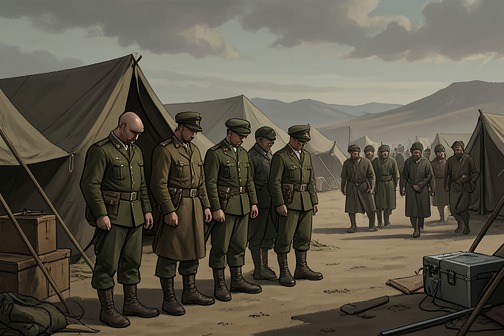
The [Klooga concentration camp massacre](entity:event-recall-event-2b1dafde0274) was a four-day killing operation in September 1944, carried out by [SS](entity:organization-recall-organization-bbcdb0ea06e2) forces as the Soviet Army advanced through occupied [Estonia](entity:location-recall-location-3174b38cc5de). Rather than release the prisoners or leave them behind, the camp’s commander ordered their murder. The massacre killed thousands, and for [Adrián Gallardo Ortega](entity:character-recall-character-adri-n-gallardo-ort-65f564eff7c8), a Spanish soldier assigned to the firing squads, it became the point at which guilt gave way to a self-protective, enduring moral numbness.
## Evacuation and Decision to Kill
As the Soviet advance gathered pace in July and August 1944, the SS began evacuating [Klooga](entity:location-recall-location-klooga-b8e6411e3c62). About five hundred prisoners were transported west by sea to other camps, including Stutthof and a camp in what was then the German city of Freiburg in Schlesien. The evacuation became increasingly difficult as German forces retreated, the front shifted, and transport grew scarce. By mid-September, with Soviet troops close to [Narva](entity:location-recall-location-02240c347dbb), the operation stopped. Hans Aumeier chose not to free or abandon the remaining prisoners, as had happened elsewhere, but to exterminate them.
## The Massacre and the Evidence Left Behind
On 19 September, armed guards surrounded the camp. Prisoners were taken in groups to nearby woods and killed indiscriminately. The executions continued for four days. In the first days, SS personnel forced prisoners to stack the bodies of their murdered companions on pyres and then set them alight. On 23 September, some pyres had been assembled but not burned; after killing the last prisoners, the SS men hurried west with the retreating German forces.
When the Red Army reached Klooga on 28 September, it found eighty-five survivors rather than the 2,400 prisoners believed to have remained after the last evacuation. Some survivors had hidden in barracks; others had escaped during transport. They guided Soviet troops to the sites of the killings. In the woods, soldiers found carefully arranged pyres: rows of bodies face down, interleaved with cut logs laid in regular horizontal and vertical layers. The ordered construction, intended to turn the dead into ash and charred bones, made the violence legible as a methodical operation rather than an uncontrolled outburst.
## Adrián Gallardo at the Firing Line
Adrián took part in the murder of two hundred unarmed people in a single day: one hundred men in the morning and one hundred women in the afternoon. During the executions, the camp guards placed the bodies face down on logs. They brought the women forward in groups, aligned them, and fired. Adrián imagined refusing the order, as Heinrich Beyer had refused to shoot prisoners, but when commanded he loaded, aimed, and shot through successive groups until all one hundred women were dead. He did not cry or pray, and he did not risk his life by resisting.
At midday, the men were given unusually generous food and drink: stewed meat with potatoes, chocolate shared between every two soldiers, and vodka shared between every four. A corporal’s drunken joke about how much good the Jews of Klooga had done for them broke the silence for some of the men. Adrián walked into the devastated woods until he smelled burning flesh, vomited, and sat on a stump. His thoughts raced through his life. He recognized that he wanted to live, even as the example of Beyer’s refusal made him imagine his own death as a possible alternative to becoming a murderer.
That possibility ended when Adrián obeyed [Kleiber](entity:character-recall-character-kleiber-d6064d4f9ff0)’s order and fired on the women. To bear what he had done, he reversed the meaning of the killing in his mind: he decided that the prisoners’ supposed passivity made them responsible for turning him into an assassin. The victims became, in his distorted account, the cruel enemies who had chosen their own deaths. This self-exculpating explanation brought him a fierce exhilaration and released him from the fear and remorse that had troubled him. He understood himself as a murderer, but no longer found the knowledge frightening or repellent; the people and memories that had once judged him seemed to fall silent.
## From Immediate Euphoria to Lasting Impunity
The killing did not end when the firing stopped. On the truck returning to the front, Adrián embraced [Jan Schmitt de Wandaleer](entity:character-recall-character-jan-schmitt-de-wand-d0c70eae4580), saying he loved him and that the two men were now alike and bound together. Jan pushed him away but smiled. The scene makes the violence’s first consequence visible in the perpetrators’ altered fellowship: Adrián’s attempt to turn shared guilt into intimacy met not an embrace but a joking rebuff.
Vodka continued to flow during the return to the front and through the next three days, 20–22 September 1944. Kleiber’s men—soon known by his name within the [III Panzerkorps der SS](entity:organization-recall-organization-iii-panzerkorps-08b8b6ed50ff)—drank at breakfast, meals, and bedtime while helping Klooga’s guards kill roughly 550 prisoners a day, including 400 assigned to their unit and 1,200 in total. Jan stopped repeating that the victims were not human at every volley. Adrián still knew they were human, but that recognition no longer restrained him.
On 23 September, the group withdrew from the Narva front with the retreating German forces. Their sudden drunken exhilaration dissipated at the border. They did not speak openly about the forest, but fear returned in recurring questions: had the Soviet Army reached Klooga, found the bodies, or discovered survivors? Some tried to reassure themselves that survivors would not recognize German insignia. The reassurance lasted only days, then hours, before the questions began again.
Adrián remained silent through these conversations. He understood that his companions feared eventual defeat and exposure, and that the prospect of a final German defeat deepened their anxiety. He did not share their agitation, imagining that it belonged to another Adrián: the once-innocent grandson of Don Carlos Garrote whom he could scarcely remember. Yet he privately expected that the perpetrators would eventually be identified. The pyres might be found, or a prisoner might speak; someone could recite names, and he would not be mistaken for another man, since he was the group’s only Spaniard.
He nevertheless continued to fight through [Latvia](entity:location-recall-location-2550659298f2), [Lithuania](entity:location-recall-location-a3372cb02a13), [Poland](entity:location-recall-location-8e143713a3f3), and [Germany](entity:location-recall-location-a3c24dd56e42) in the final months of 1944 and the opening months of 1945, as if combat could postpone a death he believed he deserved. He had chosen [Berlin](entity:location-recall-location-769cdeac2511) as the place to die, the last point in a retreat that, in his imagination, would bring his body into alignment with the deadened state of his spirit. Klooga had remade him not simply as a killer, but as someone who could no longer imagine a country, a home, or a life to return to.
## Historical Record and Continuing Significance
The novel sets the massacre’s immediate scene of complicity against the evidence by which it could later be reconstructed. In the narrative, Kleiber is accused of recruiting men who took part in the extermination of more than two thousand Jews at an Estonian camp and of killing a German soldier who refused his orders. He insists that his subordinates volunteered, including the man he executed, and offers to identify them. His account exposes the chain of participation while also presenting a perpetrator’s self-serving claim about responsibility. The number in that accusation is larger than the roughly 2,400 prisoners believed to have remained after Klooga’s final evacuation, underscoring how the novel’s later inquiry encounters crimes through imperfect testimony and records as well as through the scene itself.
The massacre’s aftermath is framed not as a completed atrocity but as a question of discovery, identification, and accountability. Survivors guided Soviet troops to the pyres, where the arrangement of bodies and logs preserved evidence of deliberate, organized killing. The fleeing perpetrators, meanwhile, repeatedly wondered whether the dead would be found and whether any survivors could identify them. The contrast is stark: the perpetrators hoped that insignia would obscure who had carried out the murders, while the surviving witnesses and physical remains made concealment uncertain.
For Adrián, the forest becomes the dividing line between the person he had been and the identity he chooses to inhabit afterward. He believes the crimes will eventually be exposed, yet this expectation does not lead him to acknowledge responsibility publicly or seek forgiveness. Instead, he treats his Spanish identity as a detail that will make him easier to identify and fights on toward Berlin, imagining death as the only fitting end. The narrative thus links a documented mass killing to a private moral transformation without confusing the two: the victims’ destruction is the historical crime, while Adrián’s rationalization records how a perpetrator makes continued participation psychologically possible.
## Consequences and Aftermath
The massacre continued beyond the four days at Klooga through the perpetrators’ effort to imagine what might follow. On 23 September, as Kleiber’s men withdrew from the Narva front, their exhilaration gave way to unease. They avoided speaking plainly about the forest, yet repeatedly asked whether Soviet forces had reached the camp, whether the bodies had been found, and whether anyone had survived. Some reassured themselves that Baltic Jewish survivors would not recognize German insignia. At first that comfort lasted several days; soon it lasted only hours before the same questions returned.
Adrián did not join these conversations. He understood that his companions feared defeat and exposure, but felt detached from the fear that had unsettled the man he had once been. He nevertheless believed that the killings would eventually be traced: the pyres might be discovered, a prisoner might identify the perpetrators, and he could not be mistaken for someone else, since he was the group’s only Spaniard. His expectation of accountability did not restore remorse or prompt confession. He fought on through Latvia, Lithuania, Poland, and Germany, believing that he deserved death and trying to delay it until Berlin, where he intended to complete his retreat toward a state in which body and spirit would both be dead.
Later testimony gives the crime another, compromised route into view. Kleiber was accused of recruiting men who participated in the extermination of more than two thousand Jews at an Estonian camp and of murdering a German soldier who refused his orders. He maintained that all his subordinates, including the executed soldier, had volunteered, and offered to identify them. His account points toward the participation of the unit while making responsibility itself a contested part of the record. The survivors’ guidance and the pyres provided physical traces of the murders; the perpetrators’ anxious speculation revealed how uncertain they were that those traces could be concealed.
The episode connects mass violence with the manufacture of moral evasion. Adrián knows that the victims were human, yet rationalizes their murder by blaming them for his own transformation and continues fighting without fear of himself. The survivors, the ordered pyres, and the perpetrators’ fear of identification resist that private fiction: the massacre remains a crime whose evidence and witnesses outlast the moment in which its participants try to silence their consciences.
## Evidence, Identification, and Accountability
The later investigation gives the massacre another, compromised route into view. Kleiber was accused of recruiting a group of men who participated in the extermination of more than two thousand Jews at an Estonian camp, and of killing a German soldier who refused to obey his orders. He insisted that all his subordinates had volunteered, including the soldier he had executed, and offered to identify them. His account exposed the chain of participation while making responsibility itself contested: even as he named the men, he presented their service as their own choice. The accusation’s figure exceeds the roughly 2,400 prisoners believed to have remained after Klooga’s final evacuation, a discrepancy that underscores how the novel’s later inquiry must work through imperfect testimony and records.
## Moral Evasion and the Record of the Crime
The episode connects organized mass violence with the means by which its participants evade responsibility. Adrián knows that the prisoners are human, but convinces himself that their supposed passivity makes them responsible for his becoming a murderer. This reversal gives him a fierce, temporary exhilaration; he accepts the name of murderer without fear or revulsion, and the voices and memories that once troubled him fall silent. The change does not erase his awareness that the killings will one day have a reckoning. He expects the pyres or a survivor to expose the perpetrators, and knows that, as the group’s only Spaniard, he will be identifiable. Yet anticipated exposure does not restore remorse: he continues to fight, believing he deserves death and fixing on Berlin as the place where his body might finally match his deadened spirit.
The massacre’s later reconstruction also comes through testimony shaped by the struggle over blame. Kleiber was accused of recruiting men for the extermination of more than two thousand Jews in an Estonian camp and of killing a German soldier who refused his orders. He maintained that his subordinates had volunteered, including the soldier he had executed, and offered to identify them. His account could name participants while framing their actions as their own choice. Against this contested testimony stand the survivors who guided Soviet troops to the killing sites and the carefully built pyres, physical traces of deliberate murder. The perpetrators’ repeated questions about whether survivors could identify them show that concealment remained uncertain even as they tried to reassure themselves otherwise.
## Evidence, Identification, and Accountability
The massacre’s later reconstruction also comes through testimony shaped by the struggle over blame. Kleiber was accused of recruiting men for the extermination of more than two thousand Jews in an Estonian camp and of killing a German soldier who refused his orders. He maintained that his subordinates had volunteered, including the soldier he had executed, and offered to identify them. His account could name participants while framing their actions as their own choice. Against this contested testimony stand the survivors who guided Soviet troops to the killing sites and the carefully built pyres, physical traces of deliberate murder. The perpetrators’ repeated questions about whether survivors could identify them show that concealment remained uncertain even as they tried to reassure themselves otherwise.
Event 31
Allied entry into the German Embassy in Madrid
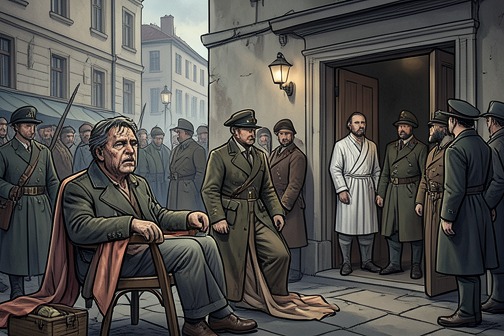
[Allied entry into the German Embassy in Madrid](entity:event-recall-event-17511af6ea75), on June 5, 1945, ends not in the recovery of Nazi diplomatic records or treasures but in an encounter with [Hans Lazar](entity:character-recall-character-hans-lazar-bdc10f3f12a4), the regime’s indispensable [Madrid](entity:location-recall-location-madrid-8acd4123f416) operative. Nearly a month after [Berlin](entity:location-recall-location-769cdeac2511)’s capitulation, Allied representatives reached an embassy emptied of its contents; Lazar greeted them in a silk dressing gown and said he lived there. The Allies’ only spoil, the narrative concludes, was his smile.
## Background and Delay
Lazar’s importance to the [Third Reich](entity:time-recall-time-f3c47f5ce6a4)’s embassy in Madrid had extended through the war and beyond it. The book presents him not as a functionary whose influence ended with [Germany](entity:location-recall-location-a3c24dd56e42)’s defeat, but as the central, irreplaceable figure in the embassy’s operations. In that light, the Allied entry is the final act of a longer contest over what could be found, proven, and recovered from the German presence in [Spain](entity:location-recall-location-0fe76f866976).
The representatives did not enter as soon as Berlin surrendered. Francoist authorities delayed access with a succession of bureaucratic obstacles, putting off the moment until the latest possible deadline. By the time the Allies crossed the threshold on June 5, almost a month had passed since the capitulation of Berlin. The delay matters because the embassy’s condition made the difference between an inspection that might yield evidence and one that confronted only absence.
## An Embassy Stripped Bare
The building seemed to have been looted. No documents or records remained, and neither money nor gold could be found. The antiques and artworks that had decorated the rooms only days earlier had disappeared; the safes were empty, the walls bare, and even the furniture was gone. The inventory of missing things expands the scale of the absence: the Allies did not merely find an office whose papers had been removed, but a diplomatic residence stripped of its contents.
That emptiness gives the scene its stark reversal. An embassy is expected to preserve the instruments of its work—records, valuables, the material traces of official presence. Here, after the German defeat, the premises offer none of them. The narrative supplies no account of who removed each item or where it went, so the emptied rooms cannot by themselves establish the fate of every missing object. What they do establish is that the Allied representatives arrived too late to find the collection that had occupied the building just days before.
## Lazar’s Encounter with the Allies
The sole figure the Allies found inside was Lazar. He came down a corridor wearing a silk dressing gown, an incongruously private appearance in the emptied seat of a defeated state’s embassy. When asked who he was and what he was doing there, he smiled, identified himself, and explained that there was nothing particular he was doing: the building was his private residence.
His answer makes domestic possession a shield against the political meaning of the visit. The embassy had been the setting of his work for Nazi Germany, yet he presented himself not as an official encountered at the end of a regime, but as a resident in his own home. The account does not describe an arrest or a confrontation. Instead, the scene closes on Lazar’s composure: for all the Allies’ effort to reach the building, his smile was their only booty.
## Consequences and Narrative Significance
The entry joins two forms of evasion. Outside, Francoist officials had postponed Allied access through bureaucratic obstruction; inside, the missing documents and property left the visitors with no material record of what the embassy had held. Lazar’s presence then sharpened the paradox: the operative who had served the Third Reich remained at the scene, while the objects that might have testified to its activity were gone. The episode depicts the postwar transition not as a clean transfer of power or evidence, but as a moment in which access came only after the traces had vanished.
Its ending is deliberately concentrated in a single, almost weightless image. The Allies find no archive, treasure, or furniture—only Lazar, wrapped in silk, answering their question with a smile. That smile cannot replace the missing records or explain the removal of the embassy’s contents. Its force comes from the contrast between the scale of what is absent and the ease with which Lazar asserts his right to remain. The event thus gives the embassy’s disappearance a human face without pretending that the encounter resolves the unanswered questions it leaves behind.
Event 32
Hans Aumeier's postwar trial and execution
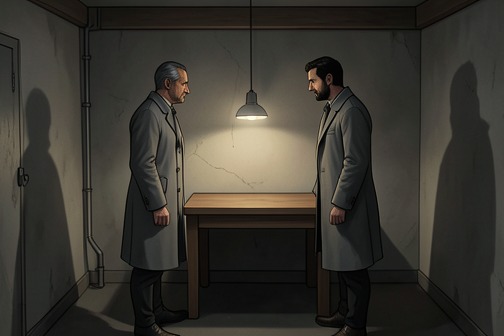
Hans Aumeier’s postwar trial and execution brought a formal judgment for his crimes at [Auschwitz](entity:location-recall-location-548373df0ac9), but not for the massacre at [Klooga](entity:location-recall-location-klooga-b8e6411e3c62), where he had also been implicated. Captured after the war, extradited to [Poland](entity:location-recall-location-8e143713a3f3), and tried in [Kraków](entity:location-recall-location-d7d3402420b5), he denied the existence of gas chambers and cast himself as a scapegoat for [Germany](entity:location-recall-location-a3c24dd56e42)’s defeat. His execution closed the legal proceedings against him while leaving one of the crimes associated with his command outside the case.
## Capture and Extradition
On 11 June 1945, Aumeier was himself a prisoner at Terningmoen when he was arrested following the British Secret Intelligence Service’s capture of [Gestapo](entity:organization-recall-organization-94416ae64d32) files. The files connected him to the postwar reckoning, turning documentary evidence seized by the Allies into the basis for his detention.
In 1946, he was extradited to Poland. The prosecution concerned his conduct at Auschwitz, where his crimes would determine both the scope of the trial and, ultimately, what it did not address.
## Trial and Sentence
Aumeier was tried as a war criminal between November and December 1947. He pleaded not guilty, denied that gas chambers existed at Auschwitz, and claimed that he was being made a scapegoat for Germany’s defeat. His defense thus combined denial of the camp’s killing apparatus with an assertion that responsibility for the defeated regime was being displaced onto him.
On 22 December 1947, the court sentenced him to death. He was hanged on 28 January 1948 in a prison in Kraków. The short interval between sentence and execution gave the proceedings a definitive legal ending, but did not extend the judgment to every crime associated with his wartime record.
## The Klooga Crime Left Outside the Case
Aumeier’s crimes at Auschwitz prevented him from being tried for the [Klooga massacre](entity:event-recall-event-klooga-massacre-856fafa53f4d). The result was a stark distinction between the crimes that formed the basis of his prosecution and those that remained untried: the Auschwitz case brought a death sentence, while the Klooga killings received no separate judgment against him.
That omission is especially grave in the book’s account of Klooga. After the camp’s discovery, soldiers encountered carefully arranged pyres: rows of bodies laid face down, layered with cut logs in alternating horizontal and vertical courses. The arrangement exposed mass murder organized with industrial efficiency, yet Aumeier’s subsequent conviction for Auschwitz did not provide a trial for that massacre. His execution therefore marks both accountability and its boundary: he was condemned for one field of crimes, while another remained outside the case.
Event 33
Klooga massacre
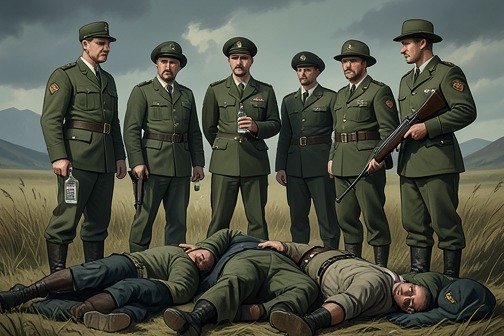
The [Klooga massacre](entity:event-recall-event-klooga-massacre-856fafa53f4d) was the mass killing of prisoners at the [Klooga](entity:location-recall-location-klooga-b8e6411e3c62) concentration camp in [Estonia](entity:location-recall-location-3174b38cc5de) in September 1944, carried out by camp guards with assistance from [SS](entity:organization-recall-organization-bbcdb0ea06e2) troops under [Kleiber](entity:character-recall-character-kleiber-d6064d4f9ff0). The killings expose the violence concealed by the perpetrators’ ideology and the terror that follows when retreat makes accountability seem possible: even as the men try to reassure one another that no witness can identify them, the massacre travels with them as a haunting prospect of discovery.
## The killings and the retreat
For three days, 20–22 September 1944, Kleiber’s men drank vodka from breakfast through bedtime while helping the Klooga guards murder prisoners. The novel gives an approximate scale of about 550 prisoners killed each day, including 400 attributed to the SS men’s part in the operation—1,200 in total. [Jan Schmitt de Wandaleer](entity:character-recall-character-jan-schmitt-de-wand-d0c70eae4580) stopped repeating that the victims were not human before every volley; [Adrián Gallardo Ortega](entity:character-recall-character-adri-n-gallardo-ort-65f564eff7c8) remained convinced they had never been anything else, but no longer cared. The contrast makes plain that recognition alone did not prevent participation.
On 23 September, the men withdrew from the [Narva](entity:location-recall-location-02240c347dbb) front with the remains of the German eastern army. Their retreat was orderly, but the Soviet pursuit and the recent killings gave the movement a different destination in their minds: [Berlin](entity:location-recall-location-769cdeac2511). The exuberant embraces and laughter of the journey to and from the camp did not survive the border. The drunken celebration that had accompanied the killings dissolved as they left Estonia.
## Fear, denial, and complicity
After the retreat, the men periodically asked whether the Russians had reached Klooga, found the bodies, or discovered any survivors. Some reassured themselves that Baltic Jewish prisoners would not have recognized German military insignia and therefore could not identify their killers. At first, that explanation quieted them for days; later it worked for only hours before the questions began again. Their recurring need for reassurance reveals the fragility of their attempted concealment: they could neither undo what they had done nor establish that the evidence and witnesses had disappeared.
Gallardo did not join these conversations. He understood that the others’ questions were driven by fear, which the prospect of [Germany](entity:location-recall-location-a3c24dd56e42)’s defeat intensified. He expected that someone would eventually uncover the pyres or that a prisoner would speak; someone, perhaps Kleiber himself, might recite names and numbers. As the only Spaniard in the group, Gallardo believed he would not be mistaken for anyone else. He thought he deserved death and fought through [Latvia](entity:location-recall-location-2550659298f2), [Lithuania](entity:location-recall-location-a3372cb02a13), [Poland](entity:location-recall-location-8e143713a3f3), and Germany to postpone it, not to escape the guilt attached to Klooga.
## Evidence, identification, and aftermath
The novel later recounts that Soviet soldiers found carefully arranged pyres in the nearby woods. Bodies had been laid face down in rows, interleaved with cut logs in alternating horizontal and vertical layers. The systematic arrangement, intended to reduce the dead to ash and bone, stands in stark contrast to the perpetrators’ hope that the forest would conceal the crime.
In a later search for the men involved, Kleiber was accused of recruiting a group that took part in the extermination of more than 2,000 Jewish prisoners at an Estonian camp and of killing a German soldier who refused his orders. Kleiber maintained that the men—including the executed dissenter—had volunteered, and offered to identify them. His account implicated a Spanish former professional boxer who had gone to the Russian front and was regularly accompanied by [Jan Schmitt](entity:character-recall-character-jan-schmitt-75ecceb3a91a). The document left the Spanish man’s name uncertain, recording it as Adrian with a question mark; the novel’s narrator later identifies him as Adrián Gallardo Ortega. This uncertain spelling and punctuation make the search for a perpetrator a matter of documentary recovery as well as memory.
The crimes Aumeier committed at [Auschwitz](entity:location-recall-location-548373df0ac9) prevented him from being tried for the Klooga massacre. The distinction does not lessen the crime; it marks how one perpetrator’s larger record could displace judicial reckoning with another atrocity. At the former camp site, a monolith commemorates more than two thousand innocent people murdered for the simple fact of having been born. The memorial’s public certainty stands against the killers’ private cycle of speculation and denial.
Event 34
Battle of Berlin
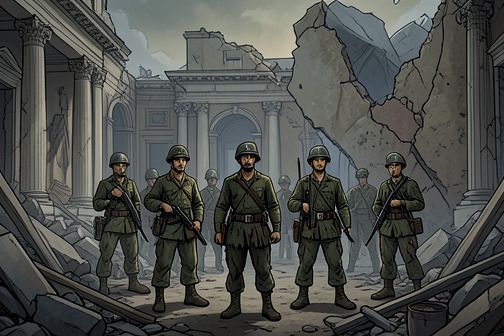
The [Battle of Berlin](entity:event-recall-event-a9cd810fe47e) is the last and most consequential ordeal in [Adrián Gallardo Ortega](entity:character-recall-character-adri-n-gallardo-ort-65f564eff7c8)’s wartime story: amid the city’s collapse, he abandons his own identity, surrenders under [Alfonso Navarro López](entity:character-recall-character-alfonso-navarro-l-p-c83845fb86be)’s papers, and leaves behind a body whose absence will complicate the search for him. The novel presents the battle not as a single heroic tableau but as a drawn-out experience of bombardment, hunger, exhaustion, and compromised loyalties. Its ending converts battlefield survival into a postwar mystery: Adrián is reported as a defender of [Berlin](entity:location-recall-location-769cdeac2511), yet the person who emerges with Navarro’s documents cannot safely claim his own name.
## The City’s Last Defensive Ring
The final phase of the fighting closes around a small group of defenders stationed in a damaged palace on [Unter den Linden](entity:location-recall-location-7e5b8c317a39). They spend a week clearing rubble from the building so they can occupy it, even as its fragile walls seem likely to collapse in another air raid. Their commanders dismiss the prospect of a further bombardment. The expectation that Soviet ground forces will soon overrun the city makes an air attack seem wasteful, but the defenders’ assumptions prove wrong: on 10 April, more than twelve hundred Soviet aircraft strike the remaining Nazi stronghold in a mass raid that makes the already devastated city look newly ruined.
Before the Soviet infantry reaches the city’s final defensive ring, the soldiers’ routine is defined by waiting. Food is scarce, and their officers permit them to spend much of the time sitting inside or among rubble in the garden. To prevent desertion, the men are confined to their compound, where idleness becomes almost as oppressive as the approaching enemy. Adrián and [Jan Schmitt](entity:character-recall-character-jan-schmitt-75ecceb3a91a) pass the time together, set apart from the desperate fighting in Berlin’s outer districts. On 24 April, the familiar warning that the Soviets are here finally proves true: beyond the last ring, there is only Berlin, and within Berlin, only the defenders.
A colonel addresses the men from a table, urging them to defend the city street by street and house by house, and presenting their deaths as a sacrifice that future generations will honor. The scene exposes the gap between the language of heroic resistance and the condition of the soldiers expected to enact it. Adrián, twenty-eight but feeling old, registers the tears of the colonel and his companions without sharing their fervor. [Klooga](entity:location-recall-location-klooga-b8e6411e3c62) has left him unable to feel much beyond physical sensations such as hunger, thirst, heat, and cold. He understands the solemnity of the speech but sees its glory and honor as theatrical decoration over a dirty, certain defeat. He expects to die in a foreign land for a cause that is not his, and believes that surrender will not spare him from eventually paying for what happened in [Estonia](entity:location-recall-location-3174b38cc5de).
## Bombardment, Hunger, and Defeat
The destruction of the palace turns the men’s precarious shelter into a death trap. During the 10 April raid, Adrián is wounded and suffers a broken bone. At an improvised aid post beside hospital ruins, a doctor sets the bone, treats the wound, and places his arm in a sling. Jan’s companion Lazlo returns with two aspirins requisitioned at gunpoint; the doctor advises Adrián to take one and save the other. The incident is small beside the scale of the bombing, but it captures the shrinking terms of survival: medical care, a little bread, and whatever can be taken from the ruins.
The men have eaten no more than pieces of bread scavenged from a bakery being looted by a crowd. Their comrades have gone hungry, too, and the bombs have buried the palace kitchen. No one remembers the survivors until the following morning, when they are distributed among other barracks in buildings just as ruined. Inactivity, hunger, and boredom begin again. The military collapse is thus experienced less as a clean sequence of advances and retreats than as a cycle of confinement, inadequate food, damaged shelters, and orders delivered to men who have little control over what comes next.
On 1 May, the defenders prolong their resistance for another twenty-four hours, preventing the Soviet celebration of the holiday with Berlin’s capture. The next day, a Soviet tank points its cannon directly at Adrián’s position in a shell crater on Wilhelmstrasse. He emerges with his arms raised, but he does not surrender alone: he carries the identity papers of Alfonso Navarro López and leaves Navarro’s corpse undisclosed to the occupying soldiers. The act turns the military defeat into a personal deception. Adrián survives the immediate danger by letting the documents speak in place of his own identity.
## Adrián, Jan, and the Identity Exchange
Adrián’s change of identity is inseparable from his relationship with Jan and [Agneta Müller](entity:character-recall-character-agneta-m-ller-765ffbc5342a). In the final days, he is also dealing with the possibility that Jan and Agneta’s attachment has made him an outsider. He understands that Navarro had misread Agneta: she did not choose Jan because of his race, skin, or surname, but because of the love Adrián lacked. Yet the recognition does not undo the emotional force of the rivalry or explain away the violence that follows. When Adrián shoots Navarro, the act is not presented as a calculated punishment for being wrong, nor simply as revenge for the fear and jealousy Navarro represented. At that instant, Adrián is consumed by a love that leaves no room for any other feeling.
He tells himself he must cease to be Adrián if he is to have any chance with Agneta after the war. The victory of the Allies will reduce the old slogans and fervor to ashes, but that prospect does not immediately release him from what he has done. He no longer wants to die before he has kissed Agneta or experienced the intimacy he has imagined with her; at the same time, he believes his presence at Klooga will sooner or later exact a price. Others, including [Kleiber](entity:character-recall-character-kleiber-d6064d4f9ff0) and the men who served under him, can also be identified with the crimes there. The papers offer Adrián a way to evade recognition, not a way to erase responsibility.
The exchange also alters the meaning of surrender. Adrián raises his arms when the Soviet tank confronts him, but he conceals the dead man whose name he has taken. His survival depends on the discrepancy between the person the occupiers see and the person who has emerged from the crater. The novel makes this a decisive reversal: a fighter who had accepted death as the end of his obligation now has a reason to live, but the life he seeks is possible only through another man’s identity and a concealed death.
## Aftermath and the Missing Man
After the war, the identity exchange makes it difficult to establish what happened to Adrián. A report associated with Kleiber’s case describes the extermination of more than two thousand Jewish prisoners in an Estonian camp and the murder of a German soldier who refused to obey orders. Kleiber maintains that his subordinates volunteered, including the man he executed for insubordination, and offers to identify them. The first person implicated is a Spanish professional boxer who went to the Russian front and was often seen with Jan Schmitt, a man with a Flemish first name and German surname who was born in [South America](entity:location-recall-location-93067fb0ae2c). In the attached list, Jan’s name carries a question mark; the final entry is a Spanish-sounding first name, Adrian, also marked as uncertain.
The postwar search cannot turn that uncertain listing into a confirmed fate. Meg begins checking the lists held by the Allied Control Council in [Spain](entity:location-recall-location-0fe76f866976), but Adrián is not recorded as wounded, a fugitive, a prisoner, or an officially registered missing person. The last known fact is that he took part in Berlin’s defense. He seems to have vanished. The records’ silence is not proof that he died; it is the consequence of a life lived under a borrowed name, with no body or document that reliably joins the battlefield survivor to Adrián Gallardo Ortega.
The uncertainty persists because the people around the assumed identity have their own reasons to keep moving between names and places. Agneta hides Jan in a storeroom when she returns to her family on 30 April. After the German capitulation, her father agrees to help, on the understanding that Jan is an ordinary soldier without criminal responsibility; Agneta can truthfully say that she knows nothing about Klooga. Jan enters the household and works at repairs, while concealing the number of his Argentine passport from prospective employers. The household’s sheltering of him and his continuing connection to clandestine associations show how the defeat of the regime does not simply end the political world that shaped the battle.
Years later, Adrián’s presumed story reaches Spain through a protector who believes he has returned. Don [Antonio Ochoa](entity:character-recall-character-antonio-ochoa-1e1d925155de) welcomes him as a hero who defended Berlin to the end and says the Allies are searching for him. He has heard that the man intends to go to [Buenos Aires](entity:location-recall-location-caf56b79d5c4), based on information linked to Jan and Messerschmidt. But this account belongs to the person using Adrián’s identity. The real Adrián realizes that someone has used his name to emigrate to [Argentina](entity:location-recall-location-27e2c37f5c3d) while he was living in Schöneberg under another man’s identity. He says nothing, recognizing that for the moment he can use two identities as if he were playing with two decks of cards.
## A Battle That Continues After Surrender
Berlin’s fall therefore produces no clean return from war. In the novel, military defeat opens onto a longer struggle over names, culpability, and protection. Adrián’s papers give him a chance to survive the Soviet occupation, but they also make the postwar record unreliable and allow another person to occupy the life attached to his name. The missing body of [Alfonso Navarro](entity:character-recall-character-0a9dcf648ac2) and the unverified listing of Adrian are joined by the later confusion in which a supposed Adrián is welcomed as a returning hero.
The battle’s emotional center is the contrast between public narratives of sacrifice and the compromised private acts that follow. The colonel promises future glory; Adrián hears a performance masking an ugly end. He surrenders rather than dying under the prescribed slogan, but his survival requires concealment, and it does not settle the debt he associates with Klooga. The final image of Berlin is thus not only the tank on Wilhelmstrasse or the raised hands of a defeated soldier. It is the uncertain record left behind when one man lives under another’s name, allowing the war’s violence and its consequences to persist in the postwar world.
Event 35
Soviet air raid on Berlin, 10 April 1945
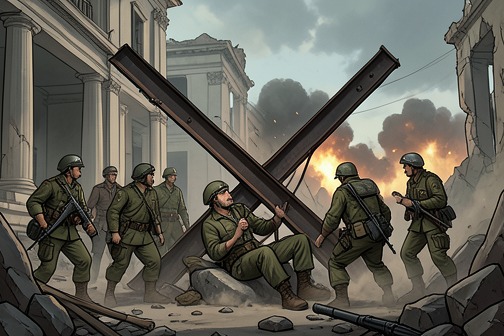
The [Soviet air raid on Berlin, 10 April 1945](entity:event-recall-event-1945-4-10-31da1db67515), is the final mass bombing of the [Third Reich](entity:time-recall-time-f3c47f5ce6a4)’s last stronghold in the novel. More than 1,200 Soviet aircraft strike a city already seemingly reduced to ruins. For Adrián Gallardo, quartered with his unit in a damaged palace on [Unter den Linden](entity:location-recall-location-7e5b8c317a39), the attack makes defeat suddenly physical: the building collapses around him, and he survives only because a fallen iron beam shelters him long enough for Lazlo and [Jan Schmitt](entity:character-recall-character-jan-schmitt-75ecceb3a91a) to reach him.
## The exposed refuge
The soldiers have spent a week in a palace that has withstood earlier bombing better than most buildings on Unter den Linden. Their first task is to clear rubble from its floors so the unit can occupy the space. As they work, the walls shed dust and stones at the slightest touch; the men recognize that another air raid could turn the palace into a tomb. Their commanders, watching them work and smoking calmly, dismiss the prospect of a further attack.
That confidence rests on an assumption the soldiers cannot safely voice: Soviet infantry is advancing so rapidly, and outnumbers the defenders by so much, that Stalin would have little reason to spend aircraft on [Berlin](entity:location-recall-location-769cdeac2511) when a ground assault is imminent. The raid overturns that calculation. The narrative identifies the leadership’s willingness to strike despite the approaching land offensive as an expression of Stalin’s refusal to forgive, and presents the bombing as a simultaneous assault on the Reich’s last refuge.
## The strike and the collapse
By 10 April, the defenders’ position has already become a waiting game. Food is scarce, and the unit’s leaders let the men spend much of their time sitting inside the quarters or outdoors among heaps of garden rubble. To prevent desertions, they forbid the soldiers to leave a compound from which nobody else is allowed to enter. The men experience the Soviet advance as an agonizing delay: the enemy seems at the gate, yet never quite arrives. Adrián and Jan pass the time talking, detached from the desperate fighting on Berlin’s outskirts.
Then the palace comes down before the men can distinguish the sound of one explosion from another. The impact throws Adrián to the floor. A large iron beam falls into a position whose ends lodge among the rubble, leaving a narrow shelter between him and the wall as it collapses. Trapped in a space he cannot break out of with his hands, Adrián expects a slow death by suffocation, hunger, or thirst. He had wanted to die in Berlin, but not buried alive beneath a building, without heroism or any certainty about how long the end would take. He screams for help in every language he knows.
## Rescue and reversal
Lazlo, the Hungarian volunteer who had been with Adrián at [Klooga](entity:location-recall-location-klooga-b8e6411e3c62), answers first; Jan’s voice soon joins his. Together they open a gap, climb down, pull Adrián from beneath the beam, and haul him to the surface. The rescue reverses the scene’s apparent outcome: the same collapse that seems to have sealed Adrián’s fate has left him a chance of survival, while the two men who reach him make that chance real.
Jan explains his own fortunate absence from the palace’s destruction in crude, comic terms. He had gone down to the basement latrines because of the chronic constipation that had tormented him since childhood; after six days without relief, the urge arrived just as the Soviet attack began. His bodily misfortune becomes the circumstance that saves him from the building, sharply contrasting with Adrián’s life-or-death entrapment above. The scene sets the ruin of Berlin against an unheroic accident: survival arrives not as a military victory but through a beam’s position, a friend’s voice, and a trip to the toilet.
## Significance in the narrative
The raid strips away the orderly expectations of the soldiers’ commanders and exposes the vulnerability of the palace they have made into a barracks. It also brings Adrián face to face with the death he believes he has been waiting for, only to deliver it in a form he neither wanted nor could control. His rescue does not erase the defeat surrounding him; it carries him forward from one catastrophe into the postwar struggle for survival. In miniature, the episode makes the novel’s contrast between heroic accounts of war and the contingent facts of staying alive unmistakable.
Event 36
Korczyna pogrom (1919)
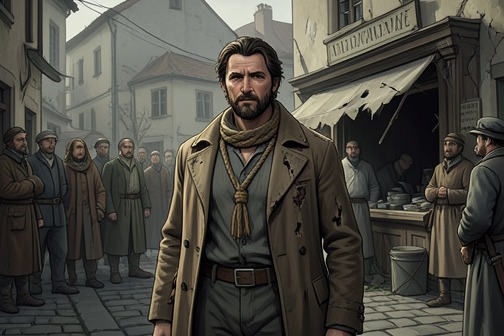
The [Korczyna](entity:location-recall-location-511f90146586) pogrom of 1919 was the defining catastrophe in [Sal Burnstein](entity:character-recall-character-sal-burnstein-67e1ec897e9f)’s family history: a mob led by Polish army officers murdered his father, [Abraham](entity:character-recall-character-727d149fb3ed), and the violence dispersed a family whose surviving members would be devastated by the Holocaust. Recalled through a family photograph and the few who escaped, the pogrom links private bereavement to the larger history of antisemitic violence and mass displacement.
## The attack in Korczyna
Abraham Burnstein was religious, orderly, and neither a Polish patriot nor sympathetic to the revolutionaries who had overturned the Russian Empire. Those distinctions offered no protection. A group of Polish army officers used the allegation that [Galicia](entity:location-recall-location-c547828ba2f6)’s Jews were supporters of the Soviets and enemies of Polish independence as a pretext for the pogrom. The mob wrecked Abraham’s shop, dragged him through the streets, and hanged him in a Korczyna square while onlookers applauded. His attackers did not bother to ask what he believed.
The violence fell on a family already spread across several places. Abraham’s eldest son, Elyahu, had emigrated to the [United States](entity:location-recall-location-5d55e9152db1) in November 1918 after returning from the war and learning that his fiancée had married someone else. Abraham’s daughters were away from home on the night of the pogrom: Agar lived in [Kraków](entity:location-recall-location-d7d3402420b5), Rebeca in [Warsaw](entity:location-recall-location-a2daecdb29f1), and Linka with her mother. Their absence spared them from being found in the family home, though the narrative offers no certainty about what would otherwise have happened. Sal’s recollection imagines that the attackers might have raped them instead of killing Abraham, and that Abraham would not have survived the added grief.
## The photograph and the survivors
On 12 April 1919, a family gathering in the Burnsteins’ Korczyna dining room was recorded in a photograph. Sara sits at the center beside the guest of honor; other relatives pose around the table, including Efraim, David and his wife with a baby, Linka, and Abraham’s older daughters with their husbands and children. The picture’s inscription, written in Sal’s mother’s hand, gives the date and place. Nearly three decades later, Sal still turns the photograph over to read it, and the image remains his way of finding himself in a family history broken by violence.
Of the sixteen people in the photograph, only two were alive by 21 May 1946. The pogrom killed Abraham; the catastrophe that followed the family’s dispersal claimed most of the others. Agar, David, and their relatives died at [Plaszów](entity:location-recall-location-523fc5422ef8); Moshe, Linka’s husband, died in the [Warsaw Ghetto](entity:location-recall-location-073177ac5f30); Rebeca and her family, as well as Linka and hers, died at [Auschwitz](entity:location-recall-location-548373df0ac9). The three Burnstein brothers who crossed the Atlantic were the only survivors from Korczyna. Elyahu’s earlier emigration and Efraim’s later decision to accept his brother’s offer and leave for America carried consequences far beyond their original circumstances.
## Sal Burnstein’s life after the pogrom
Sal’s survival in the United States depended on that chain of departures. Efraim waited until Sal’s Bar Mitzvah before taking him with him to America. The book makes the counterfactual stark: without Efraim’s decision to emigrate, Sal would have remained in Europe and, like his mother and many of his siblings and relatives, might have died in a concentration camp. Instead, he became a Democratic congressman representing the American people. The pogrom is therefore not only the loss at the beginning of his family’s story; it is also the event against which his later political identity and American life are measured.
The photograph turns that history into something Sal can hold and revisit, but it cannot restore the people missing from it. His father’s murder and the later deaths of relatives make survival inseparable from absence: the family image preserves a moment of togetherness, while its small number of living subjects records how nearly the family was erased. The pogrom’s significance in the novel rests in that tension between a particular act of antisemitic violence and the long, unequal aftermath that determines who can remember it.
Event 37
Invasion of the Aran Valley by Spanish Communist forces
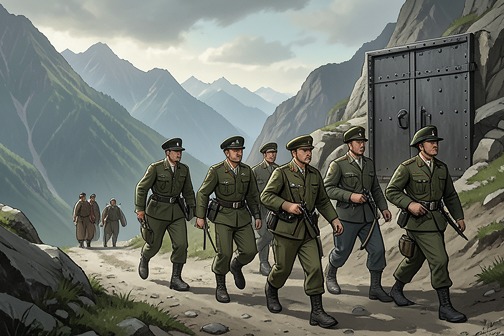
The [Invasion of the Aran Valley by Spanish Communist forces](entity:event-recall-event-468e2713b029) was a failed 1944 incursion organized by Jesús Monzón’s clandestine network and the [Unión Nacional Española](entity:organization-recall-organization-uni-n-nacional-e-ef70866112d2). Its aim was not merely to cross the [Pyrenees](entity:location-recall-location-bca267e59698): Monzón hoped to unite democratic opponents of Franco and prepare for a restoration of the Republic after an Allied victory over the Axis. The brief occupation of the valley exposed the gap between that political hope and the international realities of the postwar settlement. Its failure became a turning point for underground resistance and a charged memory among exiles and later generations of Spaniards.
## Background and political design
In July 1943, Monzón invited [Manuel Arroyo](entity:character-recall-character-3296d1a401b2) Benítez to join a clandestine project of democratic unity. He argued that the course of the war had changed after Stalingrad and that, once the Allies defeated the Axis, Franco’s position would be vulnerable. His proposed coalition reached beyond communists: it was to include Basque nationalists, anarchists of the CNT, and non-fascist members of monarchist and conservative circles. Monzón presented national interest as more important than the Communist Party’s immediate interests, and described the Unión Nacional Española as an underground organization that would oppose the dictatorship until democratic forces could return to power.
The invasion grew from that strategic expectation. Monzón’s scheme depended on the belief that an Allied victory would create an opening for domestic opposition to act, and that a broad coalition could give that action political legitimacy. Yet the Republican opposition was already divided. In [Madrid](entity:location-recall-location-madrid-8acd4123f416), the disappearance of Andreu Nin had angered the small POUM community and many anarchists, while socialists were themselves split; socialists and communists found common ground chiefly in supporting the government in [Valencia](entity:location-recall-location-760e70b8ce24) and the [Madrid Defense Council](entity:organization-recall-organization-e616bdf60130). The hoped-for unity of democratic forces therefore had to be built across real factional fractures, not presumed as an existing alliance.
## The incursion and its immediate aftermath
The invasion followed months of clandestine organizing and discussion of moving forces across the Pyrenees. In September 1944, Monzón’s associates spoke of the possibility of an incursion into Spanish territory; twenty days later, the Unión Nacional’s army occupied the Aran Valley. The narrative gives the occupation as a sudden, concentrated event, but its brevity is made clear by what follows: Manuel never saw Monzón again, and the attempt did not produce the uprising or transition its planners had hoped to set in motion.
The defeat also changed how opponents of Franco judged the possibility of intervention. By the postwar period, rumors that Franco had only days left encouraged some Spaniards to imagine taking power once the [United Nations](entity:organization-recall-organization-e95d8c5557b2) supported them. [Pablo de Azcárate](entity:character-recall-character-pablo-de-azc-rate-a0624bf814b0) warned that the communists had learned from the failure of the Aran incursion and trusted the Allies no more than he did. He described a younger group—students from the [Federación Universitaria Escolar](entity:organization-recall-organization-b92486e1938a), anarchists, members of the United Socialist Youth, and unaffiliated anti-Franco activists—as considering an armed revolt in Madrid. In his view, such a rising risked becoming a massacre rather than a democratic transition. The memory of Aran thus served as a practical warning against treating international sympathy as a promise of military support.
## Monzón, his network, and the changing stakes
A detailed report received by Azcárate in late October 1946 reconstructed the clandestine Communist organization in Madrid under Monzón’s direction. It described preparations for the failed Aran invasion from inside [Spain](entity:location-recall-location-0fe76f866976), Monzón’s contacts with regime dissidents and representatives of other illegal parties, the meetings that produced the short-lived Unión Nacional Española, and the organization’s underground work in the capital. It also recorded the collapse of Monzón’s leadership and reprisals by the Communist Party leadership after its return from Moscow. The political consequences reached into private life: the report explained that Guillermo had lost the only friend he had in Madrid.
The invasion’s defeat did not erase the infrastructure built around it. The report particularly drew Azcárate’s attention to clandestine medical work: pharmacies supplied medicines to underground doctors, injured activists received care, and assistance extended to prisoners’ families and other people without resources. The source was a clandestine physician who had saved Manuel’s life after he was shot outside the gate of [El Pardo](entity:location-recall-location-0ec67d8830f2). In this way, the episode’s legacy appears not only in military failure or political recrimination, but also in the everyday support systems that sustained opposition under repression.
## Memory, exile, and significance
Years later, the invasion remained part of the political and emotional landscape of exile. Casa Inés, a restaurant whose reputation drew Spaniards across the Pyrenees, was remembered as a sanctuary of Communist exile, a monument to the Aran invasion, and a gathering place for Republican military men and anti-fascist guerrillas. Its customers included young Spaniards raised under the dictatorship who had not fought in the war. They studied the photographs on its walls, identified themselves as Party militants, and asked to be photographed with veterans. Inés, moved by their admiration, came to imagine that the old defeat might acquire the force of a lasting, perhaps final, victory through the allegiance of a generation born too late to take part in the original struggle.
The novel also identifies [Fernando González Muñiz](entity:character-recall-character-fernando-gonz-lez-m-af159071a4fb) as a Communist military man, an invader of Aran, a clandestine infiltrator in Spain, and a patient of Dr. García. That compressed description connects the incursion to the later world of covert resistance and medical refuge: participation in the failed operation was not a self-contained episode, but one strand in a longer history of clandestine service, danger, and survival. The invasion’s meaning therefore remains double. It was a military defeat that undercut confidence in an imminent Allied-sponsored liberation, yet its memory continued to furnish exiles and younger opponents with a language of resistance and political inheritance.
Event 38
Léon Degrelle's emergency landing in Spain
[Léon Degrelle's emergency landing in Spain](entity:event-recall-event-76c2bd073e51) was the dramatic arrival of one of the most sought-after Nazi collaborators in postwar Europe. On 8 May 1945, one day after the [Third Reich](entity:time-recall-time-f3c47f5ce6a4) surrendered, a Heinkel He 111 carrying Degrelle and three others ran out of fuel and came down in the sea off La Concha beach in [San Sebastián](entity:location-recall-location-df4dc0d605ae). The landing brought an internationally prominent fugitive into [Spain](entity:location-recall-location-0fe76f866976), where Francisco Franco would ultimately shield him rather than surrender him to the Allies or Belgium.
## Flight at the end of the war
Degrelle had been the creator and commander-in-chief of the Walloon Legion, which was integrated into the [Waffen-SS](entity:organization-recall-organization-897b2a4149a8). His standing in the Nazi hierarchy was underscored by the story that Hitler, while decorating him, had said that if he had had a son, he would have wanted him to be like Degrelle. Yet as Allied forces advanced, Degrelle did not head to [Berlin](entity:location-recall-location-769cdeac2511) to defend his father's house. He went instead to Copenhagen, hoping to find a place aboard one of the submarines rumored to be ready to take Hitler's inner circle to [South America](entity:location-recall-location-93067fb0ae2c).
The submarines never crossed the Atlantic. At the naval base, Degrelle was told there was no place for him. That refusal, which might have seemed a final exclusion from escape, proved life-saving: he understood that remaining in Europe meant almost certain death. He protested forcefully until someone offered him the aircraft of Albert Speer, the Reich's Minister of Public Works, who had not left [Germany](entity:location-recall-location-a3c24dd56e42). Degrelle gathered a crew, chose Spain as his destination, and departed without hesitation.
## The emergency landing
The flight ended abruptly when the aircraft ran out of fuel over the coast. On 8 May, the Heinkel made an emergency landing in the sea off La Concha, where its stranded presence on a beach full of astonished bathers made the episode immediately conspicuous. The visual spectacle and Degrelle's standing as Hitler's celebrated adoptive son combined to make him the Allied Control Council's most coveted fugitive during its first period of activity in Spain.
The landing was not merely an escape route's final mishap. It made Degrelle's presence in Spain visible, while placing him within the reach of authorities who could demand his surrender. His choice of Spain, made when the route to the submarines failed, became the beginning of a prolonged refuge. He would never regret that choice.
## From fugitive to protected resident
The episode unfolded amid a wider question of whether Franco's Spain would cooperate with Allied efforts to locate and extradite Nazi-linked fugitives and collaborators. Another prominent arrival was [Pierre Laval](entity:character-recall-character-15ef0570a0b5), the former head of the [Vichy](entity:location-recall-location-bf97abc3c886) collaborationist government, who reached [Barcelona](entity:location-recall-location-fcf889cebf1e) on 2 May, several days before Degrelle. On 30 July, under pressure from [France](entity:location-recall-location-4f282e1af8a7) and wary of offending the victors, Franco handed Laval over. Laval was tried for treason, sentenced to death, and executed in mid-October 1945. The surrender marked the beginning and the end of Franco's cooperation with Allied justice.
Franco took the opposite course with Degrelle. Despite Belgium's repeated demands over the next fifteen years, Spain refused to extradite him and, in 1954, definitively protected him. From then on, although he continued to speak publicly and sign articles under his real name, official records treated him as the Spanish citizen José [León](entity:location-recall-location-637f7c21f2cc) Ramírez Reina. With that identity he founded a construction company and made considerable money from public contracts awarded by the Francoist state.
## Significance
Degrelle's landing became an emblematic instance of how Spain could turn a wartime fugitive's arrival into long-term protection. His eventual status did not rest on simple concealment: the account describes the retrospective grant of Spanish nationality and the creation of authentic documentation for a false identity. The same procedure would be used for decades to shelter other Nazis seeking either a permanent refuge in Spain or a staging point on the way to another country. A plane forced down by empty fuel tanks thus led not to extradition, but to a durable official identity backed by the state.
Event 39
Pierre Laval's extradition to France and execution
[Pierre Laval's extradition to France and execution](entity:event-recall-event-22a718a642ef) was the conspicuous exception that exposed the limits of Francoist [Spain](entity:location-recall-location-0fe76f866976)'s cooperation with Allied justice. Handed over on 30 July 1945 under pressure from [France](entity:location-recall-location-4f282e1af8a7) and amid Franco's concern about antagonizing the victors, the former [Vichy](entity:location-recall-location-bf97abc3c886) leader was tried, sentenced to death, and executed in mid-October. The decision opened and closed Spain's collaboration with Allied justice: it did not become a general policy of surrendering wanted war criminals.
## Background and the fugitives in Spain
Laval, a leading French collaborator and head of the Vichy government from April 1942 until the Allied liberation of France, reached Spain on 2 May 1945, days before [Léon Degrelle](entity:character-recall-character-ba48febc7c6a). His arrival in [Barcelona](entity:location-recall-location-fcf889cebf1e) followed a comfortable flight assisted by José Félix de Lequerica, then Francoist foreign minister, with whom Laval had become friendly while De Lequerica served as Spanish ambassador to Vichy. The assistance and personal connection place Laval's arrival within a political refuge, not simply an accidental crossing of a border.
Degrelle's route to Spain was more dramatic. On 8 May, a day after the [Third Reich](entity:time-recall-time-f3c47f5ce6a4)'s surrender, the plane carrying him made an emergency landing off [La Concha Beach](entity:location-recall-location-7b7e815d40c7) in [San Sebastián](entity:location-recall-location-df4dc0d605ae) after running short of fuel. He had left Oslo in an aircraft belonging to Albert Speer after failing to secure a place on a submarine rumored to be taking Hitler's inner circle to [South America](entity:location-recall-location-93067fb0ae2c). The beach landing made the Belgian leader of the Walloon Legion, part of the [Waffen-SS](entity:organization-recall-organization-897b2a4149a8), the Allies' most coveted fugitive in Spain during the early period of their efforts there. The contrast with Laval's quieter arrival sharpened the question both cases posed: whether Spain would deliver the men who had sought shelter on its territory.
## Extradition, trial, and the limit of cooperation
French authorities pressed for Laval's return, and Franco, wary of offending the victorious powers, handed him over on 30 July 1945. France tried him for treason, sentenced him to death, and executed him in mid-October. In the novel's account, this single transfer was the beginning and the end of Franco's cooperation with Allied justice. Its result was real accountability for Laval, but the episode did not establish a consistent practice of extradition.
The distinction is clearest in the fate of Degrelle. Belgium repeatedly demanded his return over the following fifteen years, but Franco refused. In 1954, the regime secured his position by granting Spanish nationality retroactively and issuing genuine papers under a false identity: officially he became José [León](entity:location-recall-location-637f7c21f2cc) Ramírez Reina. He continued to intervene publicly and publish articles under his true name, while the protected legal identity enabled him to establish a construction company that profited from plentiful state contracts. The same mechanism—citizenship conferred after the fact and authentic documents made out to a false identity—would protect other Nazis seeking permanent refuge in Spain or passage to another country.
## The wider machinery of protection
The later Allied claims known as the List of 104, or the Black List, show how the exception hardened into obstruction. The list identified 104 Germans whom the Allies regarded as active contributors to Hitler's regime and wanted brought before German courts. In late 1947, Foreign Minister Martín-Artajo delayed meeting the Allied representatives; when he finally did, he produced a collection of documents, letters, and certificates they had not known existed. The explanations varied: some fugitives were said to have been Spanish citizens for years, others had received nationality for wartime service or held positions in strategically important companies. Others were declared missing or unknown, or protected through religious and political connections.
Only one woman appeared on the list: [Clarita Stauffer](entity:character-recall-character-clarita-stauffer-46f541dee867), whose [Madrid](entity:location-recall-location-madrid-8acd4123f416) address at [14 Calle Galileo](entity:location-recall-location-14-021d84809dfc) was accurate. The Allied description accused her of helping organize a secret relief association, supply false papers, and find employment for Germans, and said she had received special permission from the German embassy to obtain Spanish nationality for postwar activity. Her case makes plain that the protection of fugitives depended not only on official denials, but also on documentation and practical assistance. In Madrid, the escape network associated with Stauffer competed with and collaborated with other routes, including [Die Spinne](entity:organization-recall-organization-die-spinne-9184ac79210d), founded by [Otto](entity:character-recall-character-9f54aedde4b4) Skorzeny; both networks helped fugitives reach [Argentina](entity:location-recall-location-27e2c37f5c3d), where they benefited from another welcoming government.
Laval's transfer therefore stands against a broader pattern in which asylum, selective nationality, and administrative evasion frustrated pursuit. The contrast also belongs to the novel's wider account of the politics of postwar accountability: [Manuel Arroyo](entity:character-recall-character-3296d1a401b2)'s assignment required him to maintain pressure and learn what was not disclosed at diplomatic receptions, even as the promises of political allies repeatedly proved unreliable. By setting a completed extradition beside years of refusals and concealment, the episode shows how a government could make one highly visible surrender without accepting a durable obligation to justice.
Event 40
1946 United Nations General Assembly resolution on Spain
The [1946 United Nations General Assembly resolution on Spain](entity:event-recall-event-1946-ce6056019b84) is a diplomatic rebuke whose limits matter as much as its condemnation: it kept Francoist [Spain](entity:location-recall-location-0fe76f866976) outside the [United Nations](entity:organization-recall-organization-e95d8c5557b2) but offered no credible path to dislodge Franco. The novel presents the resolution as a moment when republican hopes for international intervention collide with [Cold War](entity:time-recall-time-700d9e46b459) calculation. Its cautious wording disappoints exiles and encourages dangerous expectations among young opponents of the regime, while the same international retreat helps create room for Francoist Spain to shelter Nazi fugitives.
## Background and limited aims
By 1946, [Manuel Arroyo](entity:character-recall-character-3296d1a401b2) Benítez had come to distrust promises made in the name of international solidarity. Working in [Geneva](entity:location-recall-location-634fbb9f6bb2) for the republican government in exile, he met representatives of neutral and Allied countries under the assumed name Felipe Ballesteros Sánchez, then sent reports to [Taplow](entity:location-recall-location-b6266fdd1c9f). He endured conversations with people whose declarations of sympathy seemed to him part of an endless imposture. The exclusion of Francoist Spain from international forums was a real diplomatic result, but it did not restore the Republic or end the dictatorship; to Arroyo, Geneva had become a stage on which his country’s tragedy received no adequate role.
Before the General Assembly acted, Arroyo told [Pablo de Azcárate](entity:character-recall-character-pablo-de-azc-rate-a0624bf814b0) and Juan Negrín that he expected a resolution that would neither strengthen the economic blockade nor threaten military action, much less an Allied invasion. Azcárate and Negrín agreed that this was what they expected too. Arroyo’s forecast arose from a changing account of the recent war: public memory was increasingly crediting the Normandy landings while diminishing the Soviet Union’s role in defeating Hitler. He argued that this shift served Franco, who could present himself as an anticommunist ally in a political climate newly organized around fear of Soviet power.
Arroyo also connected the prospect of inaction in Spain to the treatment of Nazi criminals elsewhere. While the [Nuremberg trials](entity:event-recall-event-6025b3df1553) were conducted with conspicuous publicity, he said, Nazis were reportedly disappearing from camps and prisons, and some Allied commanders were rumored to be recruiting them for anti-Soviet work in [Germany](entity:location-recall-location-a3c24dd56e42) and Eastern Europe. If the former Nazis no longer obstructed the Western powers’ priorities, Arroyo reasoned, Franco might not obstruct them either. Azcárate affirmed the substance of his warning. The scene frames the resolution not as an isolated diplomatic decision but as part of a wider accommodation in which anti-communist utility could outweigh democratic accountability.
## The resolution and its reception
The eventual outcome matched Arroyo’s prediction. The General Assembly condemned Franco’s regime and made clear that Spain would not enter the United Nations while Franco remained in power, but it imposed neither a tougher economic blockade nor a military threat. The resolution denied Franco international acceptance without threatening the source of his authority: as Negrín observed, Franco might be offended by being treated as an outcast, but his decisive defeat would require forcing him from power. That was not what the assembly did.
The difference between condemnation and intervention was especially consequential for young Spanish opponents who believed that international support could make an uprising viable. Azcárate warned Arroyo that rumors of Franco’s imminent fall had grown since the Allied victory and that people in [Madrid](entity:location-recall-location-madrid-8acd4123f416) were contemplating an armed seizure of power if the United Nations acted decisively on behalf of Spanish democrats. The prospective insurgents were described as very young students associated with the [Federación Universitaria Escolar](entity:organization-recall-organization-b92486e1938a), anarchists, members of the [Juventudes Socialistas Unificadas](entity:organization-recall-organization-juventudes-socia-5e5aef1ed1ce), and unaffiliated anti-Franco activists who had been children during the Civil War. Azcárate feared that such a revolt would end in a massacre. The resolution’s actual restraint left those expectations dangerously out of step with the international response.
When Arroyo returned to Spain through [Gibraltar](entity:location-recall-location-da80b0a7ad4a) on 10 September 1946, he entered under the cover of an American citizen visiting his parents’ homeland. In Madrid he encountered the domestic response to the United Nations decision in a café. A one-armed former combatant, wearing numerous insignia, loudly denounced the resolution as an insult to Franco and urged listeners toward a protest at Plaza de Oriente. He did not understand the terms of the mild measure, but his anger showed how Francoist supporters could turn even a limited diplomatic rebuke into a public grievance against the United Nations.
Arroyo’s own assignment brought him into contact with the opposing consequences. Through an introduction from Azcárate, he reached [Ramón Mateos](entity:character-recall-character-ram-n-mateos-750f6ab66171), an engineering student, and found him with a small group of young men on the Paseo de Recoletos. They formed part of the right wing of a planned assault group that intended to seize the Palacio de Comunicaciones at Cibeles if the United Nations intervened decisively for Spanish democrats. When Arroyo realized they already knew the intervention they expected was not coming, he felt relief that he would not have to deliver the news himself, together with the heartbreak of seeing their hopes collapse. The resolution thus entered the story not only as a text but as a false horizon around which a potentially disastrous plan had formed.
## Consequences for resistance and exile
The resolution also shaped the political choices of people working from abroad. Before saying goodbye to Arroyo, Meg wrote Azcárate to report that Washington would withdraw its ambassador from Madrid as a gesture consistent with the United Nations declaration. She had anticipated that change and had pressed her father and Burnstein to secure her a position in a department that would survive the embassy’s conversion into a Business Office. Her maneuver illustrates the distinction between symbolic diplomatic distancing and a decisive break: the diplomatic presence was downgraded, but arrangements were made to preserve an institutional foothold.
For Arroyo, even a resolution that excluded Francoist Spain from the United Nations could not be mistaken for liberation. The Spanish republicans invited to international proceedings could serve as observers, while the country they claimed to represent remained under dictatorship. The novel sets this limited recognition against the exiles’ continuing exposure to defeat, deprivation, and political disappointment. Formal isolation of Franco’s government was not the same as an Allied commitment to remove it, and the distinction left the burden of resistance with people inside Spain who had little reason to expect rescue.
## The wider consequences of non-intervention
The novel places the resolution beside the later treatment of Nazi fugitives to show how quickly the meaning of international isolation could be overtaken by changing priorities. The Allies’ 1946 list of 104 German fugitives, also called the Black List, included people wanted for their active roles in Hitler’s project. Spain delayed, obstructed, or refused their surrender through claims of Spanish nationality, official protection, strategic employment, or simple denial of knowledge. The list named [Clarita Stauffer](entity:character-recall-character-clarita-stauffer-46f541dee867) as the only woman among the 104 and gave her correct Madrid address at [14 Calle Galileo](entity:location-recall-location-14-021d84809dfc), identifying her as a principal organizer of a secret relief association that supplied false documents and found employment for Germans. The novel’s account of the list contrasts the appearance of international pressure with the practical means by which the Francoist state frustrated it.
The case of [Jean-Jules Lecomte](entity:character-recall-character-jean-jules-lecomte-2119a7da971a) makes the stakes concrete. A member of both the [Partido Rex](entity:organization-recall-organization-partido-rex-e6273cc243e7) and the [SS](entity:organization-recall-organization-bbcdb0ea06e2), Lecomte had persecuted Jewish families in [Chimay](entity:location-recall-location-1a6f836f9fe9), forced his way into convents where nuns hid Jewish children under false names, and helped expose those children to deportation. He was condemned to death in absentia in [Charleroi](entity:location-recall-location-ef263f4e1888), but was never captured; Negrín identifies him as having been in Madrid, at 14 Calle Galileo. His story binds the resolution’s weakness to a larger failure of accountability: condemnation and legal claims could coexist with refuge for an accused criminal in a country whose government had little incentive to cooperate fully.
The resolution’s significance is therefore measured by the space between what it declared and what it could compel. It marked Franco’s regime as an international pariah, yet left Franco in power; it gave Spanish democrats grounds to hope, yet supplied no guarantee to the young people prepared to act on that hope. In the novel’s account, that gap is also part of the setting in which political isolation became compatible with the protection of fugitives. The measure was not meaningless, but its limits exposed how little moral judgment could achieve when it was not backed by a willingness to bear political or military costs.
Event 41
1946 Madrid student armed uprising plan and its failure
The [1946 Madrid student armed uprising plan and its failure](entity:event-recall-event-1946-6f96f0dbad6f) expose the gulf between young resisters’ confidence in Allied intervention and the political isolation that left Franco in power. On 12 December, [Manuel Arroyo](entity:character-recall-character-3296d1a401b2) Benítez finds students prepared to take up arms after the [United Nations](entity:organization-recall-organization-e95d8c5557b2) has not acted against the dictatorship. He persuades them to abandon the plan and go home; as police pursue other students through central [Madrid](entity:location-recall-location-madrid-8acd4123f416), Arroyo is shot and forced into hiding. The planned seizure never occurs, but the episode makes the students’ courage, their exposure to danger, and the cost of misplaced hope impossible to separate.
## Causes and Expectations
The uprising belongs to the broader postwar resistance described as a story of faith and failure. After the Allied victory in the Second World War, young Spaniards convinced themselves that the defeat of the Axis would bring down Franco as well. Their hope had a specific political trigger: they expected the United Nations to intervene decisively on behalf of Spanish democrats. The plan was to take the Communications Palace at Cibeles by force at the moment that intervention came.
The students were not seasoned fighters. They were very young men and women, including students, apprentices, and young workers, many from middle-class families impoverished by their Republican past. Some had been children during the war and had little political experience. Their decision to resist was therefore not a continuation of a long, organized military career but a conscious and costly commitment made in expectation that international events would open a way to change [Spain](entity:location-recall-location-0fe76f866976).
The wider novel places their hope against a history of failed promises and political isolation. Arroyo had spent years gathering information for the Spanish Republic in exile, enduring encounters with people whose professions of sympathy and solemn commitments proved empty. [Pablo de Azcárate](entity:character-recall-character-pablo-de-azc-rate-a0624bf814b0) had refused his request to be relieved, insisting that he was needed to keep pressure on until the war ended. Even the exclusion of Francoist Spain from the founding of the United Nations in 1945, and the presence of Republican politicians as observers, did not persuade Arroyo that the international order would deliver liberation. The students’ expectation of intervention thus confronts a skepticism already learned through experience.
## The Armed Plan
The narrative locates the crisis in Madrid on 12 December 1946. Arroyo enters a bar, glad that he has bought a navy-blue overcoat, orders coffee and brandy, and asks to use the telephone. The ordinary details of the scene frame the moment before he meets the students: the resistance’s decisive hour arrives not as a public military operation but through a conversation, a call, and the effort to keep young people from exposing themselves to arrest or death.
Arroyo’s available contact in Madrid had come from Azcárate. Through Paco Contreras, a former Socialist Party entertainment columnist now scraping by as a proofreader, he had met [Ramón Mateos](entity:character-recall-character-ram-n-mateos-750f6ab66171), a third-year Industrial Engineering student. Ramón’s family circumstances embodied the pressures surrounding the students’ politics: his father had died before the war, a brother had been killed at Brunete, another was serving a prison sentence in a penal detachment, and his sister worked cleaning houses by the hour so that he could study. A Franco scholarship, awarded for his academic record and secured through an uncle who had served as a military chaplain on the victorious side, tormented him rather than reconciling him to the regime.
Ramón and the young people around him formed the right wing of an assault group preparing to seize the Communications Palace. Four boys sat with him on the last bench of the Paseo de Recoletos; six or seven more were nearby. When Arroyo reached them, he greeted them as though they had arranged to meet and urged them to take a walk. Ramón rose when Arroyo took his arm, moving with the docility of a small child but saying nothing as they went up Calle Alcalá. Arroyo could tell that the students already knew the news he had come to deliver. Relief that he would not have to tell them was inseparable from the feeling that his heart was breaking.
## Abandonment and Withdrawal
Arroyo tried to give the students a way out without belittling what they had risked. He told them that no one could fault their bravery, but that the cause would gain nothing from their arrest. They should go home separately and without attracting attention; the resistance could not afford to lose young people like them. Ramón, rigid and staring toward the horizon, finally asked how they could have been treated this way and why they had been let down. Arroyo’s answer was not a promise of rescue: they had always been alone, he said, and would remain so. The encounter makes the failure of international intervention a personal fact, heard in the students’ bewilderment and in the older operative’s inability to offer them a remedy.
Their weapons made the threatened action concrete. The students carried pistols that had belonged to parents, siblings, and neighbors, weapons Republican soldiers had refused to surrender in April 1939 and that the young people had retrieved from trunks, spaces beneath loose floor tiles, and household cisterns. Juanma Gómez, a history student and Ramón’s close friend, also carried two grenades found in the boot of a wardrobe. Arroyo could not stop thinking about them. When Juanma asked why the group should obey him and who he was, Arroyo revealed part of his history: he had worked for Republican intelligence during the war and had served at the embassy in [London](entity:location-recall-location-1bfd335cdd1b), where he fought the Non-Intervention Committee and lost repeatedly. He invoked experience, not rank, to persuade the students to trust his judgment.
Arroyo told them to return home, find the others, and get as many as possible to safety; he promised to seek them out again in a few days. He had already noticed other armed groups around central Madrid, their presence betrayed by Ramón’s and Juanma’s nervous glances toward young men standing on pavements and by metro entrances. He could not reach everyone. At Calle Barquillo he parted from the group, still trying to send them away before the police could find them.
## Gunfire and Consequences
The crisis does not end with a successful dispersal. Halfway along Calle Barquillo, Arroyo saw a group of boys he did not know running in the roadway and heard gunshots. A half-dozen police officers were still some distance behind the students, who returned fire while continuing to run. Arroyo then felt a burning bite on the right side of his body. He took shelter in a doorway and watched from behind its partly open door as the police ran past; their shouts grew more distant, then stopped. He stayed crouched in place until two women emerged from a doorway across the street. Before he could cross, he heard the screams of a mutilated man, breaking a silence that seemed to leave his voice alone in the world.
The armed uprising intended to seize the Communications Palace does not take place. Instead, the hoped-for intervention has failed, the students are scattered, and Arroyo is wounded while trying to prevent their capture. In the book’s account of the day, the students’ struggle does not end with this aborted action: those who remain continue fighting, and their sacrifice is not erased by the plan’s failure. The episode’s reversal is stark: the young resisters had prepared to act at the instant the United Nations would move against Franco, but the decisive action becomes Arroyo’s attempt to get them out alive.
## Significance in the Narrative
The failed plan is the practical and emotional answer to the resistance’s postwar expectation that the defeat of the Axis would also end Franco’s rule. In the novel’s wider account, students listen eagerly to the BBC, make bombs that fail to explode, form relationships amid clandestine leafleting, and retrieve old weapons in preparation for an armed rising. The date 12 December 1946 marks the collapse of the particular opportunity they had built their plan around; it does not make their commitment disappear.
For Arroyo, the scene joins two forms of disillusionment. Years of diplomatic work had taught him to distrust professions of solidarity, while his meeting with Ramón and Juanma obliges him to protect young people who still believe that their courage might be met by action from abroad. His appeal to his Republican intelligence service record briefly establishes why he knows the danger, but it cannot restore the authority or protection the students lack. The episode gives the political failure a human measure: inherited pistols and hidden grenades lead not to the liberation of Madrid but to a retreat through its streets, a wound in Arroyo’s side, and the unanswered shock of students discovering that the promised help has not come.
Event 42
Allies hand Spain the list of 104
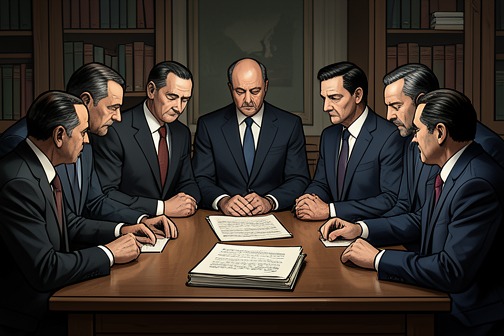
The [Allies hand Spain the list of 104](entity:event-recall-event-104-45d1c242e157) in October 1947, when the Allied Control Council in [Spain](entity:location-recall-location-0fe76f866976) formally submitted a blacklist to the government in [Madrid](entity:location-recall-location-madrid-8acd4123f416). The eleven-page document gave concrete form to years of largely fruitless demands for the location and surrender of people connected to Nazi activity and collaborationist regimes. Its delivery became a test of whether the Franco government would cooperate with postwar justice; the answer, shaped by [Cold War](entity:time-recall-time-700d9e46b459) politics, was effectively no.
## Background and purpose
For more than two years, the Allies had repeatedly asked Spain to help find and hand over hundreds of people associated with Nazi activities in Spain. They also sought prominent collaborators from occupied countries, many accused of crimes against humanity and believed, or known, to be living comfortably in Spain. The requests produced little result. By October 1947, the list represented the most developed form of those demands, but the passage of time had not made the Franco government more willing to comply.
The document arrived in a rapidly changing international climate. In the span of two years after Hitler’s defeat, Cold War antagonism had altered the position of the [Franco regime](entity:organization-recall-organization-eac43190d576) to its advantage. The novel presents anti-Soviet fervor and fear of another war with Stalin as the forces behind Spain’s diplomatic maneuvering before the victorious Allied powers. The handover therefore took place in a setting where demands for accountability had to compete with the strategic realignment of the postwar order.
## The list and the people it named
The List of 104, also known as the Black List, identified people the Allies described as “hateful Germans”: individuals who had actively furthered Hitler’s cause and could not hide their responsibility behind claims of discipline or obedience to superiors. They were citizens of the [Third Reich](entity:time-recall-time-f3c47f5ce6a4) and had outstanding cases before German courts. Yet the Spanish regime considered these same individuals important to preserving good relations with the victors, a contradiction that shaped its response to the list.
One hundred and three entries were men; the sole woman was [Clarita Stauffer](entity:character-recall-character-clarita-stauffer-46f541dee867). The list gave her correct address, [14 Calle Galileo](entity:location-recall-location-14-021d84809dfc) in Madrid, and described her as one of the principal organizers of a secret relief association. It accused her of involvement in supplying false documents and finding employment for Germans, among other activities, and said that she had received a special German Embassy permit at the end of the war to obtain Spanish nationality for the express purpose of continuing those activities after defeat. Her inclusion linked the diplomatic document to the clandestine assistance network operating from her Madrid home.
Other named figures included Johannes Bernhardt, described as an [SS](entity:organization-recall-organization-bbcdb0ea06e2) general and president of [SOFINDUS](entity:organization-recall-organization-sofindus-28229415b3da), a German state institution, and accused of responsibility for clandestine supplies to German troops trapped on [France](entity:location-recall-location-4f282e1af8a7)’s western coast during and after liberation. Horst Alberto Carlos Fuldner, whose name was incorrectly transcribed in the list, was identified as a member of the [Sicherheitsdienst](entity:organization-recall-organization-c1a6f2c24d91) sent from [Germany](entity:location-recall-location-a3c24dd56e42) to organize underground activities after the defeat; he was listed at a Madrid address but was in Tarrasa near [Barcelona](entity:location-recall-location-fcf889cebf1e) when the document was submitted. Eberhard Messerschmidt, a former assistant to the German Embassy’s naval attaché who had worked for German naval intelligence, was listed as residing in [Cercedilla](entity:location-recall-location-85100c36d067). The list thus combined claims about wartime roles with addresses and information about the men’s postwar whereabouts.
## Spain’s response
Foreign Minister Alberto Martín-Artajo received the eleven-page document in English. The novel makes clear that the names could not have surprised him: he knew both of the Allies’ earlier demands and how slowly his predecessor had acted, even under more difficult circumstances. Rather than promptly address the claims, Martín-Artajo let time pass until the Allied Council’s patience was exhausted. When he finally met its representatives, he brought out documents, letters, and certificates they had not previously seen.
The explanations varied from person to person. Some could not be surrendered because, officials claimed, they had already been Spanish citizens for years; others had received nationality from the Generalissimo for their assistance to the National Army when the Condor Legion came to Spain’s aid. The government said that some could not be found, that one held Spanish nationality because he directed a strategically important company, and that an Austrian was protected by the Cardinal of Toledo and Spain’s primate because of his Catholic faith and the risk of trouble with the [Vatican](entity:location-recall-location-416dda4866db). For others, officials professed not to know them. In Stauffer’s case, they asserted that she had been born in Madrid and was therefore Spanish, a patriot, [Pilar](entity:character-recall-character-pilar-8a2ad262e179) Primo de Rivera’s right hand, and a tireless worker famed for charitable works. The repeated claims converted nationality, religious influence, administrative ignorance, and patriotic standing into barriers against surrender.
## Outcome and significance
The outcome is stated without ambiguity: none of the people named felt the slightest anxiety at this latest and final demand. The list did not produce their surrender or even immediate unease. Instead, the government’s procedural delays and retrospective or protective claims of Spanish nationality turned a demand for legal accountability into a display of the regime’s ability to shield those it considered useful or politically protected.
The event’s significance lies in the gap between the precision of the list and the evasiveness of the response. It supplied names, alleged roles, and addresses, including Stauffer’s exact Madrid residence, yet information alone could not compel cooperation from a government that chose to protect or disavow the people sought. The Cold War shift helps explain why the Allied demand failed, while the officials’ varied excuses show how protection could be administered through paperwork and diplomatic calculation. The list marked the culmination of Allied claims, but not their fulfillment.
Event 43
Gallardo kills Alfonso Navarro and assumes his identity
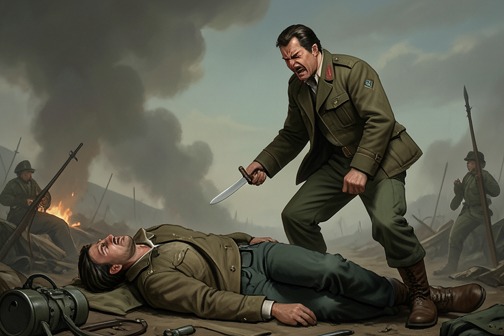
[Gallardo kills Alfonso Navarro and assumes his identity](entity:event-recall-event-0756ca4d66fe) in the last days of the [Battle of Berlin](entity:event-recall-event-a9cd810fe47e), an act that lets him surrender under another man’s name while concealing his own part in wartime atrocities. The killing emerges at the intersection of love, survival, and fear of accountability: Gallardo wants a future with [Agneta Müller](entity:character-recall-character-agneta-m-ller-765ffbc5342a), but also knows that witnesses to [Klooga](entity:location-recall-location-klooga-b8e6411e3c62) could identify him and denounce him to the Soviets.
## Background and Breaking Point
After eating in the [Berlin](entity:location-recall-location-769cdeac2511) position, [Jan Schmitt](entity:character-recall-character-jan-schmitt-75ecceb3a91a) takes Gallardo aside and tells him that he and Agneta intend to leave together. Their arrival had once been bound to a different purpose: they had come prepared to die defending the Reich. Now, Jan says, everything has changed. He recognizes that Gallardo saw Agneta first and loves her too, but insists that she can choose for herself. As Jan trails off and begins to retreat, Gallardo cuts him short and tells him that he loves him as well, calling him a bastard but also the best friend he has ever had.
The scene turns abruptly from confession to physical violence. Jan collapses after a right-handed blow from Gallardo, whom the narration identifies as the Tiger of Treviño. Agneta rushes to Jan and pounds Gallardo’s chest with her small fists as she tries to get to Schmitt. Gallardo pushes her aside without hurting her; when she bends over Jan to revive him, he leaves and wanders for hours until he is lost. When he returns to the position, only [Alfonso Navarro](entity:character-recall-character-0a9dcf648ac2) remains to call him a lout. Gallardo does not care. This is the emotional rupture immediately preceding his decision to take Navarro’s identity.
## The Killing and Assumed Identity
On 1 May 1945, Berlin’s defenders prolong their resistance for another twenty-four hours, preventing the Soviets from celebrating the conquest of the city on May Day. The following day, with a tank’s barrel trained directly on him, Gallardo emerges from the Wilhelmstrasse position with his arms raised. He is not alone in the surrender: he carries [Alfonso Navarro López](entity:character-recall-character-alfonso-navarro-l-p-c83845fb86be)’s papers. He does not show the occupying forces Navarro’s corpse.
The concealed body makes the surrender more than a simple effort to pass under a new name. Gallardo has killed the man whose documents can support his new identity, and the story states plainly that this is why he did it. The deception allows him to present himself to the Soviets as Navarro even as he hides the evidence of the crime that made the impersonation possible. After six weeks in an overcrowded cell, the other prisoners show no surprise at hearing his new name. The first interrogating officer instead asks why he speaks German so badly, a detail that exposes a practical weakness in the identity he has assumed without revealing the truth to those around him.
## Motives: Love, Survival, and Fear
The narration distinguishes Gallardo’s murder of Navarro from a simple act of revenge. Gallardo knows Navarro was wrong about Agneta: she did not choose Jan because of race, skin, or surname, but because Jan possessed a love that Gallardo lacked. Gallardo had been competing at a disadvantage, but the text says that neither this grievance nor Navarro’s role in his nightmares explains the killing. In the moment he pulls the trigger, Gallardo is not thinking of the port of [Bilbao](entity:location-recall-location-00ac960a262f), the fear that cost him the Spanish championship in 1941, or [Christmas](entity:time-recall-time-0cffe7da2c4d) Eve 1942. Resentment, guilt, and fear are all explicitly set aside as his immediate motive; the narration instead describes a love so immense that it fills his entire inner life.
That love gives the assumed identity its forward-looking purpose. Gallardo no longer wants to die without having kissed Agneta or been close to her. He imagines that, after defeat has reduced the old hymns and their fervor to ashes, the world may forget the beliefs that once defined him. For that future to be possible, however, he believes he must cease to be himself. Without another identity, his hope of being with Agneta would have little chance.
The prospect of accountability supplies a separate, equally concrete reason to disappear. Gallardo had been at Klooga, and he expects that sooner or later he will have to answer for it. [Kleiber](entity:character-recall-character-kleiber-d6064d4f9ff0), his men, and the camp guards could all point toward the III Panzerkorps; the soldiers left at [Narva](entity:location-recall-location-02240c347dbb) were numerous enough that Gallardo fears some may survive and remember him. He needs a different person’s documents so that no one can identify and denounce him to the Russians. The narration therefore places his romantic hope alongside his effort to evade the consequences of his actions: both depend on becoming someone else.
## Consequence and Significance
Gallardo’s new identity does not represent a clean break with his past. It is secured by another killing, and that crime barely disturbs his conscience as he gives himself up without resistance. The contrast is sharp: the surrender looks like an end to combat, but the papers concealed on his person carry the violence forward into a postwar life built on impersonation. His willingness to preserve himself is also bound to his past participation in Klooga, which remains a debt rather than a danger he has morally resolved.
The sequence makes identity a practical instrument and a moral evasion at once. Navarro’s documents may enable Gallardo to survive the collapse of Berlin and imagine a life with Agneta, but they cannot undo the death of Navarro or the history Gallardo is trying to outrun. His first interrogation underscores the fragility of the disguise, while the prisoners’ untroubled acceptance of his new name shows how readily a name can pass as a person when no one suspects the substitution. The episode’s decisive reversal is thus not merely that Gallardo survives the fall of Berlin: he leaves his own identity behind at the precise moment when the possibility of answering for his actions should become unavoidable.
Event 44
1947 Madrid student uprising
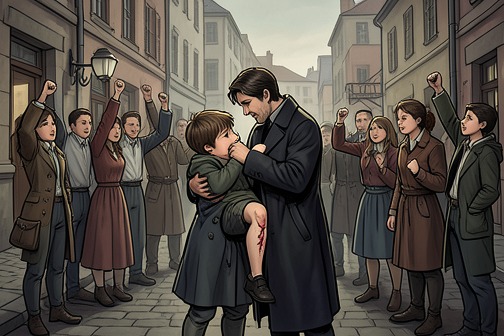
The [1947 Madrid student uprising](entity:event-recall-event-1947-d15111623a9c) is presented not as a triumphant insurrection but as a risky, doomed act whose human scale is embodied by a wounded boy. Through a conversation between [Guillermo García Medina](entity:character-recall-character-guillermo-garc-a-me-d52c3f18d2cc) and [Manuel Arroyo](entity:character-recall-character-3296d1a401b2) Benítez, the episode exposes the distance between youthful defiance and the danger faced by older underground resisters in Francoist [Spain](entity:location-recall-location-0fe76f866976).
## Background and Setting
The uprising belongs to a postwar [Madrid](entity:location-recall-location-madrid-8acd4123f416) in which resistance remains clandestine and the prospect of political change is uncertain. Guillermo recalls that he had just removed a bullet from a boy’s leg. The injury makes the revolt immediate and physical: this is not an abstract political dispute, but an armed confrontation that has already left a young participant badly wounded.
The conversation takes place against the backdrop of hopes for international pressure on Franco. Guillermo observes that even a favorable [United Nations](entity:organization-recall-organization-e95d8c5557b2) vote to remove Franco would not make it plausible that two hundred students could simply take Madrid by force. His comparison places the students’ effort between political expectation and military reality: a hoped-for shift in international policy could not, by itself, turn a small student force into an army capable of seizing the capital.
## The Students’ Action
Guillermo describes Juanma as a child who, after being wounded in the leg, threw a grenade at two police officers. The act was serious, but Guillermo also calls it a childish escapade, holding together the bravery and recklessness that define his account. Juanma’s youth does not make the danger less real; it sharpens the contrast between the scale of the act and the boy who carried it out.
The episode offers no account of a successful seizure of Madrid. Instead, its immediate evidence is a wounded student receiving medical treatment and a conversation about the meaning of his participation. The uprising appears as an attempt at armed action that has encountered the force of the state before it could achieve its political goal.
## Guillermo and Manuel
Guillermo tells Manuel that he knows what happened and insists that neither of them had anything to do with the boy’s injury. When Manuel jokingly asks whether Guillermo has just joined the Communist Party, Guillermo admits that he spends so much time with its members that he sometimes forgets he has not. The exchange reveals familiarity with the underground left without establishing that Guillermo himself belongs to the party.
Guillermo’s central question is why a man like Manuel was involved in the uprising. He contrasts Manuel with Juanma: the boy, for all his courage, is still a child, whereas Manuel is an experienced adult whose presence in the affair needs explanation. Manuel answers that he had no part in it. Guillermo’s reply points to the physical evidence against that denial: Manuel has brought back a conspicuous injury. The teasing tone does not erase the danger; it lets two friends approach an episode neither can treat as harmless.
## Significance
The uprising is filtered through retrospective narration and private conversation rather than staged as a full battle. That framing keeps attention on the gap between the students’ determination and their limited means, while the wounded boy and Manuel’s injury make the consequences tangible. Guillermo’s care for Juanma also complicates any simple division between political analysis and personal responsibility: he can question the revolt’s prospects while treating one of its injured participants.
The scene links a failed attempt by students to seize Madrid with the wider conditions of underground opposition under Franco. Its emphasis falls on the human cost and on the uneasy question of who should take part in armed resistance—not on a victory or a lasting change in power.
Event 45
Nuremberg trials
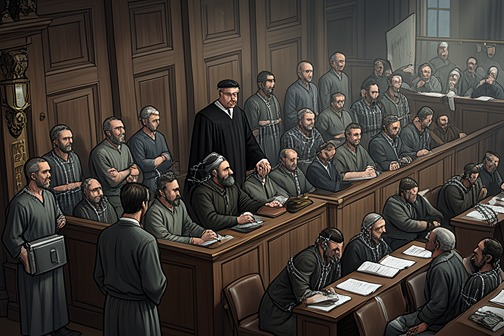
The [Nuremberg trials](entity:event-recall-event-6025b3df1553) are the novel’s central reference point for the postwar pursuit of Nazi criminals—and for the gap between documenting responsibility and securing justice. Their proceedings produced evidence that could expose perpetrators, but their limited capacity, alongside political protection and forged or altered identities, left many accused men beyond punishment and helped shape the escape routes that become a major concern of the story.
## A crowded court system and its unfinished cases
By October 1946, the [Nuremberg](entity:location-recall-location-18a35093b128) proceedings had overwhelmed the capacity of Allied justice. The delay mattered to individual prisoners: a man held by Soviet authorities was told that his case would be transferred to a British or American tribunal, but no trial followed. In November 1946 he was moved to a prison in the western zones and met not by a civilian judge or Allied military officer but by a representative of the International Red Cross, who proposed repatriating him as a citizen of a neutral country. The offer made the consequences of an uncompleted prosecution immediate: return could be more frightening than release.
The trials also supplied investigators with material that could reach beyond the courtroom. In a later search for a suitable German war criminal whose identity could be assumed, [Geni](entity:character-recall-character-geni-341ad3dc550e) could not continue reviewing the Nuremberg cases because [Saul Burnstein](entity:character-recall-character-7f428699216c) had sent her so much documentation. Manuel offered to take over that research. The accumulated records were not merely a history of completed prosecutions; they were a working archive for finding people whose wartime actions might otherwise remain hidden.
## Evidence against perpetrators
One case described through those records concerned [Kleiber](entity:character-recall-character-kleiber-d6064d4f9ff0), accused of recruiting men who took part in the extermination of more than two thousand Jews imprisoned at a camp in [Estonia](entity:location-recall-location-3174b38cc5de) and of killing a German soldier who refused an order. Kleiber’s subordinates tried to shift responsibility onto him. He countered that the men, including the executed dissenter, had volunteered, and offered to identify them. His account implicated a former Spanish professional boxer who had gone to the Russian front and travelled with [Jan Schmitt](entity:character-recall-character-jan-schmitt-75ecceb3a91a), a man whose Flemish name and German surname concealed a birth in [South America](entity:location-recall-location-93067fb0ae2c).
The documentary trail was suggestive but incomplete. Schmitt’s name appeared near the end of an annexed list, marked with a question mark; the final entry gave the possibly Spanish first name Adrian, also questioned, with no accent in the transcription. That small uncertainty became a practical obstacle: the material could connect suspected men to atrocities, but it did not yet establish their whereabouts or even the exact identity of the Spaniard. Manuel recognized the potential significance and immediately wanted to consult further lists, while cautioning that the question mark might mean the man was dead rather than missing.
## Prosecution, refuge, and obstruction
The novel contrasts the trials’ effort to establish individual responsibility with the postwar methods used to prevent extradition. In [Spain](entity:location-recall-location-0fe76f866976), officials could grant nationality retroactively after preparing authentic documents for a false identity. The practice, the narrative explains, would be used for decades to protect Nazis seeking permanent refuge or a stopping place on the way to another country. The legal record and the fabricated papers thus served opposing ends: one attached names to crimes, while the other turned identity and citizenship into barriers to prosecution.
The Allied List of 104, also known as the Black List, represents the most developed set of Allied demands described in this context. Its subjects were Reich citizens regarded as active contributors to Hitler’s regime, with outstanding claims before German courts. Spanish officials delayed responses and, when pressed, produced previously undisclosed letters, certificates, and other papers to argue that individuals were Spanish citizens, protected by influential institutions, missing, or unknown to the authorities. [Clarita Stauffer](entity:character-recall-character-clarita-stauffer-46f541dee867) was the list’s only woman. Her [Madrid](entity:location-recall-location-madrid-8acd4123f416) address was accurately recorded, and the Allied description accused her of organizing a secret aid association, supplying false documents, finding employment for Germans, and obtaining Spanish nationality expressly to continue such activities after [Germany](entity:location-recall-location-a3c24dd56e42)’s defeat.
## From records to escape networks
The proceedings’ reach was also limited by the growing organization of escape. In 1947, while imprisoned at Dachau, [Otto](entity:character-recall-character-9f54aedde4b4) Skorzeny arranged prisoners’ escapes with the complicity of Polish guards. He later founded [Die Spinne](entity:organization-recall-organization-die-spinne-9184ac79210d), which helped fugitives reach Italy; two [Vatican](entity:location-recall-location-416dda4866db) prelates assisted with onward routes to South America. Clara Stauffer’s Madrid network was a competing operation, larger and more efficient than the Vatican-linked route in the account, and the two networks cooperated while benefiting from [Argentina](entity:location-recall-location-27e2c37f5c3d)’s willingness to receive their protégés. The narrative does not present these routes as proof that the trials were meaningless; rather, it shows how prosecution and evasion developed alongside one another, with documentation on one side and practical protection on the other.
That tension extends beyond the immediate postwar years. Manuel’s work for the exiled Republic involved enduring the company of people he regarded as murderers of the Republic and listening to professions of love and solemn promises that proved part of a cruel, recurring imposture. His research and diplomatic work connected the surviving records of wartime crime to the continuing problem of impunity. The trials therefore function not simply as a historical backdrop, but as an incomplete point of reference: they made accountability imaginable and supplied evidence, while the failures to complete prosecution left identities, destinations, and responsibility open to manipulation.
Event 46
Perón receives European war-crime fugitives
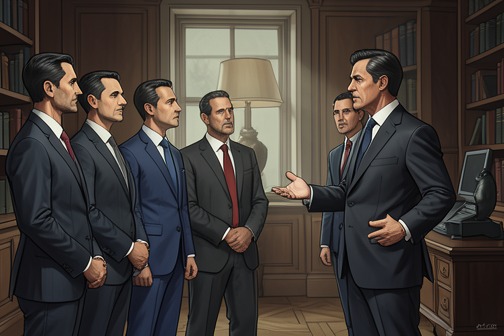
[Perón receives European war-crime fugitives](entity:event-recall-event-b8e518972e9e) was a December 1947 meeting at the [Casa Rosada](entity:location-recall-location-cdd55b7be55d) that converted the postwar flight of wanted Europeans into a matter of Argentine state policy. Six visitors arrived under the public pretext of hearing [Juan Perón](entity:character-recall-character-a454ccbc4368) explain his “third position”; the decisive subject was his willingness to welcome people connected to the [Third Reich](entity:time-recall-time-f3c47f5ce6a4), and the meeting led to a second audience and preparations for an official body to manage their arrival.
## The visitors and their concealed identities
On December 4, 1947, the six visitors appeared to form a heterogeneous group: only one was Argentine, and the others held nationalities different from one another. Yet all had entered [Argentina](entity:location-recall-location-27e2c37f5c3d) that year on legal Spanish passports. Five passports supported false identities, and their holders had settled in [Buenos Aires](entity:location-recall-location-caf56b79d5c4) despite being wanted by the courts of their respective countries for collaboration and/or crimes against humanity. The sixth man’s passport matched his real identity; he had travelled from far away specifically to attend.
## The announced subject and the real purpose
The meeting was officially convened so Perón could explain his “third position” in the international order after the Second World War. He presented himself as opposed to both Marxism and liberalism, communism and capitalism, and as the leader of a popular movement that surpassed the division between left and right. His guests applauded a familiar ideological performance, but the discussion soon shifted from political positioning to the practical question of who Argentina would receive.
Perón wanted to attract civilian and military technicians and scientists linked to the Third Reich, believing that another conflict between the West and the Soviet Union could turn the defeated and compromised into useful allies. He was prepared to welcome them. In this calculation, the fugitives’ present culpability did not rule out their future value: the prospect of a new [Cold War](entity:time-recall-time-700d9e46b459) reordered who might count as an enemy or an asset.
## From audience to reception machinery
Rodolfo Freude, Perón’s close aide, had been tasked with convening the meeting. His father, Ludwig Freude, a powerful German businessman in Argentina, had faced an Allied extradition demand in 1945. When extradition seemed imminent, Perón produced a false citizenship letter that allowed Ludwig to remain; Ludwig later financed Perón’s 1946 election campaign. Rodolfo invited Víctor de la Serna, one of the six visitors, and that invitation explains his presence in Buenos Aires.
Agreement among the attendees did not settle the matter in one sitting. Perón received the same group again the following day to work out details, and became personally involved to the extent of suggesting a confidential official body to receive this class of immigrants. The meeting therefore marks a transition from private contacts and passport-based concealment toward a more organized system of reception.
The Argentine European Reception Service, [SARE](entity:organization-recall-organization-sare-4c3fac38c8fc), became real on June 28, 1948, when its governing committee met at Radu Ghenea’s home to sign its statutes. Pierre Daye, who had designed the organization, attended with René Lagrou representing the Belgian exile community; Ghenea represented the Romanians, while other participants represented fugitives of several nationalities. Argentina’s director general of migration later recognized SARE’s capacity to accept and manage residence applications, and the city’s archdiocese provided a building on Canning Street for its headquarters. The network had acquired an institutional address and an authorized role in handling immigration.
## The meeting in the novel’s wider history
The audience sits within a larger pattern of escape and political protection. In [Madrid](entity:location-recall-location-madrid-8acd4123f416), [Clarita Stauffer](entity:character-recall-character-clarita-stauffer-46f541dee867)’s covert organization helped wanted Europeans obtain documents and employment; the Allied List of 104 identified her as a principal organizer of a secret aid association involved in false papers and postwar activity. The narrative also recounts how [Jean-Jules Lecomte](entity:character-recall-character-jean-jules-lecomte-2119a7da971a), responsible for deportations and the killing of Jewish children and nuns in [Chimay](entity:location-recall-location-1a6f836f9fe9), was sentenced to death in absentia but was never captured. Such cases give the Buenos Aires meeting its stakes: the people being received were not simply displaced Europeans, but individuals sought for grave crimes, whose movement across borders could frustrate prosecution.
The scene also echoes the novel’s treatment of exile as a succession of crossings and assumed identities. [Manuel Arroyo](entity:character-recall-character-3296d1a401b2) Benítez, living in [Geneva](entity:location-recall-location-634fbb9f6bb2) under the name Felipe Ballesteros Sánchez, had endured solitary intelligence work for the Spanish Republican government in exile and distrusted the political theatre around him. Elsewhere, a fugitive crosses into [Spain](entity:location-recall-location-0fe76f866976) through [Gibraltar](entity:location-recall-location-da80b0a7ad4a) under an American cover identity, while another survivor learns to live under a false name, measuring the boundary between identities through daily walks across the Castellana. Against these precarious individual routes, Perón’s audience shows state power organizing refuge for fugitives. Its consequence is not immediate justice or resolution, but a durable apparatus through which Cold War calculation could shelter men wanted by other countries.
Event 47
Establishment of the Argentine European Reception Agency (SARE)
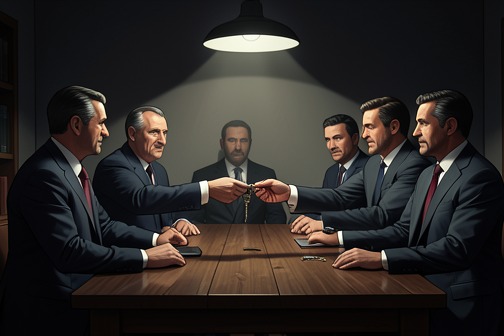
The [Establishment of the Argentine European Reception Agency (SARE)](entity:event-recall-event-sare-603dc5e568b9) formalized a system for receiving European fugitives in [Argentina](entity:location-recall-location-27e2c37f5c3d). Founded in June 1948 through a network of European collaborators and Argentine officials, the agency could process residence applications; its institutional form gave organized migration a bureaucratic channel, connecting private networks to the Argentine state.
## Background and Political Sponsorship
[SARE](entity:organization-recall-organization-sare-4c3fac38c8fc) arose from contacts between European representatives and Argentina’s political leadership. The novel places its creation within a broader effort to receive politically defined immigrants, with President [Juan Perón](entity:character-recall-character-a454ccbc4368) personally involved in shaping the proposal for a reserved official body. The agency’s origins therefore lay not only in private escape assistance but in political sponsorship that could convert such assistance into an administrative process.
## Founding and Organization
On 28 June 1948, SARE’s governing committee met at the home of Radu Ghenea to sign the agency’s statutes. Pierre Daye, who had designed the organization, attended with René Lagrou as representatives of the Belgian exile community. Ghenea represented the Romanians. Other participants represented people fleeing from multiple countries, including [Germany](entity:location-recall-location-a3c24dd56e42), Austria, [France](entity:location-recall-location-4f282e1af8a7), Slovakia, Italy, and Croatia; among them was Ferenc Luttor, a Hungarian diplomat to the [Vatican](entity:location-recall-location-416dda4866db) who had escaped in 1947 using a Vatican passport.
The founding meeting gave the organization a multinational character and a concrete governing structure. Soon afterward, Pablo Diana, director general of migration, officially recognized SARE’s authority to accept and manage applications for residence in Argentina. The archbishopric of [Buenos Aires](entity:location-recall-location-caf56b79d5c4) provided a building on Canning Street for its headquarters. These steps moved SARE from a committee and a set of statutes to a recognized body with a place to receive and handle requests.
## Work Beyond Argentina
SARE’s work extended beyond applicants already in Argentina. A letter from Daye dated 25 February 1948 asked Víctor de la Serna to prepare lists, organized by nationality, of political refugees in [Spain](entity:location-recall-location-0fe76f866976) and to identify those most urgently in need of rescue. Daye stressed that the refugees would not need to make requests themselves: his group would arrange the necessary procedures. The proposed lists made SARE’s reach transnational, tying the agency’s Argentine destination to the identification and selection of refugees still in Spain.
The network’s activity was already under way by the time its premises were secured. The narrative’s description of the machinery as having started and operating urgently underscores the difference between the date of formal establishment and the development of the system around it: the statutes and headquarters consolidated an effort already in motion.
## Historical and Narrative Significance
SARE represents the institutional side of postwar flight: personal contacts, political influence, national representatives, and migration administration converged in a system that could manage arrivals. The wider narrative situates this machinery against the later Argentine dictatorship, whose terror began with mass illegal arrests on the night of 24 March 1976 and drove thousands to seek a way out of the country. That later history is distinct from SARE’s founding, but the juxtaposition makes exile appear as a recurring condition shaped by political power, borders, and the institutions that determine who can find refuge.
Event 48
Cercedilla Nazi gathering
The [Cercedilla Nazi gathering](entity:event-recall-event-747ae2f2f969) is a July 1947 meeting at which [Manuel Arroyo](entity:character-recall-character-3296d1a401b2) Benítez, posing as Adrián Gallardo, enters a circle of former Nazi allies and their Francoist protectors. A cultivated social occasion becomes an intelligence opportunity: beneath greetings, food, and political ritual, Manuel encounters figures linked to the escape network he is investigating and glimpses the connections that sustain it.
## Approach and Infiltration
Manuel and [Guillermo García Medina](entity:character-recall-character-guillermo-garc-a-me-d52c3f18d2cc) reach the gathering after a quiet walk on donkeys. At half past seven they arrive at an iron gate between granite pillars, secured with a chain; beyond it, an earthen track runs between meadows and trees without revealing a house. The inconspicuous approach contrasts with the importance of the company waiting inside. For Manuel, the entry is not simply social: he is attending under an assumed identity, among people whose confidence depends on his performance as the supposedly returned war hero Adrián Gallardo.
Inside, the first impression is of order and privilege. Roughly fifty guests form a socially homogeneous, well-to-do group, though they represent many nationalities. Spanish serves as their common language, spoken with varying fluency. Most of the men appear with their legitimate partners, while two older guests—one French and one German—have young Spanish companions who use the aliases Luci and Cati. The gathering’s manners are themselves a kind of cover: introductions commonly consist of a first name, often false, and no surname. The scene establishes a room in which identity is both carefully managed and casually exchanged.
## Recognition and Political Performance
The social calm breaks when a man crosses the room without offering his name and embraces Manuel, calling him a comrade and recalling the brave men he had been proud to command. Manuel answers by bringing his heels together, giving the fascist salute, and embracing [Léon Degrelle](entity:character-recall-character-ba48febc7c6a). The exchange is intimate in form and political in substance: Degrelle recognizes the identity Manuel is impersonating and treats him as a former subordinate.
Degrelle speaks fluent Spanish and expresses the hope that Manuel might again serve under his command, fighting shoulder to shoulder for Europe’s future. Manuel replies in character, addressing him formally and encouraging him not to lose hope; the Reich, he says, will live for a thousand years. The encounter shows the danger and utility of the disguise at once. Manuel’s performance earns him access to a prominent former commander, but it also requires him to reproduce the language and gestures of the cause he is investigating.
## Francoist Patrons and the Gathering’s Two Centers
The meeting’s balance shifts again when guests invited by Francisco Franco arrive. Clara Stauffer comes into the garden in a white cocktail dress patterned with reddish flowers, greeting the company with the open-armed smile of a film star at a premiere. Johannes Bernhardt, president of [SOFINDUS](entity:organization-recall-organization-sofindus-28229415b3da), follows her. The guests divide visibly between those pressing forward to greet Clara and those waiting to shake Bernhardt’s hand. Their prominence makes clear that the gathering is not merely a private reunion: its social world is organized around people with influence and the means to protect or assist others.
José Félix de Lequerica, a former Franco foreign minister and a known rescuer of several people present, complicates Clara’s moment of triumph. Her admirers have to split their attention between her and Bernhardt; other Spanish guests attract less notice, apart from the father and son Víctor de la Serna, who move through the gathering as if at home. They know that Adrián Gallardo has returned to [Spain](entity:location-recall-location-0fe76f866976) and ask Herr Messerschmidt to introduce him. More Spanish men then approach Manuel, extending his contact with the gathering’s local protectors and intermediaries.
## Observation, Concealment, and the Closing Ritual
When Manuel shakes [Esteban Maroto](entity:character-recall-character-b2eccfd2c9dd)’s hand, he looks for Guillermo but cannot see him. Clara has also disappeared. She and Guillermo reappear together a few minutes later, and she approaches Manuel to greet him. She then leaves the other company and goes to the Croatian table, where she embraces a bespectacled, goateed man, sits beside him, and remains there. Her choice of company separates her from the gathering’s more public rounds of greeting and directs attention toward a quieter, more guarded conversation.
Near midnight, Degrelle gives a toast. The other comrades raise their arms and sing the Horst Wessel song, turning the party’s political loyalties into a collective display. Clara keeps both arms at her sides. Absorbed in conversation with Ante Pavelić, she and her companion look like conspirators facing trouble; at intervals she writes in a small notebook while he rubs his forehead with an expression of genuine concern. This contrast between the public salute and the private exchange reveals two simultaneous registers of the gathering: the open performance of ideological fellowship, and the discreet work of people managing more immediate problems.
Almost two in the morning, after Guillermo has shouted the Spanish fascist greeting several times, Clara rises and goes directly to him and Manuel. She has heard that they came by donkey, asks whether it is true, and laughs when they confirm it. Offering to drive them into the village on her way back to [Madrid](entity:location-recall-location-madrid-8acd4123f416), she provides a practical exit from the estate. The ride that began with an obscure track and a chained gate ends with an offer from one of the network’s central figures—a small, ordinary gesture that also underscores how access and movement depend on personal connections.
## Significance
The gathering gives Manuel firsthand access to a community that cannot be understood from rumor alone. Its guests include high-profile Nazi collaborators, Spanish political figures, and people positioned to offer social protection; its aliases and selective introductions make concealment part of everyday etiquette. Manuel’s embrace and political declarations demonstrate how convincingly he can inhabit the role of Adrián Gallardo, while the evening’s shifting clusters disclose who commands attention and who turns aside to confer privately.
The party also brings public legitimacy and covert activity into the same frame. Franco’s invited guests arrive among former Nazi allies; the song and raised arms coexist with Clara’s worried conversation with Pavelić and her notes in a pocket-sized notebook. The meeting therefore functions both as a staged display of continuing political fellowship and as a setting in which Manuel can watch the relationships behind a postwar escape network. Its polished hospitality does not erase the danger surrounding that work; it provides the room in which the danger can remain unspoken.
Event 49
Evita's visit to Madrid
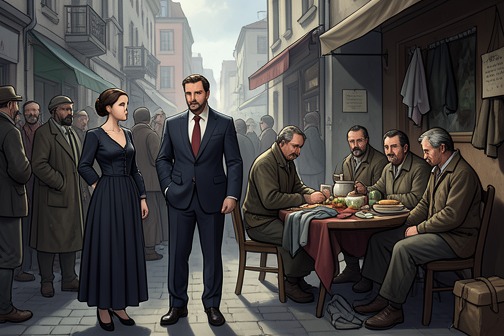
Evita’s visit to [Madrid](entity:location-recall-location-madrid-8acd4123f416) in 1947 provides a public backdrop to the private machinery of Clara Stauffer’s escape network. The visit mattered because Argentine assistance was important to that network, even as Clara’s work sheltering fugitives and arranging their papers continued behind the scenes. The contrast between a hungry crowd welcoming Evita and exhausted escapees being quietly fed and clothed makes the visit part of a larger story about political spectacle, refuge, and clandestine logistics.
## The visit and the escape network
Clara Stauffer’s preparations for aiding fugitives had begun well before Evita’s arrival. In the summer of 1945, she converted two rooms of her home into an office, installed a new telephone line, hired two secretaries, and filled newly made wardrobes with men’s clothes in every size and shoes in every size. Men who appeared thin and exhausted began coming to the house at all hours. They were fugitives who had escaped European prisons and crossed the [Pyrenees](entity:location-recall-location-bca267e59698), or prisoners released from Nanclares. At Galileo 14 they received food and fresh clothes; the arrangements also appeared to provide lodging elsewhere and, in some cases, work.
The operation relied on more than hospitality. A Spanish replacement soldier regularly delivered sealed envelopes bearing the letterheads of Madrid parishes. When one was inadvertently left open, [Sole Ruiz](entity:character-recall-character-sole-ruiz-3e0947d42f94) found a baptismal certificate bearing German names and a date in 1907. The parish documents could supply the identities needed for Spanish papers, connecting the household’s practical aid to an administrative route out of [Spain](entity:location-recall-location-0fe76f866976).
## Why Argentine support mattered
The investigation led by [Meg Williams](entity:character-recall-character-meg-williams-9e3155a7cbc0) and [Manuel Arroyo](entity:character-recall-character-3296d1a401b2) Benítez treated the network’s Argentine connection as a crucial but unproven part of the case. Clara was suspected of providing fugitives with Spanish documentation through parish certificates and contacts in the state administration, with [Argentina](entity:location-recall-location-27e2c37f5c3d) believed to be their intended destination. The investigators also suspected cooperation with the government of [Juan Perón](entity:character-recall-character-a454ccbc4368), which continued sending grain and frozen meat to Spain despite the blockade. These were claims they still needed to substantiate, not established proof of every route or transfer.
The political stakes extended beyond identifying individual escapees. Meg persuaded [Sal Burnstein](entity:character-recall-character-sal-burnstein-67e1ec897e9f), who had been searching for evidence of an organized Nazi escape system, that the Stauffer network appeared stable enough to investigate. The investigators hoped to demonstrate that Franco’s regime sheltered war criminals implicated in the genocide of the Jews. In their assessment, proof could force the Allies to break relations with the Madrid government and intensify international pressure for intervention. They nevertheless recognized that testimony from a household worker alone would not suffice: identities, the role of the network’s contacts, and the purpose of its work all required confirmation.
## A public appearance and its private consequences
A later account describes Clara as meeting Evita in Madrid, where thousands of hungry people received her as a blonde goddess of abundance. The image places the visit in a city marked by hunger and gives the Argentine visitor a conspicuous public presence. For Clara, however, the visit also imposed immediate demands: when Adrián arrived seeking protection, she explained that she would be very busy from the next day because of Eva Perón’s visit and because Argentine aid was important to the network. [Ingrid Weiss](entity:character-recall-character-ingrid-weiss-c9fed2f4fcc4) would look after him in her place.
The contrast is telling. Evita’s visit drew a mass public welcome, while the escape operation depended on private rooms, parish paperwork, secretaries, and discreet intermediaries. The visit did not halt the network’s work; it changed who could attend to a newly arrived fugitive and underscored how closely the clandestine operation was tied, in the investigators’ understanding, to Argentina.
## Narrative significance
The episode links Madrid’s public politics to the novel’s investigation of postwar flight. The visit is not treated as proof that Argentina directly received particular fugitives; rather, it illuminates why the suspected Argentine connection mattered and why the investigators sought evidence beyond rumor. Clara’s competing obligations—to a high-profile political visitor and to the fugitive she has just taken in—make the network legible through its ordinary work of sheltering, feeding, clothing, and arranging papers. The public ceremony and the hidden route occupy the same political landscape, but they operate at sharply different levels of visibility.
Event 50
Sefton Delmer interviews Clara Stauffer
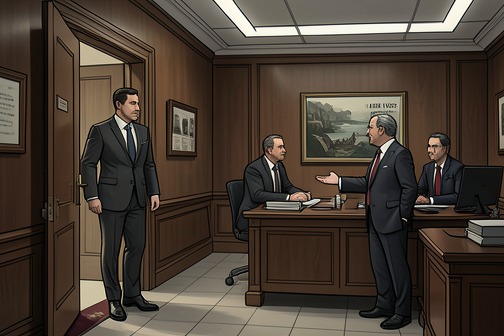
[Sefton Delmer interviews Clara Stauffer](entity:event-recall-event-a65b499f4979) in [Madrid](entity:location-recall-location-madrid-8acd4123f416) in February 1948, turning a clandestine visit to the organizer’s home into a public revelation of her escape network and its political protection. The encounter exposes the machinery of assistance—food, clothing, documents, connections abroad—and, through the interview’s striking mixture of candor and evasion, the impunity that allowed it to operate.
## The visit to Galileo 14
By late February 1948, [Sefton Delmer](entity:character-recall-character-sefton-delmer-05901777523e) had already made a career of adopting a false identity to get close to his targets. He had returned to England in 1940 and joined the newly founded Special Operations Executive, then spent the war making black propaganda: posing as a German Nazi broadcaster to spread disinformation among German forces. At Galileo 14, the Madrid residence of Clara Stauffer, that practiced impersonation again opened a door. The building’s porter recognized the kind of visitor arriving and directed him without hesitation to Stauffer’s home.
A very blond young German told Delmer that Stauffer was ill and could not receive him, then guided him through an office staffed by secretaries to a man who introduced himself as Herr Vost. Vost was Stauffer’s close associate. With paternal concern, he explained that she was exhausted by constant travel: visiting people in need, helping prisoners leave Spanish camps, finding work for those released, and assisting others to get out of the country. He added, with evident pride, that the organization served more than eight hundred people. Delmer then dropped his assumed identity, identified himself as a Daily Express journalist, and said that he had come specifically to interview Stauffer about the Allied Control Council’s description of her activity and the fact that she was the only woman it had requested.
Vost left without a word. When he returned a few minutes later, he led Delmer past a dark wooden dining room and into a bedroom dominated by a large oak crucifix. Stauffer was resting on pillows, presentable despite a pleurisy that would take time to recover from. Her bedside telephone kept ringing. She apologized for receiving him while ill, did not reproach him for the deception that had brought him there, and asked what he wanted to know.
## A network made visible
The interview brought together a system Delmer had partly encountered at the house and an account Stauffer gave of its wider reach. She said she helped many people. Most of the Germans and collaborationists held in [Spain](entity:location-recall-location-0fe76f866976), she explained, wanted to return to their own country; some preferred to emigrate elsewhere. For those seeking a third country, she was in contact with a reception network in [Buenos Aires](entity:location-recall-location-caf56b79d5c4) run by Cissy von Schiller, a German woman and friend of hers who had lived in Madrid until 1947. Stauffer also acknowledged contacts with the [Vatican](entity:location-recall-location-416dda4866db), since some of the people she helped crossed the Atlantic from Genoa.
Her disclosures made the network’s routes and intermediaries more legible. The assistance was not simply a matter of offering a fugitive temporary shelter: it could extend to release from Spanish camps, employment, a destination abroad, and onward passage through different networks. The Buenos Aires connection and the Vatican contacts placed Stauffer’s work within a transnational system, while her account of travel and personal assistance echoed Vost’s description of her constant journeys on behalf of people who needed help.
That account had an earlier counterpart in the house’s everyday traffic. In the summer of 1945, Stauffer renovated two rooms for an office, installed a new telephone line, hired two secretaries, and filled newly made cupboards with men’s clothes in many sizes and shoes to fit every number. Thin, exhausted men began arriving at all hours alongside her customary dinner and coffee guests. [Sole Ruiz](entity:character-recall-character-sole-ruiz-3e0947d42f94) recognized them as fugitives: some had escaped European prisons and crossed the [Pyrenees](entity:location-recall-location-bca267e59698), while others had been released from Nanclares. At Galileo 14 they were welcomed, fed, and given clothes; they did not stay overnight, and many returned to the office to conduct further business before or after receiving help.
Sole also noticed that none of the men spoke Spanish. A replacement soldier visited nearly every week with sealed envelopes, often bearing the letterheads of Madrid parishes. When one envelope was left open, Sole found a German baptismal certificate dated 1907. The traffic continued until she fled Spain. Shortly before then, she heard a secretary tell a visitor named [Jean-Jules Lecomte](entity:character-recall-character-jean-jules-lecomte-2119a7da971a) that she had him in front of her. That clue was later identified as important: [Meg Williams](entity:character-recall-character-meg-williams-9e3155a7cbc0) discovered that Lecomte was a Nazi fanatic and a member of both the Rex Party and the [SS](entity:organization-recall-organization-bbcdb0ea06e2), appointed burgomaster of his hometown, [Chimay](entity:location-recall-location-1a6f836f9fe9), during the occupation. The household’s clothes, parish papers, and visitors thus formed separate visible pieces of a network whose operation depended on both personal hospitality and administrative documents.
## Protection, candor, and a deliberate falsehood
Delmer asked directly whether Stauffer ran an escape network for war criminals and Nazi leaders. She did not accept that characterization in those terms, replying that she helped many people, and then described the Germans and collaborationists seeking repatriation or emigration. Her manner astonished him: she spoke with a calm bordering, in his view, on arrogance. When he asked whether the Spanish government knew what she was doing, she said that it did, that she had its understanding and the protection of Franco. She also invoked her close friendship with [Pilar](entity:character-recall-character-pilar-8a2ad262e179) Primo de Rivera and her comradeship with the people who had built the new Spain, insisting that she had no reason to fear anyone.
Yet the interview’s apparent frankness had limits. Stauffer was not as secure as she claimed, and the narrative makes that insecurity visible in the lie she chose to tell. She said that she had also helped several members of the [Spanish Communist Party](entity:organization-recall-organization-ffc0cbce21cb) leave the country. The account identifies this as a falsehood no Spaniard would have believed, but Delmer was not Spanish and wrote it down. Her willingness to speak openly about assistance to German and collaborationist fugitives therefore coexisted with an attempt to manage what her foreign interviewer would carry away. The lie was not a general confession of political neutrality; it was a calculated claim made when her assurance of official protection had already been put under pressure.
The contrast between her confidence and the practical effort surrounding her is sharp. If she felt wholly safe, the narrative suggests, she would have had no need to invent communist beneficiaries. Her repeated telephone calls, the delegation of access to Vost, and her claim of Francoist protection place the interview inside an operating network rather than outside it. Delmer’s arrival as an impostor briefly reverses the usual direction of concealment: the journalist conceals who he is to enter, then reveals himself, while Stauffer continues to control what she will and will not disclose.
## Publication and the limits of exposure
A few days later, the Daily Express placed Delmer’s interview on its front page as a major exclusive. The story caused considerable commotion in public opinion, both inside and outside the United Kingdom. Its publication made Stauffer’s role and her own account of assistance harder to keep within the private world of Galileo 14. The interview therefore accomplished a form of exposure: an operation that had been visible to its beneficiaries, household staff, and intermediaries was now a public controversy.
For Republican exiles scattered across the world, the report may have seemed to offer grounds for hope. Public attention could be imagined as the first step toward scrutiny of the people protected in Spain and of the authorities who enabled them. But the account closes the gap between publicity and consequence with brutal brevity: nothing happened. The front-page story made the network known without producing the decisive intervention that hope might have promised.
The interview’s significance lies in that unresolved collision. Stauffer could acknowledge routes through Buenos Aires and Genoa, describe her organization’s hundreds of beneficiaries, and affirm Franco’s protection, while still attempting to shape the record with a false claim. Delmer could expose her account to a broad readership, but exposure alone could not compel action. In the novel’s larger picture of postwar impunity, the interview becomes both a rare moment when a protected network speaks about itself and a demonstration of how little public revelation necessarily changes.
Event 51
Gran Sasso raid
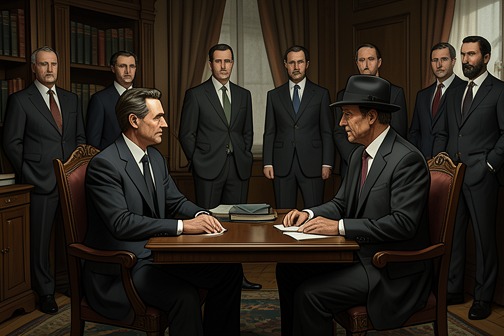
The [Gran Sasso raid](entity:event-recall-event-gran-sasso-raid-68cae90e8023) appears as one of the defining operations in [Otto](entity:character-recall-character-9f54aedde4b4) Skorzeny’s public record: he is described as the Nazi special-operations chief favored by Hitler and the man who liberated Mussolini. The reference does not stage the raid itself; instead, it uses the rescue as shorthand for Skorzeny’s wartime reputation and introduces a sharper question about what that reputation means after the war, when legal judgment and political protection no longer align.
## The raid in Skorzeny’s record
In a conversation with Guillermo, a speaker insists that Skorzeny was a soldier, despite never having pursued a conventional military career. The list of his exploits includes the rescue of Mussolini, the kidnapping of Miklós Horthy’s son, and his infiltration operation during the [Battle of the Bulge](entity:event-recall-event-b7a3624db7cd). The Gran Sasso raid is thus grouped with other operations that made Skorzeny a celebrated and feared figure in Nazi special warfare. The passage supplies no operational details about the rescue; its emphasis is on the place the raid occupies in the reputation being defended.
## Reputation and accountability
The speaker acknowledges Skorzeny’s Nazi commitment and his many killings in combat and special missions, but rejects the label of murderer on the grounds that he was a military man. That distinction becomes consequential when the conversation turns to [Nuremberg](entity:location-recall-location-18a35093b128): Skorzeny was acquitted, and prosecutors failed to establish a war-crimes case against him. The raid consequently stands beside a legal outcome that the speaker treats as a boundary between military service and criminality, even as the evidence of Skorzeny’s allegiance and violence remains explicit.
## The postwar shadow
The defense of Skorzeny’s record does not settle the question of how he escaped from [Darmstadt](entity:location-recall-location-b230fe49f3d4) prison. The speaker speculates that he may have been working for the Americans, while acknowledging that this is a personal conviction rather than a proven fact. In this account, the Gran Sasso rescue and the later escape occupy opposite ends of a career shaped by powerful patrons: the wartime operation made Skorzeny an asset to Hitler, while the suspected American connection suggests how former Nazi operatives could remain useful after defeat. The raid’s significance in the novel is therefore less a depiction of battlefield daring than an entry point into the unsettled relationship between military fame, legal acquittal, and postwar political expediency.
Event 52
Operation Panzerfaust
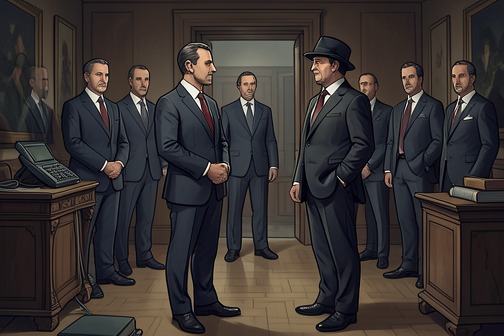
[Operation Panzerfaust](entity:event-recall-event-f53588cd8ec2) is recalled as one of [Otto](entity:character-recall-character-9f54aedde4b4) Skorzeny’s defining wartime missions: the kidnapping of Horthy’s son. The novel invokes it not through a staged account of the operation, but through a later conversation that weighs Skorzeny’s military reputation against the question of criminal responsibility. Set beside other episodes of secret violence and official concealment, the reference makes a distinction between a celebrated operation and the violence it helped normalize.
## Wartime reputation and the operation
Skorzeny is described as a fervent Nazi and Hitler’s favorite chief of special operations. The account lists the liberation of Mussolini, the kidnapping of Horthy’s son, and his infiltration during the [Battle of the Bulge](entity:event-recall-event-b7a3624db7cd) as successful missions. The kidnapping appears as one item in a catalogue of military accomplishments, presented as work carried out effectively rather than as an act examined from the perspective of its victim.
That framing is immediately complicated. Skorzeny had killed many enemies at the front and on his missions, yet his defender insists that he was a soldier, not a murderer. His scars and boasting make him look the part, but the argument rests on his status as a military operative and on the fact that the [Nuremberg trials](entity:event-recall-event-6025b3df1553) did not secure a war-crimes case against him. The episode therefore enters the narrative through a dispute over how military service, criminal responsibility, and legal proof are made to fit together.
## Postwar impunity
The conversation links Skorzeny’s freedom to suspicion that he worked for the Americans: his escape from [Darmstadt](entity:location-recall-location-b230fe49f3d4) prison is offered as evidence that he may have had powerful protection. This remains the speaker’s conviction, not a proven fact. The distinction matters: the narrative shows how an unexplained escape invites a political interpretation while leaving the underlying arrangement uncertain.
Skorzeny’s legal acquittal and suspected postwar protection place the kidnapping in a larger pattern of violence whose consequences outlast the war. A mission once praised for its effectiveness becomes part of a record that can be discussed without producing accountability. The novel’s focus is not a reconstruction of the operation’s details, which this recollection does not supply, but the postwar conditions under which a Nazi operative could remain beyond reach.
## Secret violence and the handling of bodies
Elsewhere, the novel presents an earlier example of concealed political violence. After guards mistake a wounded man for a corpse, a commander discovers identification connecting him to the Public Order Council of the Defense Junta. A police commissioner instructs the commander that, if the man is dead, he must be buried as an unknown person without registration; if alive, he must be kept out of hospitals under his own name and saved at any cost, because someone may try to kill him again. The order protects a Republican asset, but it also makes anonymity a matter of life and death.
A later burial scene shows the same erasure serving the opposite purpose. At [La Almudena Cemetery](entity:location-recall-location-ec9d8210f724), an unidentified man with a fatal bullet wound in his neck is assigned to a mass grave among people officially recorded as having died of cardiac arrest. The gravediggers notice the wound, but the immediate practical concern is to return the body sack because it costs money; one proposes taking the dead man’s good coat, and another agrees to hide it in his locker for a card game. The bureaucratic disguise of murder and the casual theft from the corpse turn the handling of the dead into another layer of the violence.
## The pattern across regimes
The narrative extends this pattern into [Argentina](entity:location-recall-location-27e2c37f5c3d) under the National Reorganization Process. It identifies Operation Independence, launched under President María Estela Martínez de Perón in February 1975, as a prelude to the dictatorship’s repression. Though presented as a campaign against guerrillas in Tucumán, it divides the country into five military zones and gives their commanders unlimited power to repress those labeled subversive. Its commander describes its purpose as cultural, and the campaign terrorizes civilians including teachers, students, intellectuals, artists, scientists, and religious figures.
After the coup of 24 March 1976, the dictatorship’s clandestine apparatus turns disappearance into an organized practice. Thousands are forcibly disappeared between 1976 and 1982; estimates reach about 30,000, though many bodies are never found. Specialized task groups carry out abductions, secret detention, torture, executions, disposal of bodies, and the removal and reassignment of babies born to detained women. The so-called death flights take living prisoners, bound and drugged, out over the sea and drop them from military aircraft. In this account, killing is joined to the deliberate destruction of identity and evidence.
Operation Panzerfaust itself remains a brief recollection, not a narrated action sequence. Its place in Skorzeny’s résumé, the doubts surrounding his escape and protection, and the later examples of concealed murder give the reference its force: wartime violence does not end with the mission or the surrender. It persists through the institutions and procedures that determine whose actions are celebrated, whose deaths are denied, and whether a victim can be recovered at all.
Event 53
Battle of the Bulge
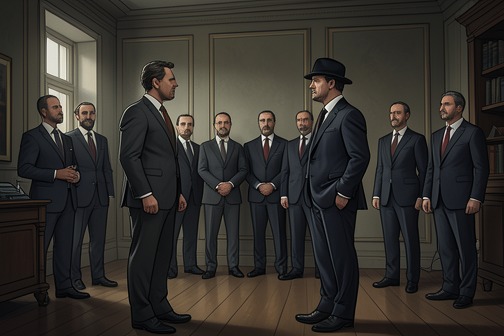
The [Battle of the Bulge](entity:event-recall-event-b7a3624db7cd) is recalled as the setting for a German deception operation led by [Otto](entity:character-recall-character-9f54aedde4b4) Skorzeny, and as an example of how a real military action became entangled with a more dramatic, unsubstantiated legend. The novel separates what Skorzeny’s men were ordered to do from what Allied soldiers came to believe, making the battle’s afterlife in rumor and propaganda central to its significance.
## The operation and its purpose
As the fourth anniversary of the battle approaches in December 1948, [Manuel Arroyo](entity:character-recall-character-3296d1a401b2) considers Skorzeny’s record while imagining how he might approach him in [Madrid](entity:location-recall-location-madrid-8acd4123f416). During the [Ardennes](entity:location-recall-location-5a987f1aaa53) offensive, Skorzeny had tried to sabotage the Allied lines by leading 3,500 men disguised as American soldiers. The operation had been personally designed by Hitler, and its immediate purpose was to misdirect Allied troops ahead of the offensive.
The deception did cause confusion for several hours. But Allied command reacted to the suspicious conduct of officers who were directing troops the wrong way; the disguised Germans were identified, arrested, and summarily shot. The episode thus appears not as an unqualified triumph of infiltration, but as a short-lived disruption that Allied forces ultimately recognized and stopped.
## The assassination rumor
Before their deaths, some of the captured Germans said their objective had been to kill Eisenhower. The account identifies this as a rumor that spread among the troops, not as Skorzeny’s actual orders. The men themselves did not know the purpose of their mission; the assassination story took hold when one soldier proposed it and others accepted the explanation.
The rumor nevertheless seemed plausible to those who knew Skorzeny’s public image. His fame, combined with the lack of information about the operation’s real aims, made an attempted assassination seem consistent with the reputation attached to his name. The novel stresses the distinction: neither Eisenhower’s murder appeared in Skorzeny’s orders nor was the general in that sector that day. The story’s persuasive force came from the legend, not from evidence of the supposed plot.
## Skorzeny’s postwar reputation
Skorzeny’s men’s ability to penetrate Allied lines infuriated the Americans, who placed him at the top of their list of most-wanted Nazis. At his [Nuremberg](entity:location-recall-location-18a35093b128) trial, however, his lawyer secured testimony from a British squadron leader who had also infiltrated enemy lines wearing a German uniform, in an operation that had served as Hitler’s model. That comparison damaged the case against Skorzeny, and he was acquitted.
The acquittal did not erase the image of Skorzeny as a dangerous figure. Allied propaganda continued to preserve his criminal notoriety, even though the dramatic assassination story was, by 1948, recognized as a fabrication. Manuel understands that gap between documented conduct, legal outcome, and enduring public reputation as he weighs the prospect of arresting Skorzeny in Madrid. The battle’s legacy in the novel is therefore not only the failed deception itself, but the way a brief operation and an unsupported rumor could help sustain a powerful postwar legend.
Event 54
Operation Greif
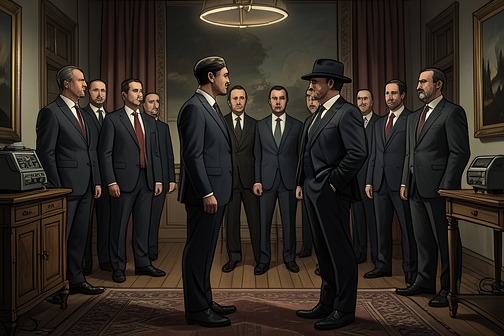
[Operation Greif](entity:event-recall-event-46b7f5f744ec), the German deception operation associated with the [Battle of the Bulge](entity:event-recall-event-b7a3624db7cd), sent 3,500 men disguised as American soldiers across Allied lines. In the novel, its significance lies both in the confusion it briefly caused and in the more durable legend built around its commander, [Otto](entity:character-recall-character-9f54aedde4b4) Skorzeny: the supposed plot to kill Dwight D. Eisenhower was a rumor, not the operation’s documented objective, yet it helped make Skorzeny a symbol of infiltration and danger.
## Operation and Objective
As the fourth anniversary of the Battle of the Bulge approaches, [Manuel Arroyo](entity:character-recall-character-3296d1a401b2) recalls that Skorzeny led the operation personally. The novel presents it as a plan designed by Adolf Hitler: disguised German troops crossed behind enemy lines shortly before the offensive, and their actions were meant to misdirect Allied forces. For several hours, the deception unsettled the Allies, but their command recognized that some officers were sending troops the wrong way and reacted in time.
## The Assassination Rumor
The men in American uniforms were identified, arrested, and shot. Before their deaths, some said that they had been tasked with killing Eisenhower. The account separates that claim from the operation’s actual orders: the men did not know what their mission was, and a rumor circulating among the troops supplied an explanation that seemed to fit Skorzeny’s fame. Eisenhower was not in that sector, and the novel states that Skorzeny had no order to assassinate him. The story thus shows how uncertainty about a covert operation allowed a sensational allegation to grow into part of its public mythology.
## Trial, Reputation, and Afterlife
Skorzeny’s ability to infiltrate Allied lines nevertheless enraged the Americans and placed him at the top of their list of most-wanted Nazis. At his [Nuremberg](entity:location-recall-location-18a35093b128) trial, his lawyer secured testimony from a British squadron leader who had also infiltrated enemy lines in German uniform in an operation that Hitler had used as a model. That testimony undermined the case against Skorzeny, and he was acquitted. The verdict did not dispel the image of him as exceptionally dangerous: Allied propaganda continued to preserve his notoriety, even as the assassination story remained unsupported.
## Meaning in the Later Plot
Years later, in [Madrid](entity:location-recall-location-madrid-8acd4123f416), Arroyo considers whether Skorzeny—then living under the name Rolf Steinbauer—could be lured into revealing himself. Arroyo imagines exploiting Skorzeny’s vanity by approaching him as an admiring comrade and invoking his reputation. He concludes that the scheme might work, but does not put it into practice. The episode’s reputation has outlived its military context: for Arroyo, it is both a possible route to arresting a fugitive and a reminder that the public image of Skorzeny is partly made from rumor, propaganda, and a real capacity for deception.
Event 55
Lazar evades repatriation to Germany
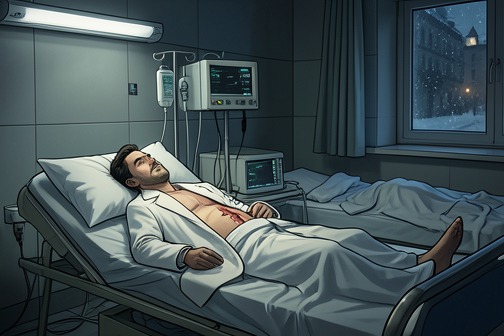
[Lazar evades repatriation to Germany](entity:event-recall-event-c3947afcfe2c) when a severe bout of appendicitis places him in a [Madrid](entity:location-recall-location-madrid-8acd4123f416) clinic on the eve of his scheduled flight in February 1946. The episode leaves him beyond the Allies’ reach and intensifies suspicion that he is hiding Nazi embassy treasure and documents; years later, clues about his connections to the escape network make his disappearance newly consequential.
## Repatriation and the operation
The Spanish government authorized the former diplomat’s repatriation in February 1946. On the day before he was to board the plane to [Germany](entity:location-recall-location-a3c24dd56e42), however, Lazar was admitted to [Clínica Ruber](entity:location-recall-location-b05acb3f9c1e) with a serious case of appendicitis. His appendix was removed that same day. The operation was real, but the timing made it suspect to the Allies: they believed he had entered the operating room without any urgent medical need and had used the procedure to avoid returning to Germany.
After the operation, no one heard from Lazar again. The account does not establish where he went or how he remained out of view; the lasting fact is the abrupt break between his authorized return and his disappearance. The episode thus turns a documented medical event into an unresolved escape, with the explanation resting on suspicion rather than proof.
## The missing treasure and archive
The Allies believed Lazar had secretly moved the treasures from the German embassy and the ambassador’s residence to a hiding place they had searched for unsuccessfully for years. They expected the cache to contain artworks, gold bars, and other valuable objects, as well as documents from an archive that had also vanished. The failed repatriation mattered not simply because a former diplomat had escaped their custody, but because he might be the remaining link to both the missing property and the records that could explain its movement.
The Allies’ search had yielded little: in the German embassy in Madrid, they had found only Lazar. His absence therefore sharpened the mystery around what had been taken and where it had gone. The treasures and archive remain objects of investigation in the account, not discoveries confirmed by the repatriation episode itself.
## The episode’s later significance
In a later line of inquiry, Guillermo’s account of a meal at [Horcher](entity:location-recall-location-horcher-975a3e2e46d3) leads [Manuel Arroyo](entity:character-recall-character-3296d1a401b2) Benítez to revisit Lazar’s disappearance. Manuel connects the name Bam—if the final consonant was an m rather than an n—to Josef [Hans Lazar](entity:character-recall-character-hans-lazar-bdc10f3f12a4), whom his intimates called Bam. He then sets that possibility beside the Allies’ suspicion that Lazar had carried away the embassy’s treasures and archival documents. The reasoning remains explicitly uncertain, but it makes the old flight from repatriation newly relevant to a suspected operation involving Nazi assets.
Manuel also considers the possibility that [Otto](entity:character-recall-character-9f54aedde4b4) Skorzeny had directed escape routes for wanted Nazis even while moving through successive prisons. He has only rumor to support that idea, yet he notes that [Clarita Stauffer](entity:character-recall-character-clarita-stauffer-46f541dee867), usually authoritative, had treated Skorzeny as a superior and said her friend Rolf had more authority than she did. These later suspicions do not prove that Lazar’s 1946 evasion was part of a coordinated scheme; they show why his disappearance could be read as one piece of a wider network.
## A continuing uncertainty
The event preserves a sharp distinction between what is known and what is inferred. Lazar was scheduled for repatriation, entered Clínica Ruber with appendicitis the previous day, underwent surgery, and disappeared from public knowledge afterward. The Allies suspected deliberate evasion and believed he had hidden treasure and documents, but neither the hiding place nor the archive is located in this account. That gap gives the episode its narrative force: the operation closes the route back to Germany while leaving the larger trail open.
Event 56
Operation to transport Nazi loot out of Spain
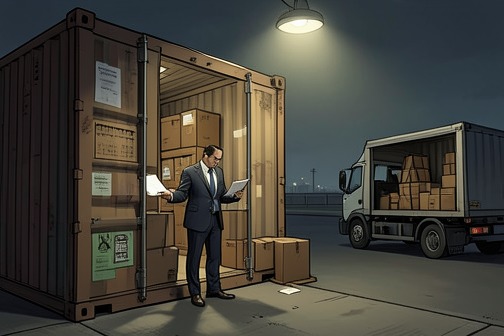
[Operation to transport Nazi loot out of Spain](entity:event-recall-event-f8b1fe8a91be) is a clandestine export operation that converts commercial paperwork, freight, and a transport agency into instruments for moving Nazi plunder. Its significance lies not only in the goods it carries, but in the machinery that makes their movement look ordinary: disputed property is described as legitimate commerce, concealed in routine cargo, and moved through an established shipping route while the people who might trace or reclaim it are kept at a distance.
## The operation and its cover
The scheme is presented to [Manuel Arroyo](entity:character-recall-character-3296d1a401b2) Benítez by Clara Stauffer as a series of discreet commercial transactions. She insists that the network is acting as a custodian rather than an owner of the goods, and describes the property as belonging to the [Third Reich](entity:time-recall-time-f3c47f5ce6a4), supposedly the spoils of its victorious campaigns. The claim that the objects have no other rightful heirs than the men who fought for the Nazi cause recasts seizure as entitlement. In her account, secrecy is forced upon them by the victorious Allies’ allegedly unjust claims. The language is a deliberate moral disguise: the goods’ origins and the people from whom they were taken disappear behind the vocabulary of deposit, ownership, and trade.
The stated purpose of the arrangement is practical as well as ideological. Stauffer needs someone inside a transport agency who can falsify the declared contents of shipments and ensure that each package reaches its destination intact. She tells Manuel that he will have support, including the cost of disguising an object inside an ordinary product such as soup pasta or altering its appearance. He already has experience concealing cargo for Communist friends, but this new work places the same technical skill in a different political and financial system. He recognizes the contrast: before, concealment was clandestine and undertaken for people he loved; now he is being recruited into a paid operation where he is not the decisive piece on the board but a pawn.
The operation draws on an escape network whose suspected routes lead from [Spain](entity:location-recall-location-0fe76f866976) to [Argentina](entity:location-recall-location-27e2c37f5c3d). [Pablo de Azcárate](entity:character-recall-character-pablo-de-azc-rate-a0624bf814b0) explains that Allied investigators regard Argentina as a likely destination for Nazi fugitives and believe Stauffer’s network cooperates with [Juan Perón](entity:character-recall-character-a454ccbc4368)’s regime. The network can provide Spanish identity documents using birth records supplied by friendly priests and contacts within the state administration. The evidence is presented as a strong suspicion, not a proven account of every shipment or fugitive. In the wider political setting, Perón’s invitation to Reich-linked technicians and scientists is tied to his ambition to make Argentina a power and to his expectation that [Cold War](entity:time-recall-time-700d9e46b459) realignments could turn yesterday’s enemies into tomorrow’s allies. The freight operation therefore belongs to a larger system in which political protection and practical logistics reinforce one another.
## Cargo, concealment, and transport
Manuel begins reporting before the shipments are under way. Three days after receiving a letter from [Buenos Aires](entity:location-recall-location-caf56b79d5c4), he sends his contact at Burnham an account of his meeting with [Hans Lazar](entity:character-recall-character-hans-lazar-bdc10f3f12a4), his conversation with [Otto](entity:character-recall-character-9f54aedde4b4) Skorzeny, the distrust Skorzeny feels toward a weakened comrade, and the creation and rental of the headquarters of [Sociedad Europea de Comercio Exterior](entity:organization-recall-organization-sociedad-europea-8252f86c26b9). As time passes, Manuel curbs his initial eagerness and records only relevant facts. He also writes to [Helen Murray](entity:character-recall-character-helen-murray-55656855d6d9) roughly ten days before each consignment, using the letters to give details of the previous expedition rather than to announce the next one. By separating his love letters from the precise dates of shipment, he makes it harder for [Gabino de la Fuente](entity:character-recall-character-gabino-de-la-fuente-c67615e76111) to connect the gifts he sends to his English girlfriend with his work for Stauffer. The precaution never has to be tested by an interception.
Between January and April, Manuel helps conceal the cargo in seven trucks. He is not supposed to know what the boxes contain, but Rolf Steinbauer repeatedly arranges to meet him on Jacometrezo Street while they wait for Lazar. At first Lazar is displeased to find Manuel there. His attitude softens when he sees that Manuel is better at camouflage than he is, and he begins identifying the goods whose sale he has arranged. Their collaboration makes the mechanics of the operation visible: the transporter’s expertise is not incidental support but a condition of moving the goods without discovery.
Most of the cargo consists of works of art. Paintings are removed from their frames, rolled, protected inside metal or wooden tubes, and hidden among construction materials or other hollow tubes that appear to reinforce the bottoms of containers. Gold without artistic value is melted into ingots; it travels with jewels in the false bottoms of boxes. Manuel’s preferred packing material is oranges. Three-dimensional objects—including statues, candelabra, and clocks—require more elaborate concealment, as does religious art taken from churches across Europe: crucifixes, icons, antique monstrances, chalices, and tabernacles. To hide such objects, Manuel persuades Gabino that a trusted coachbuilder must alter at least one truck, building a cavity in the floor between its two axles. The different hiding methods answer the physical character of the cargo, from paintings that can be rolled to sacred objects that must be concealed intact.
The origin of the goods is not merely an inference from the operation’s Nazi connections. Manuel becomes nearly certain that the consignments contain art looted from museums and Jewish owners in occupied territories, along with valuable jewels and antiquities of the same provenance. He also suspects that they may include gold, silver, and foreign currency from the vanished Nazi treasury. He connects the shipments to Lazar’s role in the vanished contents of the German embassy and ambassador’s residence in [Madrid](entity:location-recall-location-madrid-8acd4123f416). The Allies had found those premises stripped of records, money, gold, antiques, and works of art; Manuel reasons that Lazar may have moved the embassy’s treasures to a hiding place the Allies had searched for in vain. The cargo operation thus appears to continue a larger concealment of property and records, though Manuel’s account distinguishes his strong suspicions from what he can establish directly.
## The reporting operation and its paradox
The trucks leaving Spain through La Meridiana are never stopped along the route, and every load reaches its destination without incident. That uninterrupted success creates a paradox for Manuel. His mission is not to recover the goods or prevent their departure; his [London](entity:location-recall-location-1bfd335cdd1b) contact does not intend to seize the contents of the shipments as they move. Manuel is tasked with collecting information and transmitting it periodically. Only after the final truck has been unloaded is someone expected to assemble a dossier recording the number, frequency, and nature of the expeditions, allowing the Allies to trace the route, check the information, and recover their property.
Manuel is promised that his name will not appear in the dossier. Its source will remain anonymous, both because anonymity will not invalidate the information and because identifying him would put his life at risk. If the operation goes well and [Meg Williams](entity:character-recall-character-meg-williams-9e3155a7cbc0)’s Jewish associates decide to publish the dossier to pressure their government on two fronts, Manuel and his friend are to be taken out of Spain before the owner of the agency understands what has happened. The prospect of rescue, and of returning to Madrid after Francisco Franco has fled [El Pardo](entity:location-recall-location-0ec67d8830f2), is conveyed to him as a promise. Yet Manuel never gives up the hope that French customs will stop a load, inspect it, and bring the future shipments to an end. He performs his assigned work successfully while wishing that its success would be interrupted.
That split purpose shapes the operation’s moral and practical structure. The cargo continues outward, while a parallel stream of information is meant to preserve a trail back to it. The Allies’ plan depends on observing the traffic rather than stopping it at once, and Manuel’s anonymity is essential to that arrangement. His reporting therefore does not undo the transport as it happens; it is intended to make later recovery possible. The distinction between movement and documentation also explains why the loads can arrive safely even as an intelligence report is being built around them.
## Payment and complicity
The operation’s commercial surface is reinforced by money. After Manuel has assisted with the shipments, Rolf gives him an envelope over dinner at a seafood restaurant on Preciados Street. Raising a glass of Albariño, Rolf toasts the ideas, and Manuel repeats the toast before pocketing the envelope. Its thickness alarms him; when he opens it, he realizes that he has become rich. Stauffer had promised that her associates would make him wealthy, and the promise is fulfilled through payments that grow as the deliveries succeed.
Manuel never discusses the money with Rolf. He cannot tell whether the amounts are a percentage or simply a matter of Rolf’s discretion. At first he considers refusing them, but cannot find an argument that would persuade a man whose convictions coexist comfortably with cigars and luxury restaurants. Instead, Manuel deposits the money in small, varying amounts across three bank accounts he has opened for that purpose. He has not yet spent a cent, but the funds cease to feel like an inconvenience as he grows accustomed to living several lives at once. Payment makes the operation more than a test of skill or a cover for intelligence work: it gives Manuel a personal stake in a trade whose supposed legality obscures the violent dispossession at its source.
The resulting operation rests on contradiction. It relies on respectable business forms while hiding the contents and provenance of the freight; it invokes custodianship while moving objects that Manuel believes were stolen; and it gives the Allies information about the trade while allowing every truck to complete its journey. Its route is therefore both logistical and political: the cargo’s concealment depends on agency paperwork, modified vehicles, banks, and commercial contacts, while the protection surrounding Nazi fugitives and their property depends on a broader climate of postwar accommodation. The goods move successfully, but the records meant to make their passage legible leave the operation suspended between complicity and a delayed attempt at recovery.
Event 57
Manuel Arroyo's undercover mission in Argentina
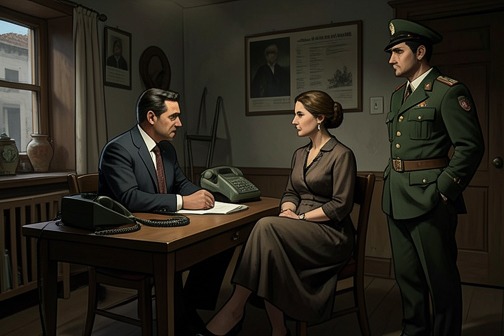
[Manuel Arroyo's undercover mission in Argentina](entity:event-recall-event-2550f0ba2d33) carries his infiltration of Clara Stauffer's escape network across the Atlantic and exposes how practical assistance—lodging, cash, work, documents, and social introductions—can make a fugitive system function as an ordinary service. Traveling as Adrián Gallardo, Arroyo enters a network supported by Argentine institutions and German business interests, gathers evidence while remaining dependent on the people he is investigating, and ultimately refuses Clara's invitation to extend the operation elsewhere in [South America](entity:location-recall-location-93067fb0ae2c).
## From [Madrid](entity:location-recall-location-madrid-8acd4123f416) to [Buenos Aires](entity:location-recall-location-caf56b79d5c4)
Arroyo's mission grows out of evidence gathered in Madrid. At Galileo 14, Clara's house had been transformed into a reception and assistance center: renovated rooms became offices, a new telephone line was installed, secretaries were hired, and cupboards were filled with men's clothes and shoes in many sizes. Men who looked to [Sole Ruiz](entity:character-recall-character-sole-ruiz-3e0947d42f94) like exhausted prisoners arrived at all hours. They were fed and given new clothes, then apparently directed toward lodging and work. Some were escapees from European prisons; others had been released from Nanclares. Sole also noticed that none spoke Spanish. Parish baptismal certificates bearing German names supplied another clue to how the network might furnish newcomers with usable identities.
A name overheard in the office gave this pattern a more specific lead. Sole struggled to identify [Jean-Jules Lecomte](entity:character-recall-character-jean-jules-lecomte-2119a7da971a) because of her poor French, but [Meg Williams](entity:character-recall-character-meg-williams-9e3155a7cbc0) recognized him as a committed Nazi who belonged to both [Partido Rex](entity:organization-recall-organization-partido-rex-e6273cc243e7) and the [SS](entity:organization-recall-organization-bbcdb0ea06e2). During the occupation he had become burgomaster of his native [Chimay](entity:location-recall-location-1a6f836f9fe9). The discovery helped turn testimony from a household servant into a possible route toward identifying the people and mechanisms behind the escape operation.
The investigation had political stakes beyond identifying fugitives. Meg persuaded [Sal Burnstein](entity:character-recall-character-sal-burnstein-67e1ec897e9f), who had been searching for evidence of an organized escape network, that Clara's operation might be stable enough to document. The investigators hoped that proof of Franco's protection of war criminals implicated in the genocide of the Jews could create pressure for a break in relations with [Spain](entity:location-recall-location-0fe76f866976) and, potentially, intervention. But they recognized that Sole's account alone could not establish the identities of Lecomte and [Horst Fuldner](entity:character-recall-character-horst-fuldner-ea72bba08c24), verify the Argentine visitors' connection to [Juan Perón](entity:character-recall-character-a454ccbc4368), or prove that Clara did more than care for German soldiers.
The suspected route to [Argentina](entity:location-recall-location-27e2c37f5c3d) offered a way to pursue that proof. The investigators believed Clara's organization supplied Spanish documentation, sometimes based on baptismal records obtained through friendly priests, and cooperated with Perón's government. Argentina was an especially plausible destination: it was receiving fugitives, while its shipments of grain and frozen meat to Spain defied the blockade. The explanation remained a hypothesis, not a proven chain of movement. Arroyo therefore accepted the role of infiltrator, entering the network whose reach the investigators needed to establish.
## Entering the refuge system
On December 16, 1948, Arroyo arrived in Buenos Aires with Clara. At the airport she greeted six men and three women by name, asked after their families, and thanked them for coming. Arroyo recognized [Walter Kutschmann](entity:character-recall-character-walter-kutschmann-659eb8fbd889), whom he had encountered in Spain. [Kutschmann](entity:character-recall-character-92aa6f64f0e3) had once treated him with the cordiality of an old acquaintance; now Clara broke through the welcoming crowd to greet him as Antonio. Her public warmth and the organized reception around her made the network visible as a community, not merely a chain of secret contacts.
Kutschmann took charge of Arroyo during the first days. He lived alone in a three-room apartment in [Recoleta](entity:location-recall-location-ff288a435d5b), held a well-paid management position with the Argentine branch of Osram, and had made a routine of assisting new arrivals. His Buenos Aires tour began with a drink at the Tortoni, dinner at a popular parrilla in [San Telmo](entity:location-recall-location-9f2a04f2ed3a), and drinks at a milonga, where Arroyo saw tango danced for the first time. The weekend continued with more walking, meals, and drinking. Beneath its sociable surface, the tour gave Arroyo an introduction to how the Argentine branch of the Stauffer network operated.
Kutschmann's own history showed the depth of the assistance behind him. A Catholic upbringing, he said, had saved his life: after crossing the [Pyrenees](entity:location-recall-location-bca267e59698) following the Allied landing in Normandy, he was sheltered by religious orders in monasteries and convents in [Galicia](entity:location-recall-location-c547828ba2f6). He had remained hidden for three years, leaving only in the summer of 1947 to travel to Madrid in a borrowed habit, plan his journey with Clara, and attend the July 18 gathering in the mountains. He then reached Buenos Aires with the authentic passport of an authentic Carmelite priest, who continued to live in [Sevilla](entity:location-recall-location-7262adae2211). A trusted religious identity had enabled a wanted fugitive to cross borders and enter a new life.
Kutschmann was not simply the buoyant host he seemed. Arroyo found that his easy greetings were practiced, while his private temperament tended toward melancholy. At other times Kutschmann forced himself into sociability, drinking, singing, dancing, and talking with an energy that could become exhausting. That talkativeness also let Arroyo see how complete the fugitives' sense of impunity was in Perón's Argentina—more absolute, in his judgment, than the shelter they had enjoyed under Franco in Spain.
## Institutional support and intelligence gathering
On December 20, Kutschmann accompanied Arroyo to the office of the [European Refugee Reception Service](entity:organization-recall-organization-3da90d542cfd) ([SARE](entity:organization-recall-organization-sare-4c3fac38c8fc)) on Canning Street. Its director, Radu Ghenea, welcomed the newcomer and told him to rest, adjust to the change of time and season, and become accustomed to Buenos Aires. Ghenea ended the reception with a raised-arm salute and the Falangist greeting; Arroyo hesitated before returning it. Kutschmann did not raise his arm, and the political display did not continue into the office of [Sofía Ferreti](entity:character-recall-character-sof-a-ferreti-d979a48f8c99), who handled the practical arrangements.
Ferreti gave Arroyo an envelope containing one thousand pesos. The amount combined a monthly state subsidy of four hundred pesos, available to new arrivals for up to six months, with money from a solidarity fund supported by earlier refugees who had found well-paid work. She also described employment openings, made possible in part by Ludwig Freude and German companies operating in Argentina. The Service promised to find Arroyo an apartment in Recoleta near Kutschmann's home and later to seek him a job. The arrangements formed a system of material support: public money, private contributions, housing, and employment were coordinated to move arrivals toward independence within the network.
For Arroyo, however, the same support that made his cover plausible constrained his work. His housing, money, and social contacts all depended on the people he was investigating. He told [Fred Goodwin](entity:character-recall-character-10975db1a18f) that he learned new things every day but wanted to keep their meetings infrequent until he could become independent. Goodwin, Meg Williams's associate and Arroyo's controller, wanted information more often; Arroyo delayed the next meeting for a month and a half by giving him a sucked sweet. He also reported that [Otto](entity:character-recall-character-9f54aedde4b4) Skorzeny, whom Goodwin called Scarface, was not in Buenos Aires: Skorzeny had been there in December, returned to Europe before [Christmas](entity:time-recall-time-0cffe7da2c4d), and was believed to live in [Germany](entity:location-recall-location-a3c24dd56e42) while visiting Madrid, possibly with the intention of settling there.
Arroyo managed the flow of intelligence rather than simply passing on each new fact. A correspondence conducted under assumed identities helped him coordinate his reporting with Guillermo's. Writing in English as Peter Louzán, he arranged for a supposed British woman, [Helen Murray](entity:character-recall-character-helen-murray-55656855d6d9), to correspond with Guillermo's assumed persona, Rafa Cuesta. The letters created a channel through which the two operations could be aligned without openly contacting each other. Arroyo intended to give the Americans information gradually, so that his report on the Stauffer network would coincide with the information Guillermo was sending to Burnham. After he moved in mid-March to [Balvanera](entity:location-recall-location-1b8ce1027120) and began working nearer the Palace of Justice and farther from Kutschmann, his meetings with Goodwin became more frequent. The practical independence he gained changed the rhythm of the intelligence relationship without removing the need for caution.
## Refusal and the end of the mission
Clara eventually invited Arroyo to accompany her on a further journey. She explained that her travels in Latin America were not a holiday: she had contacted established members of the network, prepared for future arrivals, and met with a government that was helping them. She planned to go to [Lima](entity:location-recall-location-60c34669f646), attend the October fair, consolidate the work in Peru and Bolivia, visit Santiago de Chile, and return to Buenos Aires before sailing back to Spain. Her proposal offered Arroyo a chance to follow the network beyond Argentina, but also to remain bound to Clara and her associates.
Arroyo refused. He told Clara that he was exhausted by years without a home, family, possessions, or a future, and that in Argentina he had begun again: he had a normal life, work, plans, and hopes. He had also met a woman he liked and could not abandon everything at once. Clara stopped him from speaking with a raised hand, then left him without a kiss, embrace, or promise to meet again. He never saw her afterward.
The refusal was not a failure to investigate. Arroyo did not discuss Clara's offer with Goodwin, Meg, or [Pablo de Azcárate](entity:character-recall-character-pablo-de-azc-rate-a0624bf814b0), though he knew they might criticize him for giving up the chance to learn about the network's activity beyond Argentina. By then, he believed he had already collected enough information to prosecute Clara many times over; he would not sacrifice himself to pursue more. His decision marks the limit he placed on an operation that had demanded successive identities, ingratiation with people he despised, and social performance in several languages. He had completed the mission, but completion could not restore the years spent carrying it out.
## Historical frame and significance
The Argentine refuge Arroyo investigated stands against the wider political context of state violence that later engulfed the country. The narrative describes the Argentine military dictatorship as an expression of the National Security Doctrine, backed by a [Cold War](entity:time-recall-time-700d9e46b459) policy that favored military regimes as instruments against the left. Before the 1976 coup, María Estela Martínez de Perón's government had already issued the decree that founded Operation Independence, ostensibly to defeat guerrillas in Tucumán but in practice granting military commanders broad power to repress civilians and widening the country into five military zones.
From the 1976 coup onward, the regime's machinery of repression included illegal detention, torture, executions, the disappearance of bodies, and the appropriation of children born to detained women. The account estimates that about thirty thousand people disappeared between 1976 and 1982, while acknowledging that the figure varies because many bodies were never recovered. It also describes the death flights, in which living prisoners were drugged, bound, and dropped over the sea. This later history does not make Arroyo's espionage mission an account of those crimes; it places his earlier experience of an Argentine refuge system within a country whose later dictatorships would make disappearance and erasure instruments of state policy. The contrast sharpens the mission's central concern with identity: forged or borrowed identities could protect fugitives, while state violence could forcibly erase the identities and evidence of its victims.
Event 58
Adrián Gallardo's murder and the burial of his body
[Adrián Gallardo's murder and the burial of his body](entity:event-recall-event-bb90411296ef) is the turning point at which [Guillermo García Medina](entity:character-recall-character-guillermo-garc-a-me-d52c3f18d2cc), a doctor committed to saving lives, deliberately kills a man he regards as an imminent threat. Gallardo’s death is then absorbed into a second violence: the concealment of his identity and the removal of the body from ordinary legal scrutiny. The episode links a personal decision, made in the name of protecting others, to the machinery of impunity that makes an unrecorded death possible.
## Discovery and the threat of exposure
The crisis began when the real Adrián Gallardo found Rafael Cuesta Sánchez, the identity under which Guillermo García Medina was living, at the transport agency where he worked. Gallardo understood that someone with his own name was impersonating him. Guillermo did not deny the essential fact: he had a friend who shared Gallardo’s name, and he proposed a discreet meeting rather than discussing the matter at the office. He also offered Gallardo money. Gallardo, who had not initially considered blackmail, saw that surrendering his identity could be profitable.
The danger was more than embarrassment or exposure. [Manuel Arroyo](entity:character-recall-character-3296d1a401b2) Benítez had taken Gallardo’s identity to infiltrate a network helping Nazi fugitives and to travel to [Argentina](entity:location-recall-location-27e2c37f5c3d) as one of them. If the real Gallardo disclosed the deception there, Manuel might not survive a day. The discovery also threatened the committee Burnstein, people connected to the operation, and Guillermo’s own future. The false identity, which had enabled Manuel’s work, had become a vulnerability precisely because its rightful bearer was still alive.
The decision to kill Gallardo emerged through discussion rather than an immediate outburst. Guillermo first considered whether Gallardo could be frightened or paid off, but Rolf Steinbauer rejected that course: Gallardo was too dangerous, and they could not live waiting for him to talk. Guillermo asked whether Steinbauer could speak with Hans, then offered to do the killing himself. He describes the choice as a decision to protect what he loved, not as revenge or an effort to pose as a just avenger. That distinction does not undo the act; it shows how he recasts a deliberate killing as a defensive necessity.
## Preparation and the killing
Guillermo had already spent time considering the practical obstacles. He had no car, did not want to involve Communist friends who were under police surveillance, and judged that bringing [Meg Williams](entity:character-recall-character-meg-williams-9e3155a7cbc0) into the secret would expose her to matters Manuel had withheld from her. He needed not only a means of killing Gallardo but support for disposing of the body. The planning makes the change in his role concrete: a doctor who had once been forbidden by Dr. Quintanilla to enlist outside the hospital’s surgical service now reasons through the logistics of an assassination.
On 28 December, Guillermo inspected the office of the [Sociedad Europea de Comercio Exterior](entity:organization-recall-organization-sociedad-europea-8252f86c26b9), measuring the spaces between furniture and identifying what the room could conceal. In a wooden inlaid chest on the windowsill, he found the loaded .22-caliber Luger, spare ammunition, and a silencer that Rolf Steinbauer had provided. The key was hidden inside the fourth volume of Goethe’s complete works in Spanish, on the fourth shelf. Guillermo fitted the silencer and discovered that a concealed recess beneath the desk could hold the weapon ready to hand. The respectable office furniture and literary volumes thus served a double purpose: ordinary furnishings masking the preparations for murder.
On 29 December 1949, Guillermo arrived at the office at seven in the evening. His account places the killing after Gallardo’s unannounced appearance and after Guillermo had settled on the plan. He acknowledges that the real Gallardo had ceased to seem like a person to him: Guillermo had begun to think of him as a dangerous creature who had to disappear. The narrative presents that dehumanizing judgment as part of the path to violence, while also making clear that Guillermo knew what he was doing. He later says that he killed Gallardo in cold blood and that no judge, in his view, would have accepted a claim of self-defense, even though he believed such a denial would be wrong.
## An unidentified body
On New Year’s morning, the shepherd [Zacarías González Peña](entity:character-recall-character-zacar-as-gonz-lez-p-4c50bd957bc2) found a body in a hollow in [Casa de Campo](entity:location-recall-location-b8c44b15fb99), where he had brought sixty-eight sheep. Unlike the bodies he had found there over the preceding five years, this one had been wrapped in a carpet. It was still clean despite the wound in the man’s neck; when Zacarías unrolled it, the body rolled onto its back, revealing the left wrist. The carpet’s elaborate pattern partly obscured the blood, making the wrapping itself an instrument of concealment.
The dead man was between thirty and thirty-five years old, about 170 centimetres tall, with dark brown hair and a robust build. His nose had been broken, the only distinguishing feature the investigators could identify. He wore a grey suit, white shirt, and dark overcoat, but had nothing in his pockets: no wallet, papers, or coins. The absence of documents meant that the body arrived at the authorities without a name, while the broken nose offered only a possible clue, not an identity.
Inspector Roberto Conesa recognized that this was not an accidental death or a drunken shooting. The body showed none of the resistance injuries—bruises, scratches, or broken nails—that might mark a struggle. A single shot beneath the jaw had ruptured the left carotid; the position of the wound and its appearance indicated a silencer. Conesa concluded that the victim had either been taken unawares or been too frightened to resist. He suspected a policeman or soldier using an unregistered weapon, but could not identify the killer. Rather than expose the crime to judicial scrutiny, he chose to contain it.
## Administrative disappearance
Conesa told the other officers not to make a formal report and took the body to the forensic institute himself. A young on-duty examiner fixed the approximate time of death as the afternoon of 29 December. Conesa and the examiner agreed to omit the autopsy, which would delay burial, and the body was dressed again and left at the depot. A police report was attached to the death certificate in an envelope pinned to the sack. Conesa described his paperwork as routine; his superior congratulated him and said he would handle the rest. By the next day the body had been buried, and Conesa reflected that nothing made police work easier than a dictatorship.
At around seven that evening, the body reached the old Eastern Cemetery, by then renamed La Almudena. An official assigned it to the crew burying unidentified people in a common grave. The decade’s many undocumented dead, the narrative notes, had acquired the curious habit of dying from the same cause: cardiac arrest, with no further details supplied. Gallardo’s fatal bullet wound was thus administratively translated into a bland, familiar cause of death. The grave did not merely hold an unknown man; the records helped make his unknown status seem ordinary.
Even the cemetery’s handling of the body followed the logic of disposal. The foreman told the gravediggers to remove the corpse from its sack because the sack had to be returned; such things cost money. One worker proposed taking the new overcoat because the dead man no longer needed it, and another agreed, suggesting they hide it in a locker and gamble for it. The men noticed the bullet wound, but their attention also turned to the coat’s quality. That small, material detail completes the process of reduction: the unidentified victim becomes first a body to bury, then a useful garment.
## Significance and the widening pattern of erasure
The murder is bound to the episode’s larger concern with concealed identity. Manuel’s survival and undercover work depend on living as Adrián Gallardo; the real Gallardo’s presence makes the borrowed identity unstable and dangerous. After Guillermo kills him, the empty pockets, the withheld report, the omitted autopsy, and the common grave extend that instability into the official record. The crime is not simply hidden by a single lie: a sequence of decisions strips away the means by which the dead man might be named and his death contested.
The episode also draws a moral contrast between the state’s claimed order and the practical freedom it gives its agents. Conesa recognizes an execution and suspects an armed state functionary, yet chooses not to report the murder because he believes the perpetrator will never be found and that declaration would bring risks without benefit. His superior’s approval and the rapid burial show how institutional cooperation can make deliberate violence disappear without requiring a public order to kill. The state’s power lies here not only in the capacity to take life but in controlling which deaths become legible.
That mechanism recurs elsewhere in the novel’s historical account, though on a different scale. During the Argentine dictatorship, clandestine groups divided the work of kidnapping, detention, torture, execution, disposal of bodies, and concealment of stolen children’s identities; the estimated number of disappeared people reaches about thirty thousand. The Spanish episode is not equivalent in scale, but its sequence—an execution, an unrecorded identity, official obstruction, and burial under a false cause—makes the later system intelligible as a radical expansion of a logic already visible in the earlier story. In both cases, violence aims beyond the victim’s body: it seeks to deprive survivors and investigators of the facts needed to establish that a person existed and was killed.
For Guillermo, the act also marks the cost of defending a network and a friend through the very violence he had once opposed. He continues to understand himself as a man whose calling is to save lives, but on this occasion he deliberately kills because he believes there is no other way to protect Manuel, the operation, and the people at stake. The burial completes the practical concealment of that choice, not its moral resolution. Gallardo disappears from the records as thoroughly as his identity had threatened to return, leaving Guillermo’s self-justification and guilt in tension with the impunity that has made both possible.
Event 59
Otto Skorzeny escapes from Darmstadt prison
[Otto Skorzeny escapes from Darmstadt prison](entity:event-recall-event-abdc45fa34b6) in 1948 with help from three men posing as Allied officers, beginning a flight that exposes how postwar escape depended not only on forged identities but on willing intermediaries, political shelter, and profitable networks. His disappearance leads from a Bavarian farm to [Spain](entity:location-recall-location-0fe76f866976) and [Argentina](entity:location-recall-location-27e2c37f5c3d), while the wider narrative connects such routes to the concealment and export of Nazi wealth.
## The escape and its first refuge
After escaping from [Darmstadt](entity:location-recall-location-b230fe49f3d4) prison, Skorzeny was handed over by the prison authorities, without questions, to three men who claimed to be Allied officers. Instead of transferring him to another prison, they helped him disappear. He found refuge at a farm in Bavaria owned by Ilse Lüthje, Countess von Finkenstein, niece of the financier Hjalmar Schacht. Skorzeny and Lüthje began an affair there, although both were married. For more than two years, the fugitive’s trail grew obscure.
The escape therefore unfolds less as a solitary feat than as a chain of assistance: officials who failed to scrutinize his transfer, a private refuge, and connections that could place a wanted man beyond the reach of ordinary pursuit. The novel presents the gaps between institutions as active opportunities, not merely as empty spaces.
## From fugitive to assumed identities
In February 1950, the French newspaper Ce soir published a front-page photograph of Skorzeny in Paris with a woman other than Lüthje. The resulting scandal forced him to flee again. That September, the Spanish consulate in Frankfurt issued a visa to a German citizen named Rolf Steinbauer, a man whom witnesses had already placed in [Madrid](entity:location-recall-location-madrid-8acd4123f416) during the preceding two years. A separate German identity document, issued in Freiburg in February 1950, identified him as Hans-Rudolf Frey. In the photograph attached to the document, he wore glasses and dyed blond hair; the shadows helped conceal the facial scar by which he was widely recognized.
The identities do not settle into one stable disguise. Evidence cited in the narrative suggests that Skorzeny, Steinbauer, and Frey moved among [Germany](entity:location-recall-location-a3c24dd56e42), Spain, and Argentina between 1948 and the winter of 1951, with a Paris visit interrupting that triangular route. A FAMA airline pilot recognized him among passengers on a Madrid–[Buenos Aires](entity:location-recall-location-caf56b79d5c4) flight. The novel distinguishes these plausible traces from Skorzeny’s own later, self-aggrandizing account that he slept with Evita in Buenos Aires in 1947 to disprove rumors about a mission to retrieve Reich funds from Swiss banks. That anecdote is presented as the fanciful exception, not as established fact.
## Networks, protection, and political purpose
The escape belongs to a broader landscape in which Spain became a staging ground for fugitives. In the novel’s account, the Stauffer network provided wanted people with Spanish documentation, drawing on friendly priests who supplied birth records and on contacts within the state administration. [Manuel Arroyo](entity:character-recall-character-3296d1a401b2) Benítez is told that the Argentine route is credible: Argentina is a desired destination for Nazis seeking to evade international courts, and the network is believed to cooperate with the government of [Juan Perón](entity:character-recall-character-a454ccbc4368), though the connection cannot yet be proved. The proposed answer is an infiltrator.
The political welcome extended to former Reich-linked figures is made explicit in a meeting convened under the pretext of discussing Perón’s “third position.” Perón presents himself as opposed to both Marxism and liberalism, but the gathering turns toward recruiting Reich-linked civilian and military specialists to make Argentina a power. He anticipates that a future conflict between the West and the Soviet Union could recast yesterday’s enemies as tomorrow’s allies. The escape from Darmstadt thus opens onto a political calculation: refuge is not simply tolerated but can be treated as an investment in future anti-communist advantage.
## Wealth concealed and moved
The novel also links Skorzeny’s fugitive world to the movement of looted property. [Hans Lazar](entity:character-recall-character-hans-lazar-bdc10f3f12a4), a key figure in the German embassy in Madrid, had used social influence and covert operations to build pro-Axis opinion while taking advantage of postwar Spanish poverty to assemble an art collection. When Allied representatives finally entered the embassy on 5 June 1945, they found it stripped: records, money, gold, antiques, artworks, and even furniture were gone. Manuel later reasons that Lazar may have moved the embassy’s treasures and secret archive to a hiding place that the Allies had sought for years.
The suspected export route becomes concrete through the shipments handled under the name Rolf Steinbauer. Between January and April, seven trucks carried concealed cargo. Paintings were removed from their frames, rolled into metal or wooden tubes, and hidden among construction materials; non-art gold was melted into bars, while jewelry traveled in false-bottomed boxes. Statues, candlesticks, clocks, and sacred objects—including crucifixes, icons, monstrances, chalices, and tabernacles looted from churches—required more elaborate concealment, prompting the modification of a truck’s floor between its axles. Manuel’s participation made him increasingly implicated in the operation: he accepted growing payments, deposited in small and varying sums across three bank accounts, though he had not yet spent any of the money. The escape’s material underside is therefore not incidental. Concealment protected people, but it also moved stolen wealth through ordinary-looking transport and business arrangements.
## Significance
Skorzeny’s escape is the initiating breach through which a larger system comes into view. His movement across borders depends on aliases, private patrons, official omissions, and a political climate in which former Nazis could be valued for future usefulness. The same networks that sheltered fugitives also connected them to the transport and possible concealment of the [Third Reich](entity:time-recall-time-f3c47f5ce6a4)’s wealth. By following the escape beyond the prison itself, the novel shifts attention from the dramatic act of disappearance to the infrastructure that made disappearance sustainable.
Event 60
Establishment of the Die Spinne (“The Spider”) network
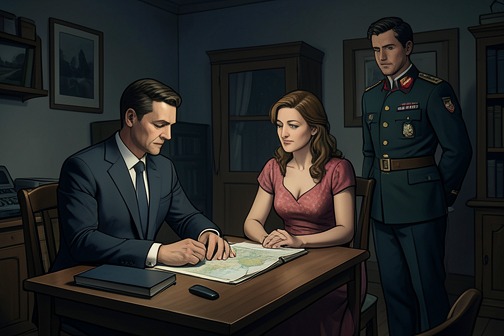
The [Establishment of the Die Spinne (“The Spider”) network](entity:event-recall-event-die-spinne-cb75cfe7c3e2) reveals how postwar escape depended not on a single secret organization but on connected routes, intermediaries, and protectors. Founded by [Otto](entity:character-recall-character-9f54aedde4b4) Skorzeny after the war, [Die Spinne](entity:organization-recall-organization-die-spinne-9184ac79210d) helped fugitives reach Italy and then [South America](entity:location-recall-location-93067fb0ae2c). The novel places it within a broader system that included Clara Stauffer’s more effective [Madrid](entity:location-recall-location-madrid-8acd4123f416) network, whose practical assistance turned shelter and identity papers into stages of an escape route.
## Formation and Route
In 1947, while imprisoned at Dachau, Otto Skorzeny organized the escape of prisoners with the complicity of Polish guards. Soon afterward, he founded Die Spinne, a network that facilitated fugitives’ flight to Italy. There, two bishops of the Roman Curia, the Austrian Nazi Alois Hudal and the Croatian [Ustaše](entity:organization-recall-organization-af19b66afff4) figure Krunoslav Draganović, helped arrange their onward passage to South America. The route was therefore not simply a border crossing: it linked prison escapes, assistance inside Italy, and a distant destination beyond Europe.
The novel distinguishes Die Spinne from the much larger mythology of [ODESSA](entity:organization-recall-organization-odessa-c706862dc8c9). Contemporary scholars, it notes, dismiss the existence of an organization called the Organisation der ehemaligen [SS](entity:organization-recall-organization-bbcdb0ea06e2)-Angehörigen, yet Skorzeny was associated with Nazi escape networks early on. Die Spinne is one documented part of that history, rather than proof of an all-powerful, unified organization of the kind later popularized in fiction.
## The Madrid Network and Its Work
The account sets Die Spinne beside the network Clara Stauffer directed from Madrid. Her operation received men who had escaped European prisons or been released from Nanclares, fed them, supplied new clothes, and apparently helped them find accommodation and work. Its organization had a domestic and administrative face: in the summer of 1945, Stauffer renovated rooms in her house for an office, installed a new telephone line, hired two secretaries, and filled new wardrobes with men’s clothes in every size and shoes in every size.
The movement of people through that house also exposed the network’s reliance on routine and intermediaries. A Spanish conscript delivered sealed envelopes, often bearing the letterhead of Madrid parishes. When one envelope was left unsealed, [Sole Ruiz](entity:character-recall-character-sole-ruiz-3e0947d42f94) found a baptismal certificate bearing German names and a 1907 date. Such certificates could support the Spanish documentation that Stauffer’s contacts arranged for fugitives. The network thus connected personal hospitality to clerical paperwork and access to state administration.
[Manuel Arroyo](entity:character-recall-character-3296d1a401b2) Benítez’s infiltration gave the story a view from inside the system. Under the identity José Pacheco Hernández, he began visiting Galileo 14 with [Ingrid Weiss](entity:character-recall-character-ingrid-weiss-c9fed2f4fcc4) and cultivated the office secretaries by bringing them newspapers, sharing coffee, and running errands. On 15 June, as their vacation period began, his help made him function almost as another secretary. He used the access to record what he learned in a small notebook bought with money saved from his weekly allowance; the secretaries also sent him to collect the baptism certificate that would be used to construct his own identity.
## From Madrid to [Argentina](entity:location-recall-location-27e2c37f5c3d)
The information gathered through Sole Ruiz and Manuel’s infiltration gave [Margaret C. Williams](entity:character-recall-character-margaret-c-williams-b61e577104d3) and [Saul Burnstein](entity:character-recall-character-7f428699216c) grounds to treat the Stauffer operation as a stable network, not a handful of isolated acts of charity. The evidence was not yet sufficient to prove its full reach or pressure the [United Nations](entity:organization-recall-organization-e95d8c5557b2) or the [United States](entity:location-recall-location-5d55e9152db1) government. Their proposed case required confirmation of the fugitives’ identities, the role of Argentine visitors, and whether Stauffer was doing more than clothing and feeding German soldiers.
The suspected destination was Argentina. The novel describes South America as the hoped-for refuge of Nazis seeking to evade international tribunals and identifies cooperation between Stauffer’s network and the government of [Juan Perón](entity:character-recall-character-a454ccbc4368) as a working hypothesis. Argentina was also sending [Spain](entity:location-recall-location-0fe76f866976) grain and frozen meat despite the blockade. Stauffer’s presumed contribution was to shelter fugitives and provide Spanish papers, including baptismal certificates obtained through friendly parish priests and contacts in the state administration. The account is careful to distinguish what the investigators believed from what they could prove.
The network’s suspected logistics extended beyond people. Manuel Arroyo Benítez believed that shipments [Guillermo García Medina](entity:character-recall-character-guillermo-garc-a-me-d52c3f18d2cc) had agreed to supervise might contain art looted from museums and Jewish owners in occupied territories, along with jewelry, antiquities, and perhaps gold, silver, or foreign currency from the vanished Nazi treasury. He connected Clara’s interest in the man she knew as Rafael Cuesta Sánchez to this work and recalled that, at a gathering in [Cercedilla](entity:location-recall-location-85100c36d067) on 18 July 1947, she had tried to introduce him to a friend named Ban or Bam. If the name ended in m, Manuel reasoned, it referred to [Hans Lazar](entity:character-recall-character-hans-lazar-bdc10f3f12a4), known to intimates as Bam.
## A Wider System of Protection
The novel describes the [Vatican](entity:location-recall-location-416dda4866db)-associated route and Stauffer’s Madrid operation as networks that regularly collaborated and shared the hospitality Argentina offered their protégés. Although the two systems differed in scale and geography, both helped turn European fugitives’ escape into onward passage to South America. Stauffer’s network is described as larger and more effective than its Vatican counterpart, and as the closest real-world parallel to the fictional image of ODESSA.
That efficiency depended on connections between very different kinds of support: guards who enabled prison escapes, clerics who helped arrange passage or supplied certificates, household staff and secretaries who maintained daily operations, and official contacts who could facilitate documents. The result was a system capable of offering fugitives more than concealment for a night. It could provide clothing, food, paperwork, possible employment, and a route out of Europe.
The novel also gives the system a limit. It describes the networks’ success and impunity as continuing until 1955, when a military coup overthrew Juan Perón. Die Spinne’s establishment therefore signifies both the persistence of Nazi escape efforts after the war and their dependence on political protection and cross-border cooperation. The contrast between its route through Italy and Stauffer’s Madrid operation makes the larger point: fugitives escaped through linked networks, not through one omnipotent organization.
Event 61
Galán is secretly smuggled out of Spain
[Galán is secretly smuggled out of Spain](entity:event-recall-event-gal-n-78605397caa8) refers to [Manuel Arroyo](entity:character-recall-character-3296d1a401b2) Benítez’s effort to arrange a recovered underground contact’s escape across the French border. The plan reveals how a transport network built to move concealed goods could be adapted to carry a person, while also showing the danger of that adaptation: every hidden compartment required someone’s complicity, and the ordinary anonymity of the operation could no longer be taken for granted.
## The escape plan
In late summer, Arroyo and Rita had accompanied the recovered clandestine contact from a basement on Calle Desengaño to a modest house near the Manzanares, where a Republican widow rented rooms. Recovery was not enough to secure his safety. He still had to leave [Spain](entity:location-recall-location-0fe76f866976), and Arroyo judged that La Meridiana, the transport company whose routes he knew, offered the most promising means. Smuggling a person, however, was not as simple as moving illegal merchandise across a border.
Arroyo considered assigning a French itinerary to a truck already modified with a hiding place between its wheel axles. The compartment had been built to specifications he had commissioned on Steinbauer’s instructions. It could hold a man curled up for a few kilometres, a practical but severe limitation that made the concealed passage dependent on timing and careful handling. The truck and route supplied a possible way out; they did not solve the human problem of getting the passenger safely into the compartment and out again.
## The driver as the obstacle
A driver would have to know what was hidden. He would need to help the fugitive climb into the space before the frontier, close it, and reopen it after crossing. Arroyo had no one he could entrust with those steps. That requirement set this operation apart from the usual transports he arranged for the Nazis, in which drivers generally did not know what their cargo concealed.
For ordinary shipments, the recipient in Paris or [Zurich](entity:location-recall-location-36d13535e481) appeared as the official addressee of boxes disguising stolen goods. When larger objects required a hiding place, the journey went to a temporary driver recommended by [Hans Lazar](entity:character-recall-character-hans-lazar-bdc10f3f12a4), hired by La Meridiana for that trip alone. Neither practice offered Arroyo a dependable accomplice for a living passenger: the established procedures preserved ignorance, while this escape depended on disclosure and cooperation.
## Rita and the limits of concealment
Arroyo could tell Rita about the problem of finding a driver, but as he explained it he felt that he was speaking alone. They were walking slowly along Paseo de la Florida after crossing the river, without a definite destination. Rita answered that it would surely be easier for her to find someone. Her brief suggestion shifts the immediate search toward her, but the episode does not establish who the driver would be or confirm that the proposed crossing was completed.
The scene therefore holds the escape at the point of preparation: the contact has been sheltered and has recovered, a route and a purpose-built compartment are available, yet the operation remains unresolved until someone can be trusted with the secret. Arroyo’s experience moving hidden goods has given him the means to imagine an escape, but it has also shown him precisely why this passenger cannot be treated as cargo.
Event 62
Adrián Gallardo is murdered
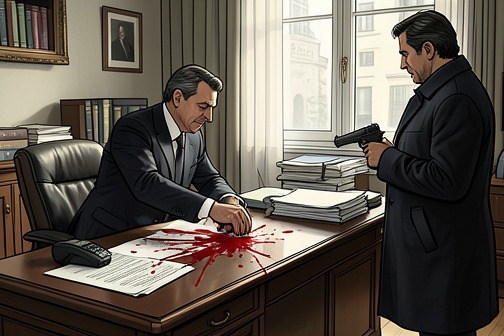
[Adrián Gallardo is murdered](entity:event-recall-event-214ad8fcbcd5) when [Guillermo García Medina](entity:character-recall-character-guillermo-garc-a-me-d52c3f18d2cc) kills the real man whose identity [Manuel Arroyo](entity:character-recall-character-3296d1a401b2) Benítez has assumed. The killing, carried out in a [Madrid](entity:location-recall-location-madrid-8acd4123f416) office on 29 December 1949, prevents Gallardo from exposing Manuel’s deception, but makes Guillermo—a doctor committed to saving lives—cross into deliberate, planned violence. The scene’s careful choreography and its later return in nightmares make the murder both an act of protection and a wound that cannot be contained by its immediate purpose.
## Causes and Stakes
For more than four years, Gallardo had been missing and was presumed dead. In that absence, Manuel used Gallardo’s identity to leave the country and infiltrate a network helping Nazi fugitives escape to [Argentina](entity:location-recall-location-27e2c37f5c3d). The deception held only while the real Gallardo remained absent. If his survival became known in [Buenos Aires](entity:location-recall-location-caf56b79d5c4), Manuel would be in mortal danger; the threat also extended to the Burnstein committee and others connected to the operation. Guillermo understood the danger not as an abstract risk but as a direct threat to his friend and to the lives and hopes bound up in their cause.
By the time Gallardo appeared in Madrid, Guillermo had already concluded that he had to die. He later recalled that Gallardo had ceased to seem like a person to him and had become, in his mind, a threat that only he could remove. Yet Guillermo did not describe himself as a vengeance-seeker or a justiciar. He framed the decision as the act of an ordinary man protecting everything he loved, while recognizing that this was also the moment he became capable of thinking and acting like a soldier.
## The Meeting and the Offer
Guillermo prepared the murder as if planning an operation. At the office of the [Sociedad Europea de Comercio Exterior](entity:organization-recall-organization-sociedad-europea-8252f86c26b9), he arranged the room so Gallardo would sit with his back to the desk, where the weapon was hidden. He had withdrawn 150,000 pesetas from each of three bank accounts and placed the money in a briefcase. The offer was designed to buy Gallardo’s silence: 150,000 pesetas immediately and the same amount a year later if he kept the agreement. Guillermo added another option during the conversation—300,000 pesetas at once if Gallardo left [Spain](entity:location-recall-location-0fe76f866976) for any country other than Argentina.
He presented the payment as a generous settlement, explaining that the organization had acted in good faith because it believed Gallardo dead. Gallardo accepted the underlying facts but knew the danger: Guillermo’s friends were powerful, and any attempt to reclaim his identity through legal channels could get him killed. The offer, however, was not a genuine path to safety. Guillermo recognized that allowing Gallardo to leave would not prevent him from going to Buenos Aires later or returning to Spain to renew his threats. The negotiation was a device to distract him and reduce the chance that a former professional boxer could resist.
## The Killing
As Gallardo counted the banknotes, Guillermo used the office telephone to perform a call to a nonexistent number, then waited until Gallardo had released the money from its briefcase. He removed his jacket, took the Luger from its hiding place, and put on rubber gloves. The gloves recalled the preparations for surgery: Guillermo later says their touch made him wish he could wash his hands before entering an operating room. He approached Gallardo without being noticed, drew the pistol, placed its muzzle against the man’s neck at the left carotid artery, and fired before Gallardo could turn.
The gunshot was louder than Guillermo expected. Gallardo remained seated, his head against Guillermo’s stomach, while blood soaked Guillermo’s shirt. He held the body still and waited for any sound of someone coming down the corridor. No one investigated. Then he moved the money aside, lowered Gallardo’s head onto the glass tabletop, and went to the tiny washroom. He washed his bare torso, arms, and face with cold water and soap, changed into the clean shirt he had brought, and returned to the office. His hands shook so badly that lighting a cigarette was difficult; it took nearly fifteen minutes before he could rely on them again.
## Concealment and Immediate Aftermath
Once his hands steadied, Guillermo moved quickly to erase the traces of the killing. He disassembled the Luger and returned it to its chest, gathered the money back into his briefcase, and wrung out the shirt that had been soaked with blood. Though it was white again, a pink stain remained on its front; he spread it over the edge of the bathtub to drip dry. He put the chairs back around the table, leaving Gallardo seated as though asleep, then used the office telephone to call [Munich](entity:location-recall-location-d277927d86b1) and tell Rolf that it was done. The ordinary tidiness of the room—chairs restored, weapon put away, money collected—stood beside the body and the bloodied shirt, the practical aftermath of a decision Guillermo had tried to make feel like a surgical procedure.
## The Killing
As Adrián counted the banknotes, Guillermo used the office telephone to simulate a call to a nonexistent number, then waited until Adrián had released the money from his briefcase. He removed his jacket, retrieved the Luger from its hiding place, and put on rubber gloves. Their feel recalled the preparations for surgery: he wished he could wash his hands before entering an operating room. He approached Adrián without being noticed, placed the pistol against his neck at the left carotid artery, and fired before he could turn.
The shot was louder than Guillermo expected. Adrián remained seated, his head against Guillermo’s stomach, while blood soaked Guillermo’s shirt. Guillermo held the body still and waited for footsteps in the corridor; no one came to investigate. He moved the money aside, lowered Adrián’s head onto the glass tabletop, and went to the small washroom. There he washed his bare torso, arms, and face with cold water and soap, changed into the clean shirt he had brought, and returned to the office. His hands shook so badly that he struggled to light a cigarette. Nearly fifteen minutes passed before they steadied enough for him to act.
## Disposal and the Dictatorship’s Paperwork
The killing’s aftermath extends beyond Guillermo’s office into a system where a body can be made administratively invisible. A police inspector arranges for the dead man to be buried without the usual delay of an autopsy, and the body is recorded as another unidentified death attributed to cardiac arrest. At [La Almudena Cemetery](entity:location-recall-location-ec9d8210f724), the corpse is assigned to a common grave for undocumented people; its gunshot wound is visible, but the false cause of death passes into the routine. The gravediggers even consider taking the dead man’s good coat, treating the body as both evidence to be concealed and a source of usable property. The sequence makes the murder’s cover-up part of a broader machinery of impunity: official procedures do not expose violence but help erase it.
## A Crime That Returns
Guillermo’s act does not end with the body. In recurring nightmares, he relives the shooting almost weekly: he sees Gallardo’s blood soak his shirt, then finds that the dead man is Manuel, whose horrified eyes accuse him. The dream turns the original act of protecting Manuel into its most feared reversal, making the friend Guillermo saved appear as the victim of his own hand. He wakes in disgust, still feeling the blood on his nightclothes, and cannot bring himself to tell Rita what he has done. His silence is partly defended as protection—Rita is active in an illegal party and could be endangered by knowing too much—but it also keeps his own complicity sealed away.
The episode’s later resonance is sharpened by Guillermo’s recollection of [Estonia](entity:location-recall-location-3174b38cc5de): he had seen photographs of heaps of bodies prepared for burning and of people reduced to charred remains. He insists he did not kill Gallardo as a avenger or a judge; he acted because he believed there was no other way to defend his friend, their cause, and the future he hoped to share with Rita. That distinction explains his decision without making it clean. The doctor who had been forbidden to enlist in anything but hospital surgery has become a killer, and the carefully planned act he once treated as a necessary operation returns as an intimate, repeating wound.
Event 63
Simona escapes Fortín Tiburcio

[Simona escapes Fortín Tiburcio](entity:event-recall-event-34e1c481fcb5) when a flood carries away [Renato Bley](entity:character-recall-character-cfe0c0bea8d8), the husband who had isolated and abused her. The escape begins as a desperate wish not to die imprisoned, but ends with Simona choosing where to go and reclaiming a life beyond the estancia.
## Confinement and the decision to survive
Renato had cut Simona off from her family: after her sister-in-law Salomé took charge of the mail, no further letters reached her. On Simona’s twenty-eighth birthday, Renato declared that she would never again set foot in [Buenos Aires](entity:location-recall-location-caf56b79d5c4). She answered inwardly with a secret resolve: she would not turn thirty at [Fortín Tiburcio](entity:location-recall-location-f7d591d4ee00), even if escape required her to kill herself. Imagining Renato’s rage at her corpse briefly made suicide seem like a peaceful release, but that thought also returned her sense of self. As she recognized the means of her confinement—distance, isolation, dependence on people financially tied to Renato, and a fence meant to keep both cattle and Simona inside—she began to think continually about escape. She learned to comply outwardly, avoid beatings, and placate her sisters-in-law, not because she had accepted captivity, but because survival gave her time to look for a way out.
## The flood and Renato’s death
The danger of escape was not abstract. Renato had killed Simona’s mare with a gunshot, she could not drive, and she slept in a locked room. She kept planning, but he never left her alone, as if he sensed what she was considering. After the months passed and she turned twenty-nine, she believed she might have to kill herself. Then, one January, rain fell for days. The [Arroyo Salado](entity:location-recall-location-589fd985126f) rose until its waters merged visually with the immense lagoon called [Mar Chiquita](entity:location-recall-location-1621c50e7a05); the flood tore away the fence that had enclosed the estancia.
A farmhand came into the house at mealtime, leaving puddles across the floor as Simona’s sisters-in-law shouted. He had news more urgent than their complaints: the water was carrying off the cattle. Renato rose and ordered Simona to get dressed and come with him. They drove out alone in a jeep. The road had vanished beneath the water, and Renato navigated from memory, while rain forced its way through the closed windows. Loose cows bellowed, the fence was gone, and the jeep stalled twice before he managed to continue to the riverbank.
There, fallen sections of fence had caught cattle and prevented them from tumbling into the river’s center, but the torrent—rushing down with stones, bricks, and even whole trees—had already swept some animals away. Renato climbed down with a rope and pulled one cow to safety, then another. Simona watched, thinking his labor futile: even the cattle he rescued remained surrounded by water. Then she suddenly could no longer see him.
Renato called for her to bring a rope, but Simona approached the bank slowly. She saw him below, abruptly helpless, clinging to a small root that soon broke. She could not dislodge it with her foot before the current took him. She had wanted to kill him, not save him; now she had done neither. As his head struck a rock and the foam turned red, she could hardly believe that the outcome was real. At that instant the rain stopped, after four days and three nights, though the river still ran violently.
## Leaving the estancia and returning to Buenos Aires
Simona walked back alone, taking more than two hours. She was not lost and was no longer afraid; she paused because she remembered her mother and wept, then felt the world, the field, and her own chest grow larger. The sound of her boots in the water pleased her, and when the clouds opened to reveal a patch of blue, she stopped to look. She could have returned to the house whenever she chose, but instead went to Fortín Tiburcio to report Renato’s death. Gendarmes later drove her back to the estancia.
Renato’s remains surfaced over the following days: first his trunk, with almost a whole leg and half an arm, then other fragments, and finally a skull that could not be confidently identified as his. Fish had consumed the rest. His death ended his authority over Simona at once. On her thirtieth birthday, she was in Buenos Aires, having survived the age she had once feared she would never reach.
The first thing Simona did as Renato’s widow was cut her hair, so no one could ever again drag her by it across the floor. She took possession of the house, half the land, and a substantial sum of money. Her sisters-in-law tried to discredit her among the neighbors and hired a lawyer, who charged them nothing, but they could not prevent her from inheriting her husband’s property. Her brother-in-law Pedro, Augusta’s husband, treated her more considerately, recognizing that he would have to continue dealing with her over the estancia for years.
After settling the paperwork with Pedro, Simona returned to the Buenos Aires neighborhood she loved. She bought an apartment on Rivadavia Street, in the building beside her mother’s, and kept her story to herself until [Manuel Arroyo](entity:character-recall-character-3296d1a401b2) Benítez’s persistent affection finally disarmed her.
## Aftermath and the life reclaimed
Simona’s return to Buenos Aires did not erase what had happened at the estancia, but it made her survival tangible. She was back in the neighborhood she loved, living in an apartment on Rivadavia Street in the building beside her mother’s. The proximity sharply reversed the isolation Renato had imposed: the woman whose family’s letters had been intercepted could now live next door to her mother. Yet she did not tell anyone her story. Silence remained her choice until Manuel Arroyo Benítez’s loving persistence finally disarmed her.
When Manuel asked why she would want a woman like herself, Simona answered by measuring herself against the imagined alternatives: pretty, simple, good girls, he could choose one of them. She said she had already lived and could not give him what he wanted. Her words show that freedom from Renato’s control did not instantly restore an uncomplicated sense of the future. The flood had carried her out of the life in which she expected to die, but trust and intimacy came later, through the gradual breaking of the silence she had kept around her past.
Event 64
Manuel proposes to Simona and decides to stay in Argentina
[Manuel proposes to Simona and decides to stay in Argentina](entity:event-recall-event-d079f8afa87c) at a turning point in which a life built on concealment becomes a chosen, shared future. On 11 November 1950 in [Buenos Aires](entity:location-recall-location-caf56b79d5c4), [Manuel Arroyo](entity:character-recall-character-3296d1a401b2) Benítez tells Simona Gaitán Peroni that he loves her and wants to marry her; if she refuses, he will return to Europe. She questions whether the proposal is a declaration or a form of pressure, but ultimately says yes. He answers by revealing the truth of his identity and history, and she accepts him while continuing to call him “gallego.”
## Background: A Life of Assumed Names
Manuel’s proposal follows years of exile and clandestine work, during which his identity has been something to conceal, adapt, or use as cover. In 1939 he returned to [Geneva](entity:location-recall-location-634fbb9f6bb2) after the Spanish Republic’s defeat. He missed [Meg Williams](entity:character-recall-character-meg-williams-9e3155a7cbc0), who no longer lived there, and the loneliness of the city shaped that period even as he worked for [Pablo de Azcárate](entity:character-recall-character-pablo-de-azc-rate-a0624bf814b0). His unofficial assignment took him from a small office rented under the name of a fictitious commercial agency to meetings with representatives of neutral and Allied countries in cafés, parks, and public squares. He presented himself as Felipe Ballesteros Sánchez and sent reports to [Taplow](entity:location-recall-location-b6266fdd1c9f) when he could find space on a British military aircraft.
The position was safe compared with the hardship endured by many Spanish exiles in Europe, but safety did not make it feel like home. Manuel would have exchanged his comfortable room in a Swiss boarding house for the exposure of a French camp. That restlessness belongs to the long history behind the proposal: his life has been shaped by political defeat, separation, and movement between countries, not by a settled choice to make a home in Buenos Aires.
On 10 September 1946, he entered [Spain](entity:location-recall-location-0fe76f866976) through [Gibraltar](entity:location-recall-location-da80b0a7ad4a) on a British military aircraft. [France](entity:location-recall-location-4f282e1af8a7) would have been a less conspicuous route, but the border was closed, and crossing the mountains with a clandestine guide risked an injury that could ruin his mission. His cover was that of an American citizen visiting his parents’ homeland for the first time. The clothing laid out on rooftops in La Línea and the wind of the Strait stirred a powerful sense of homecoming, but he kept that response from the British official who met him. His return was at once emotional and covert: even the feeling of belonging had to be hidden behind a false account of who he was.
## The Decision to Stay
By the time of the proposal, Manuel had expected to return to Europe when his mission ended. In Buenos Aires on 11 November 1950, however, he no longer felt that he had to leave. His declaration makes the decision explicit without making it unconditional: Simona’s answer will determine whether he stays. Europe remains a real alternative, but he says that nothing else in Buenos Aires would keep him there if she refused.
That condition gives the scene its emotional pressure. Manuel offers marriage as both an avowal of love and a choice about where to live, while Simona recognizes the leverage built into the offer. She asks whether he is declaring his love or blackmailing her. The question does not end the exchange; instead, it names the difficulty of answering when his future has been placed in her hands. The scene turns on a shift from the anticipated return to Europe toward the possibility of remaining with her.
## Simona’s Answer and Her Past
The decision is not detached from Simona’s own history. She has endured seven years in a marriage in which [Renato Bley](entity:character-recall-character-cfe0c0bea8d8) controlled her clothes, hair, meals, movements, and contact with her family. When a doctor told her that her husband was sterile, Renato beat her; he and his sisters nevertheless treated her as responsible for not becoming pregnant. Visits to Buenos Aires for her birthday came with beatings before and after, intended to keep her silent and prevent her from staying. Gifts and declarations of affection alternated with violence, and Simona came to confuse fear with guilt.
Against that history, her hesitation over marriage carries particular weight. She asks why Manuel wants to marry when they are already together, and points to her lengthening hair as something that means something to her. She tells him that she loves him, but does not immediately agree. When she sees his expression change, however, she gets up, sits on his knees, embraces him, and says they can marry if that is what he wants. The gesture turns a guarded answer into a freely offered closeness within the scene; it is not a claim that the past has vanished, but the evidence of her decision in that moment.
## Confession and a Shared Name
After Simona agrees, Manuel tells her everything. He explains who he is, what his name is, where he was born, what work he does, why he came to Buenos Aires, and what her love means to him. His disclosure lasts from daylight into night. The time devoted to it marks the difference between yet another cover story and an account entrusted to someone who has chosen to stay with him.
Simona listens with her lips closed and her eyes wide. Her silence is attentive rather than evasive; the emotion in her face grows as she recognizes another person’s unhappiness. The narrative connects her response to the night when she told him her own story: each has listened to the other’s suffering, and her understanding is conveyed through that reciprocal act rather than through a speech of reassurance. She asks only what she should call him now. Manuel says he would rather she continue calling him “gallego.”
That answer preserves a name born of intimacy even as the confession restores his actual identity to the relationship. The choice is neither to keep the deception intact nor to erase the private language they have made together. Simona’s final invitation, “Dale, gallego. Llevame a la cama,” completes the movement from proposal to acceptance, from disclosure to renewed intimacy. Manuel’s decision to stay in [Argentina](entity:location-recall-location-27e2c37f5c3d) is therefore bound to both truths: she knows the man behind his assumed identities, and she may still address him by the affectionate name that belongs to their life together.
## Significance and Aftermath
The proposal brings a recurring conflict over false identity into a private relationship. Earlier, Manuel’s work depended on presenting himself under names such as Felipe Ballesteros Sánchez; here, he does not make another identity useful to his mission but tells Simona who he is and why he came. The choice does not undo his exile or the years of concealment. It changes what he is willing to share and makes a future in Argentina conceivable on terms other than operational necessity.
The outcome is a commitment rather than a simple resolution. Simona agrees to marry him, and Manuel stays, but the scene does not say that their difficulties have ended. Its close places hope beside the story’s continuing uncertainty: Manuel has long believed that he has had much bad luck and much good luck, and for more than twenty years he dared to think the bad luck, sated with misfortune, had finally given up. The marriage decision is the intimate turning point that makes staying possible, not proof that history has stopped pressing on their lives.
Event 65
Washington refuses to support anti-Franco action in Spain
[Washington refuses to support anti-Franco action in Spain](entity:event-recall-event-ceed70a6fb26) in a meeting that becomes [Manuel Arroyo](entity:character-recall-character-3296d1a401b2) Benítez’s reckoning with a decade of failed hope. Faced with [Margaret C. Williams](entity:character-recall-character-margaret-c-williams-b61e577104d3) and [Fred Goodwin](entity:character-recall-character-10975db1a18f), he condemns the [United States](entity:location-recall-location-5d55e9152db1) for accommodating Franco while [Spain](entity:location-recall-location-0fe76f866976) remains under dictatorship, and rejects the American offer to recruit him. His refusal does not erase his exhaustion or the work still before him; it marks a refusal to let the language of solidarity conceal the abandonment he has just named.
## Background: the hope of a postwar intervention
For years, Manuel had held on to the hope that the defeat of the Axis would also determine Franco’s fate. Earlier, a democratic coalition had seemed possible: its advocate described a clandestine [Unión Nacional Española](entity:organization-recall-organization-uni-n-nacional-e-ef70866112d2) that would unite forces from Basque nationalists and CNT anarchists to non-fascist monarchists and conservatives, restore the Republic, and return civil liberties. Manuel had been moved by the speaker’s sincerity and by the conviction that the country’s interest stood above that of the Communist Party. The political promise had answered a need in Manuel as much as it offered a plan: he had long wanted to hear that democratic forces could act together against the dictatorship.
That prospect belongs to a longer history of work and risk. Manuel’s activities had brought him into contact with people who could supply a concrete task and an enemy to oppose, including Margaret C. Williams’s account of Clara Stauffer’s escape network. He had also seen how information could be suppressed or shaped: in Spain, [Hans Lazar](entity:character-recall-character-hans-lazar-bdc10f3f12a4)’s direction of favorable Axis coverage made the surrender at Stalingrad disappear from the public account, while the press presented retreat as recovery and defeat as continuing triumph. Against this history of managed information, Manuel’s hope for external intervention depended on a different kind of public truth: that the Allies would recognize Spain’s antifascist struggle and act on it.
## The meeting and the argument
On 10 November 1950, Manuel enters a [Buenos Aires](entity:location-recall-location-caf56b79d5c4) jazz bar to meet Fred Goodwin. Margaret C. Williams is there too. Her embrace, and the contrast between her familiar presence and his life beside Simona Gaetán, make the meeting personal before its political purpose becomes clear. Manuel has spent years moving through borrowed lives and names; the possibility of building a future with Simona had briefly made him imagine that his long defeat might end. Now he recognizes the shape of another defeat before the conversation has properly begun.
Manuel asks whether the Americans will support them and answers his own question: they will leave the Spanish alone, as before. He connects this refusal to the protection Franco gives to Nazi criminals and to the hospitality [Juan Perón](entity:character-recall-character-a454ccbc4368) extends to fugitives. His anger is not limited to a missed military intervention. He accuses the Allies of rebuilding former Axis countries, restoring their independence and dignity, while treating the Spanish, who fought fascism, as unworthy of comparable support. In his account, the change in international priorities has turned former enemies into useful partners and Franco’s opponents into inconvenient liabilities.
Goodwin invokes the changed world and Stalin as the reason for the new policy. Manuel counters that the Soviet advance helped make the Allied victory possible, and that Stalin’s tyranny did not prevent the Allies from accepting that help when it suited them. He then widens the charge: Spain had turned to the Soviet Union when other doors were closed, while Hitler and Mussolini had been free to help Franco. Manuel argues that the Spanish were not abandoned because they had failed to fight, but because they had fought without the Allies’ permission and without becoming their dependents. His bitter conclusion is that the dead might have been more deserving allies than the living.
## The death of hope
The speech releases a truth Manuel says he has suppressed for more than ten years. Since 1945, he has watched hope contract from a sustaining belief into something like a failing trickle. At the meeting, he describes that hope as dead and his speech as its funeral: the words are not a route to victory but the last possession he can use to preserve the memory of who he is. His protest reaches beyond Spanish abandonment to the Allied response to the Holocaust. He cannot accept that the piles of murdered Jews should matter no more to the victors than the Spanish dead, even as those victors honor survivors and decline to help Spain.
When the argument ends, Manuel is on the edge of tears. He pays for the untouched wine and tries to leave, but Williams catches his wrist and holds both his hands. She admits that he is right and says the betrayal disgusts her too; she pleads with him not to go. Her agreement is sincere, but it cannot undo what he has described. The scene makes the difference between shared judgment and political action unmistakable: Williams can acknowledge the wrong, while Goodwin soon resumes speaking for the institution whose policy has produced it.
## The offer and refusal
Goodwin tells Manuel that Washington is impressed by his work. He offers to get him out of [Argentina](entity:location-recall-location-27e2c37f5c3d) immediately, grant him U.S. citizenship, and bring him onto the American team. The offer arrives just after Manuel has accused the United States of treating Spain as expendable. Goodwin presents recruitment as a chance to keep applying pressure, but Manuel interrupts before the pitch can continue and refuses to work for them.
His rejection is firm in feeling but carefully qualified in wording. Manuel briefly considers adding that he might work with the Russians simply to spite the Americans, then swallows the thought. Instead, he tells Goodwin that if they need something from him, they know where he is. Nearly forty and tired of starting again, he says he is not interested now; he withdraws the absolute force of never and allows that he may change his mind later. This qualification preserves a practical opening without accepting the offer or disguising his immediate refusal.
Manuel leaves the bar and steps into the air on Lavalle Street; Williams follows, alarmed that he will be alone in Argentina. His departure does not resolve the political conflict or the personal burdens he carries. The meeting instead fixes a boundary: he will not let American recognition, citizenship, or employment substitute for support of the cause he has spent years serving. He remains in Argentina, with unfinished work and a damaged hope, rather than board the victors’ ship on terms he has just condemned.
## Significance
The episode brings international policy down to the scale of a face-to-face encounter. Spain’s isolation is not presented as an abstract diplomatic shift: it is the condition that Manuel names across the table, in front of two Americans whose responses differ. Williams accepts the moral force of his accusation; Goodwin offers a personal opportunity that leaves its political premise intact. Their meeting can provide sympathy and recruitment, but not the intervention Manuel had hoped for.
The episode also makes his refusal more complicated than a triumphant gesture. Manuel is tired, grieving the hope he has finally stopped protecting, and conscious of responsibilities that remain. His words nearly turn into a more absolute repudiation, but he restrains himself and leaves the possibility of future contact open. That tension gives the ending its weight: he rejects Washington’s offer at this moment, not because the struggle is over, but because he will not confuse being useful to an American team with seeing Spain’s abandonment set right.
Event 66
Otto Skorzeny arrives in Madrid
[Otto Skorzeny arrives in Madrid](entity:event-recall-event-c02dfebf6309) on 12 January 1951, a former [SS](entity:organization-recall-organization-bbcdb0ea06e2) officer whose landing makes visible how postwar [Spain](entity:location-recall-location-0fe76f866976) could convert a wanted fugitive into a public figure, businessman, and beneficiary of an escape network. His arrival is reported by EFE as if he were a film star; within months, the Spanish state issues him a special passport in his real name. The event is not simply a return from hiding: it is a passage from aliases and clandestine movement into official accommodation, against a background of escape routes and [Cold War](entity:time-recall-time-700d9e46b459) calculation.
## Arrival and the public account
On 12 January 1951, EFE announces that Skorzeny has landed in [Madrid](entity:location-recall-location-madrid-8acd4123f416) on a regular passenger flight from Stuttgart. The news prompts the Ministry of Foreign Affairs to ask Antonio María Aguirre y Gonzalo, the Francoist representative in the newly established Federal Republic of [Germany](entity:location-recall-location-a3c24dd56e42), for information about the newcomer. Aguirre replies that Skorzeny entered Spain on a regular visa, granted for a plan to establish an engineering company in Madrid with the support of an unnamed Spanish industrial bank. He identifies Hjalmar Schacht and Countess Von Finkenstein among the backers, then adds the startling claim that Skorzeny commands a personal army of two hundred thousand men ready to move to Spain at his word.
The account deliberately mixes verifiable information with fantasy. Skorzeny does have business plans, and Schacht and the countess are part of his circle; the immense private army belongs to the myth surrounding him. The novel presents the report as one of the ingredients from which that durable legend is made. The distinction matters: the public image of a commander able to summon an army obscures the more concrete means by which he is protected and prospers—visas, business connections, official tolerance, and networks that arrange escape.
## From flight to a Madrid home
The arrival follows a period of movement under different identities. In 1948, after regaining his freedom, Skorzeny escapes from [Darmstadt](entity:location-recall-location-b230fe49f3d4) prison with the help of three men posing as Allied officers. He hides at a Bavarian farm owned by Ilse Lüthje, Countess Von Finkenstein, and begins an affair with her. In February 1950, a French newspaper publishes a photograph of him in Paris with another woman. The resulting scandal drives him to flee. Later that year, the Spanish consulate in Frankfurt issues a visa to a German citizen named Rolf Steinbauer, an identity under which witnesses had already placed him in Madrid.
The aliases are not merely a disguise that ends upon arrival. A German identity document issued in Freiburg in February 1950 names him Hans-Rudolf Frey, while the photograph attached to it depicts the same man shown in Paris, with glasses and dyed blond hair disguising his facial scar. Testimony from a FAMA airline pilot who recognizes him on a Madrid–[Buenos Aires](entity:location-recall-location-caf56b79d5c4) flight suggests that his travels in this period also reach [Argentina](entity:location-recall-location-27e2c37f5c3d). Across Germany, Spain, and Argentina, the fugitive’s route is triangular, with Paris as a brief detour; the supposed sexual encounter with Evita that Skorzeny later claims is presented as an implausible embellishment to an otherwise credible itinerary.
By the time Skorzeny joins Lüthje in Madrid, she has bought a villa with a garden in El Viso. It becomes the couple’s home for the rest of his life. After divorcing his second wife, Skorzeny reunites with Lüthje; both have accumulated divorces, but they marry in a Catholic ceremony in Madrid in 1954, the only marriage form available to them. The fugitive’s arrival thus leads not to a brief transit through Spain but to a settled domestic life and a base from which he can build a public career.
## Official protection and commercial success
On 18 May 1951, only months after his arrival, Skorzeny obtains a special-class passport. It records his actual name, [Otto](entity:character-recall-character-9f54aedde4b4) Skorzeny; his real birth date, 12 June 1908; and Vienna as his birthplace, while describing him as stateless. His profession is listed as engineer, and the passport gives the address of the company he establishes soon afterward. The contrast between this official document and the name Rolf O.S. Steinbauer appearing in the company’s paperwork shows how openly the Spanish setting accommodates his overlapping identities: the discrepancy presents no obstacle either to the passport or to a successful business career.
Schacht’s support and Skorzeny’s role as intermediary with major German steel companies help make that career highly profitable. His company also benefits from abundant public-works contracts. The proposed engineering venture, cited to explain the visa, therefore becomes more than a cover story: it supplies a legitimate-looking framework for his residence and a route to wealth. The narrative places that commercial ascent beside his status as a fugitive, exposing the ease with which a past tied to Nazi power can be converted into business influence in postwar Spain.
## Escape networks and the Argentine route
Skorzeny’s arrival belongs to a wider system of assistance for former Nazis and collaborators. In 1947, while imprisoned at Dachau, he organizes escapes with the complicity of Polish guards. Soon afterward, he founds [Die Spinne](entity:organization-recall-organization-die-spinne-9184ac79210d), a network that helps fugitives reach Italy; there, two [Vatican](entity:location-recall-location-416dda4866db) prelates, the Austrian Nazi Alois Hudal and the Croatian [Ustaše](entity:organization-recall-organization-af19b66afff4) Krunoslav Draganović, assist their onward flight to [South America](entity:location-recall-location-93067fb0ae2c). The novel does not treat the famous [ODESSA](entity:organization-recall-organization-odessa-c706862dc8c9) as a proven organization: contemporary scholars, it says, reject the existence of an all-powerful Association of Former SS Members. Instead, Skorzeny is connected to identifiable escape activity, including Die Spinne.
The Vatican-linked route is not the only network, nor the most effective one described. Clara Stauffer directs a Madrid organization that competes with it in scale and efficiency, and the two networks collaborate and share the hospitality Argentina extends to their protected fugitives. The novel identifies their combined achievement as the closest real-world counterpart to the imagined ODESSA: an effective system whose operation depends on cross-border cooperation and whose impunity lasts until the 1955 military coup overthrows [Juan Perón](entity:character-recall-character-a454ccbc4368).
The Argentine destination is also a political choice. [Manuel Arroyo](entity:character-recall-character-3296d1a401b2) Benítez is told that the Stauffer network’s route to Argentina is solid, not one of the implausible stories about Reich gold carried by submarines. The [CIA](entity:organization-recall-organization-f8fce2cfb9d5), [Saul Burnstein](entity:character-recall-character-7f428699216c), and [Meg Williams](entity:character-recall-character-meg-williams-9e3155a7cbc0) regard South America as the hoped-for destination of fugitives seeking to evade international tribunals. Argentina, under Perón, disregards the blockade and sends Spain ships loaded with grain and frozen meat; Stauffer’s contacts and the Spanish documents she obtains for fugitives help make onward flight possible. The evidence is described as a strong lead rather than proof, and the plot’s insistence on that distinction keeps suspicion, inference, and established fact separate.
## Legend, ambition, and the limits of the project
Skorzeny regards Spain as an ideal headquarters for a universal anti-communist organization. During the 1950s, he promotes the proposed [Legión Carlos V](entity:organization-recall-organization-legi-n-carlos-v-56094e8e87aa), a force made up of Spanish fascists and German National Socialists, intended to stand ready for a Third World War. The project never succeeds. He nevertheless continues to live comfortably in Spain, making money and publishing memoirs that cultivate his image as a legendary hero. His real authority is not the fantastical army of two hundred thousand men in Aguirre’s message, but the combination of tolerated residence, commercial access, escape-network ties, and a reputation he actively enlarges.
Skorzeny dies in Madrid on 7 July 1975, four months before the death of Francisco Franco, the protector whose regime had given him a home and room to prosper. The story extends the problem of his legend beyond his lifetime: internet tales claim that his death was faked, that he later worked as a carpenter in the [United States](entity:location-recall-location-5d55e9152db1), rescued Adolf Hitler from [Berlin](entity:location-recall-location-769cdeac2511), and killed Nikola Tesla. These claims are presented as grotesque inventions, not as history. Their excess completes the contrast established by the 1951 arrival: the myth of the all-powerful fugitive flourishes, while the more consequential reality lies in the ordinary mechanisms—documents, business, diplomatic shelter, and international routes—that let him live openly in Spain.
Event 67
Death of Franco
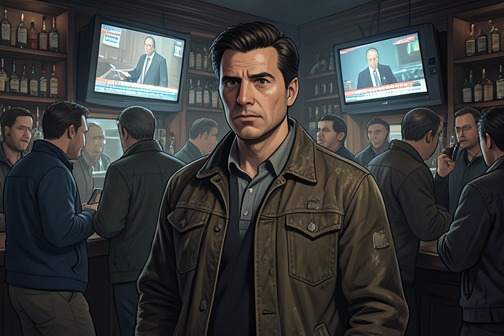
The death of Franco is a brief but consequential event in the novel: news of the dictator’s death, seen on television on November 20, 1975, draws [Saul Burnstein](entity:character-recall-character-7f428699216c) back into the past he has tried to leave behind. At the Bearskin Inn in [Rockport](entity:location-recall-location-9ae7411a945b), Massachusetts, he tells the crowded bar to celebrate. In that ordinary act, the novel joins the end of Franco’s rule to an older history of persecution, loss, exile, and survival.
## The News in Rockport
Saul has spent years building a life far from the political world that once defined him. The Bearskin Inn, which he opened with Sarah in the summer of 1951, became a modest business rather than an immediate success; it flourished more fully only after Rockport attracted vacationers and tourists from across the country in the middle of the following decade. Their arrangement allowed Saul to fish, read, sail, and try to forget his former life. That effort at ordinary peace is interrupted on the night of November 20, 1975, when television images bring the past back with what the narration describes as an invincible spell.
Saul calls for Sarah, hurries down the stairs, and finds the inn full of customers. Their noise is so great that his voice cannot reach her at the bar. He goes to her instead and asks her to serve a round, offering to pay. Sarah rings the bell she uses to summon the patrons’ attention and asks why he wants to treat them. Saul pauses before answering. The delay matters: the news has opened a private landscape that the people around him cannot yet see.
## A Private Memory Inside a Public Celebration
As Saul looks around the Bearskin Inn, the room becomes, in his perception, large enough to hold a Jewish family gathered around a dining table in [Korzcyna](entity:location-recall-location-07dda9b8f007), in Polish [Galicia](entity:location-recall-location-c547828ba2f6). He sees [Sara Burnstein](entity:character-recall-character-792e60b1686c) among her older daughters, Agar and Rebeca; David standing nearby; and the youngest, Linka, on the other side. Efraim and Elyahu are there too, along with many small children, some held by their mothers, and young sisters- and brothers-in-law whose names he has forgotten. The remembered relatives look at him and smile. The scene does not explain their absence in that moment; instead, it lets the remembered family enter the present without interrupting the bustling bar around him.
That inward vision gives Saul’s response a personal scale beyond the political importance of Franco’s death. For the customers, the celebration is prompted by news from [Spain](entity:location-recall-location-0fe76f866976); for Saul, it also touches a past in which a family gathered in Korzcyna remains vivid even when some of its names have faded from memory. The present room and the remembered table coexist for an instant, joined by Saul’s gaze. The scene makes remembrance part of the event rather than a separate explanation of it.
## The Announcement and Its Aftermath
Saul finally tells the room that Franco is dead and that they should celebrate. He lifts the hatch separating the bar from the rest of the inn and helps Sarah serve drinks and set bottles on the counter. Sarah smiles as she works, although she does not understand what has prompted his sudden urgency. She plans to stay upstairs that night so she can find out what has happened. Their shared work translates Saul’s private reaction into a public gathering, even as the reason for it remains unclear to her.
The gap between the significance Saul assigns the news and the customers’ limited understanding is made explicit in the last exchange. A young man asks his friend who the dead person was. Franco’s death has filled the room with drinks and celebration, but not with shared knowledge: the political event has reached Rockport, while its history is not self-evident to everyone there. The scene ends on that question, leaving Saul’s act both communal and solitary.
## The Event’s Place in the Novel
The novel presents Franco’s death through Saul’s immediate response rather than through a detached account of the dictator’s final days or the political transition. Television carries the news into a Massachusetts bar; a round of drinks turns it into a local event; and Saul’s memory folds a distant family gathering into the moment. These shifts in scale—broadcast, crowded inn, remembered table—allow the scene to register public change through one survivor’s private history.
The event also marks the return of what Saul had hoped to forget. His earlier life in the inn had offered fishing, reading, sailing, and a quieter existence, yet the broadcast restores the past in an instant. His celebration is therefore not simply a response to a death announced on television: it is a recognition of what that death means to someone whose memories are bound to Spain’s history and to a family lost in Galicia. The novel does not turn the moment into a complete resolution. It ends instead with the celebration under way, Sarah still seeking an explanation, and a young customer asking who Franco was.
Event 68
Guillermo and Rita marry

The event identified as [Guillermo and Rita marry](entity:event-recall-event-bf647d993fa4) is the 14 October 1950 wedding of Rafael Cuesta Sánchez and Rita Velázquez Martín, an act of private commitment staged under the pressures of a victorious regime. The couple reach marriage through procedures that make their union feel less like a celebration than a concession granted by institutions aligned with their former enemies. At the church door, the past arrives in the person of Amparo Priego; Rafael’s restrained response makes the ceremony a turning point in his relation to that past, while the family built afterward gives him a new way to live with its losses.
## Background and the route to marriage
Rita and Rafael marry as people who have survived defeat and political concealment, not as a couple free to arrange their lives without interference. Their wedding takes place in what Rafael calls enemy territory. Because Rita is pregnant, the necessary preparation is compressed into an especially difficult sequence of courses, confessions, and communions. The couple experience the requirements as small humiliations disguised as unavoidable formalities, crowded together on the calendar lest the pregnancy attract notice.
The church’s treatment of the marriage sharpens that sense of unequal power. The priest presents the sacrament as a generous favor bestowed on a couple who do not deserve it, while Rafael and Rita must proceed as people receiving help through recommendation. A canon relative of Rita’s late father arranges for a priest to marry them in an unexpected church; the priest says he cannot refuse the canon’s request, then leaves the explanation unfinished. Rafael thanks him, but Rita remains on guard, convinced that the arrangements may conceal a trap. For Rafael, the process recalls an earlier marriage and another pregnant bride, once part of what had seemed a happy ending. That earlier promise was a deception; this wedding’s obstacles are real, yet the couple persist.
## The ceremony and Amparo’s appearance
At noon on Saturday, 14 October 1950, Rafael Cuesta Sánchez and Rita Velázquez Martín marry in the Basilica of the Concepción on Goya Street, close to the house where [Guillermo García Medina](entity:character-recall-character-guillermo-garc-a-me-d52c3f18d2cc) lived until the end of the war. Rafael enters the church escorting his mother-in-law. When the priest invites anyone with grounds to oppose the union to speak, no one does. The silence does not reassure him: he feels that his past is waiting inside the church, an apprehension that persists through the kiss to his bride.
As they leave, that apprehension takes visible form. Amparo Priego steps out from beside the last pew and congratulates Rafael. Her elegance is set against her vivid yellow hair and dark eyebrows, a striking appearance at the threshold of his new life. Rita grips Rafael’s arm, her body rigid and her breathing suddenly quickened. Her fear is not simply jealousy; she has long expected a hidden snare, and Amparo’s arrival looks like the trap she has anticipated.
Rafael understands the encounter differently. He believes Amparo has come to display, in public, the power she once exercised over him and still imagines she possesses. But that authority no longer belongs to her. He thanks her, kisses her quickly on the cheeks, and continues toward the church door without looking back. The gesture is brusque, but decisive: Amparo does not stop him, and the old relationship cannot reclaim the scene. On the street, [María Luisa Velázquez](entity:character-recall-character-d3d14035a3db) takes Amparo by the arm and introduces her to her niece. She begins the distant, formal cordiality that will characterize her dealings with Rafael from then on.
## The past, the family, and what follows
Rafael never learns exactly how much Amparo had confided to María Luisa. Once the immediate shock passes, he reasons that Amparo could not have told anything without implicating herself in the defense of besieged [Madrid](entity:location-recall-location-madrid-8acd4123f416). Whatever she disclosed, he believes, would also reflect favorably on his own later conduct in the eyes of a fascist. The possibility of exposure therefore does not undo the life he is making with Rita. In the months after the wedding, he sees that his entry into the Velázquez family has helped distance [Caridad](entity:character-recall-character-f95eb4574533) from her sister-in-law, and he comes to understand Rita as able to neutralize both old and recent nightmares.
The harsh preparations give way to a brief, tender recovery from the ceremony. Rafael remembers the kneelers, confessionals, and false contrition as costs that the tenderness between them has more than compensated for. The couple turn their attention to their child, and name him Manuel, after the name shared by their parents’ best friends. His birth returns Rafael to the memory of Guillermo, the son he had lived for years without thinking about often. Each of the new baby’s gestures—his crying, the small advances of ordinary infancy, and his growing recognition of his father—recalls the earlier child’s first acts of feeding, grasping, and looking at his hands.
That resemblance brings fear as well as affection. Rafael becomes superstitiously anxious about the six-month mark, but Manuel passes six months, then seven and eight, and reaches his first birthday still part of his father’s life. Gradually, the new child’s presence changes the older memory: instead of allowing the lost son to remain an open wound, it makes the recollection gentler and fainter. The wedding thus does not erase defeat or restore what was lost. It establishes a shared life in which Rita’s presence and Manuel’s continuing growth help Rafael carry a past that once seemed capable of following him into every room.
## Significance
The wedding joins two sharply different kinds of ordeal: the public, procedural indignities imposed on a Republican couple under the victorious order, and the intimate test created by Amparo’s appearance. The first makes marriage a difficult passage through institutions that treat it as a favor; the second tests whether the former lover can still command Rafael’s response. He does not answer Amparo with a confrontation or explanation. He offers a short acknowledgment, turns away, and continues into the street with Rita.
Its consequences extend beyond that moment of refusal. The marriage brings Rafael into the Velázquez family, changes the relations around him, and becomes the setting for a new fatherhood. Manuel’s survival through the milestones Rafael fears allows memory to change shape: the vanished child remains present, but no longer dominates the meaning of the living one. The wedding’s achievement is therefore neither uncomplicated happiness nor a simple escape from the past. It is the beginning of a family life in which humiliation, old danger, tenderness, and renewed attachment remain together without being made equivalent.
Event 69
José Antonio reunites with his father during his illness
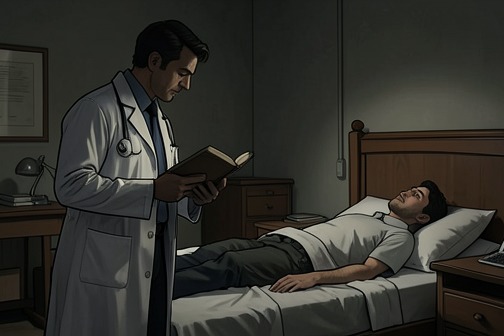
[José Antonio reunites with his father during his illness](entity:event-recall-event-efef465ab9b4) in an encounter that makes care a form of belated fatherhood. In 1952, [Guillermo García Medina](entity:character-recall-character-guillermo-garc-a-me-d52c3f18d2cc)—living under the name Rafa—returns to the life of the son he has long been separated from, first as a doctor summoned by Amparo and then as a daily presence beside José Antonio’s bed. Their connection grows through treatment, books, and chess, but remains constrained by concealed parentage and the expectation that the father will have to leave again.
## Identity and circumstances
By the time José Antonio becomes seriously ill, he has been raised under another identity. Amparo has given him the name José Antonio Urbieta, with Urbieta chosen at random from a street directory; the household’s portrait of a young Falangist presents a supposed father who died in [Russia](entity:location-recall-location-e36341713c23). The family papers support that story, while the real father remains absent. Guillermo, meanwhile, has lived for years with the memory of a son from whom he was separated. Finding the documents he had hidden—including the family record, the child’s birth certificate, and his and Amparo’s wedding photograph—had already restored the fact of that lost family to him, but not the relationship itself.
## Illness and return to daily care
In October 1952, Amparo comes to Guillermo’s office in alarm: her fourteen-year-old son has a fever, cannot eat or stand, and complains of pain throughout his body, including his heart. The illness has left him weak, though his appearance does not make its seriousness immediately obvious. Guillermo examines him and recognizes rheumatic fever, drawing on a similar case he had treated and the further study it required. He is careful to explain that the condition is unusual and uncertain in origin, and not proof that Amparo failed to care for her son.
A pediatrician confirms the diagnosis and identifies inflammation of the pericardium. José Antonio must remain in bed, avoid exertion and distress, and eat regularly while the inflammation subsides. The doctor expects him to recover without lasting effects if these instructions are followed. From 22 October 1952 until mid-January 1953, Guillermo visits him after work every afternoon, examining him and keeping observations in a notebook. At first Amparo stays close, watchful; as her son improves, she leaves them more time alone.
## Books and chess as a father-son bond
Their visits begin with medical conversation and develop into shared reading. Guillermo reads aloud from [Trafalgar](entity:object-recall-object-78a500ddf241), answering José Antonio’s questions and then, at the boy’s request, staying long enough to finish whole chapters. José Antonio starts rereading the passages on his own in the mornings. For Guillermo, the novel becomes a private island they inhabit together: a bond more powerful than the illness itself, and a route back to a son he had nearly given up recovering.
Chess gives that connection a form that can be handed down. Guillermo teaches José Antonio on Don Fermín’s old board, which Amparo had stored away. Although she had shown him how the pieces moved, she had not taught him how the game worked. Guillermo explains openings and the consequences of moving pawns without a plan; José Antonio quickly grasps the choices before him. A notebook of elementary problems gives him something to practice while still in bed, and before [Christmas](entity:time-recall-time-0cffe7da2c4d), once he can sit in an armchair, the two begin playing full games. Amparo resents the new enthusiasm, but the game becomes their shared inheritance: Guillermo remembers that his own grandfather taught him to play, and believes chess will be what his son retains of him.
## The final visit and parting gift
When José Antonio is well enough to return to school, Amparo tells Guillermo that his daily visits are no longer necessary. He agrees and offers to come less often while the boy fully recovers, avoiding the argument she had expected. She accuses him of having taught José Antonio chess so that he could leave them in peace. Guillermo answers that the books would eventually be forgotten, but José Antonio would remember who taught him the game. He makes one last visit after the boy is discharged, already understanding that he is about to lose him again.
On 22 January 1953, Guillermo deliberately loses a chess game for the first time in his life—not on the board, where he wins all three quick games they play, but through the departure that follows. He gives José Antonio his grandfather’s chess clock, a cherrywood box with Roman-numeral dials and brass push-buttons, explaining how it is used. The gift is the last truly valuable object he has kept from the trunk [Experta](entity:character-recall-character-experta-bd538c3c6d2e) filled with possessions from the commissioner Medina’s home in April 1939. José Antonio does not know its full history; Guillermo gives it to him because he wants his son to have something of his.
The boy asks for another game, and Guillermo promises he will visit from time to time, although he knows he may not. At home, he takes his younger son Manuel in his arms, while Rita watches him closely. The contrast makes the loss plain: one child is present in his daily life, while the older son has been returned to him only briefly. The clock, like the lessons, stands in for a relationship that the circumstances still prevent him from openly claiming.
## Recognition delayed
Years later, José Antonio pieces together the truth from the documents Amparo kept hidden. In 1958, short of money, he searches her underwear drawer and finds his birth certificate, a Republican family record, and evidence of a past she had concealed. He recognizes the doctor who visited throughout his illness and taught him chess in a photograph with his pregnant mother. Experta has also told him that Guillermo was his father, that he and Amparo lived together until 1939, and that Guillermo had buried his great-grandfather and hidden Amparo during the war. José Antonio’s recognition comes after the intimacy of the bedside visits, not before them: he has already known his father through the repeated acts of reading, examination, and play.
Their eventual embrace at Barajas on 30 December 1976 gives the reunion a later, fuller frame. Both men have grown old, both have lived under names other than their own, and both have families whose children do not bear their fathers’ surnames. Guillermo’s hands once stitched the wounds on José Antonio’s body; now the two men acknowledge a reciprocal debt of lives saved. Their embrace briefly restores the strength and hope that had once joined them, even as they recognize their shared defeat. The illness episode is therefore both a reunion and a postponement: father and son find one another in care, lose their everyday closeness again, and reach an explicit recognition only years later.
Event 70
Signing of the Madrid Pact
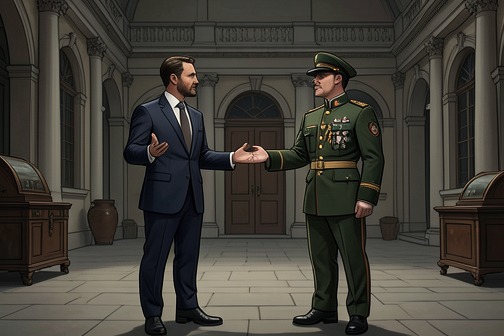
The [Signing of the Madrid Pact](entity:event-recall-event-2796d47007bd) was the public consequence of a secretive bargain that strengthened the [Franco regime](entity:organization-recall-organization-eac43190d576) while placing [Spain](entity:location-recall-location-0fe76f866976)’s territory and resources at the service of [United States](entity:location-recall-location-5d55e9152db1) strategy. Signed in [Madrid](entity:location-recall-location-madrid-8acd4123f416) on 23 September 1953, the pact comprised three agreements: military supplies, a restricted credit line, and permission to build four American bases. Its lopsided terms, muted press coverage, and lack of parliamentary consent reveal the bargain’s central contradiction: a regime seeking recognition as a sovereign ally accepted an arrangement in which Washington set the limits and Madrid’s people were kept uninformed.
## Background and Negotiation
The pact was signed at the Palace of Santa Cruz by Spain’s foreign minister, Alberto Martín-Artajo, and James C. Dunn, the United States ambassador to Spain. Spain’s trade minister, Manuel Arburúa, accompanied Martín-Artajo; Dunn attended with Max H. Klein, president of the American Chamber of Commerce in Spain. The difference in rank between the delegations made the imbalance visible. Spain had sought a higher-status instrument, but a treaty would have required approval by a majority of the United States Senate. The Eisenhower administration, aware that it could not secure that approval, opted for an intergovernmental pact that needed no parliamentary ratification.
The arrangement proceeded despite the public distaste that Franco’s regime aroused among American senators. That distaste did not prevent the United States from entering what the narrative describes as a relationship less advantageous than abusive with its former Axis friend. For Franco, the gains were substantial: the agreement offered military support and recognition at a moment when [Cold War](entity:time-recall-time-700d9e46b459) priorities were making the dictatorship more useful to Washington. The Spanish population, by contrast, was excluded from knowledge of the negotiations and their consequences.
## The Three Agreements
The first agreement specified the armaments Washington would provide. They were second-hand supplies from the Korean War, which had ended only two months earlier. The American delegation valued the equipment at $456 million, a figure Francoist experts considered scandalously inflated given its condition and use. Even so, the material modernized a Spanish army whose weapons had until then come from the civil war. Washington imposed a strictly defensive-use condition. The Spanish delegation accepted without protest, because the regime regarded its internal opponents as a more serious danger than any external enemy.
The second agreement offered what could only generously be called economic aid: a credit line of slightly more than $1.5 billion, repayable over ten years. Spain could not spend the money freely; it had to use the credit to import American products. Unlike the unconditional generosity of the Marshall Plan, this arrangement bound the supposed assistance to purchases from the creditor country. The loan thus brought resources into Spain while directing their use according to American interests.
The third agreement carried the greatest strategic consequence. Although its text called it a pact of mutual defense assistance, in practice it ceded Spanish territory for four American military bases. Construction began on three air bases, at Morón, Zaragoza, and Torrejón de Ardoz, and a naval base at Rota in the Bay of Cádiz. The language of mutual aid therefore covered a concrete transfer of access and military presence: the United States gained facilities on Spanish soil, while Spain’s consent was given under terms its representatives had little leverage to reshape.
## Secrecy, Press, and Parliamentary Reaction
The negotiation and signature were kept secret, and the Spanish press did not publish the embassy photographer’s pictures of the signing. On 23 September, [ABC](entity:organization-recall-organization-abc-548aaae226e1) did not report the ceremony at Santa Cruz. Its attention went instead to Franco’s visit to Ourense and a speech linking service to God with Spain’s greatness. The day’s other prominent story claimed that Lavrentiy Beria, Stalin’s former secret-police chief, was hiding in Spain and awaiting FBI agents. The paper’s fantastical account referred to a possible Spanish-American agreement, but not to the pact actually being signed.
The Beria story cost ABC’s director, Torcuato Luca de Tena y Brunet, his post within hours. His successor, Luis Calvo, maintained the silence. The 24 September front page featured Alfredo Di Stéfano’s debut at Chamartín, where Real Madrid lost 2–4 to the French club Nancy. A brief item on page 17 mentioned the arrival of American senators and military officers without explaining why they were in Spain. Readers could have taken their presence as connected to the Beria story; the pact itself remained out of view. Press censorship and editorial silence did not merely reduce public discussion: they left a consequential bargain obscured behind unrelated spectacle and misleading news.
Franco could not keep the text from the regime’s own appointed representatives indefinitely. On 5 October 1953 he sent it to the [Cortes Españolas](entity:organization-recall-organization-cortes-espa-olas-f772fc56e8cd), a parliament founded in 1943 to provide a façade for the dictatorship. Although censorship permitted no genuine opposition and newspapers offered only praise, dissatisfaction with the pact’s terms became a subject of discussion in many circles. The procuradores saw that the United States assumed no obligation toward Spain, making the arrangement no true alliance, and were angered by the total tax exemption granted to American investments and expenditure. The appearance of consultation arrived only after the deal had already been made.
## Consequences and Historical Significance
The pact’s immediate material effects combined military modernization with restricted dependence. Spain received equipment that improved its armed forces, but the supplies were used matériel whose valuation Madrid considered excessive and whose use Washington limited to defense. The loan supplied credit, but only for American imports. The base agreement was more lasting in its implications: it authorized the construction of facilities that embedded the American military presence in Spain. The three parts thus joined aid to conditions, and bilateral language to unequal control over how that aid could be used.
The pact also marked a change in the regime’s international position. Six years later, on 21 December 1959, United States president Dwight D. Eisenhower visited Madrid. The book presents that visit as the crowning public sign of a process consummated by the 1953 agreement. That eventual display of acceptance stands in contrast to the secrecy surrounding the signing: the pact’s political importance was concealed from the Spanish public even as its effects would shape national sovereignty for decades.
Its terms expose how Cold War priorities could override democratic accountability and earlier political repugnance. The United States obtained military facilities and a channel for influence; Franco secured strategic backing and a measure of international rehabilitation. Spain’s population, neither informed in advance nor asked to authorize the arrangement, bore the consequences of a bargain made in its name. The pact was therefore not simply a defense agreement. It was a political transaction whose formal language of assistance concealed unequal benefits, constrained spending, and the transfer of access to Spanish territory.
Event 71
Dwight D. Eisenhower visits Madrid
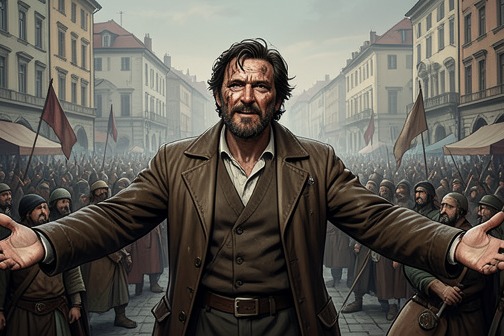
[Dwight D. Eisenhower visits Madrid](entity:event-recall-event-b239ce9aaa3c) on 21 December 1959 as the public seal on a political accommodation begun six years earlier. The visit’s significance lies in the contrast it makes visible: while the [United States](entity:location-recall-location-5d55e9152db1) publicly accepted a partnership with Franco’s [Spain](entity:location-recall-location-0fe76f866976), the novel has traced how the regime had protected Nazi networks and how political influence and stolen wealth moved through its institutions.
## The Pact Behind the Visit
The visit is presented as the culmination of the [Madrid](entity:location-recall-location-madrid-8acd4123f416) Pact, signed on 23 September 1953 at the Palace of Santa Cruz. Spain’s foreign minister, Alberto Martín-Artajo, and James C. Dunn, the United States ambassador to Spain, signed it; Spain’s commerce minister, Manuel Arburúa, accompanied Martín-Artajo, while Dunn attended with Max H. Klein, president of the American Chamber of Commerce in Spain. The imbalance between two Spanish ministers and an American ambassador accompanied by a business representative makes the unequal standing of the two countries legible in the ceremony itself.
The Franco government had tried unsuccessfully to secure a higher-status agreement. A treaty would have required approval by a majority of the United States Senate, which the Eisenhower administration knew it could not obtain; a pact between governments required no such parliamentary process. The form of the agreement thus registered the political obstacle without preventing the relationship: public revulsion among American senators toward Franco’s regime did not determine the administration’s dealings with Spain.
## From Axis Isolation to [Cold War](entity:time-recall-time-700d9e46b459) Partnership
The narrative places Eisenhower’s arrival against Spain’s earlier role as a haven and staging ground for Nazi flight. In discussions about the Argentine route, [Pablo de Azcárate](entity:character-recall-character-pablo-de-azc-rate-a0624bf814b0) tells [Manuel Arroyo](entity:character-recall-character-3296d1a401b2) Benítez that the submarine stories are a distraction but that the South American trail is credible. The Stauffer network, he explains, is believed to cooperate with [Juan Perón](entity:character-recall-character-a454ccbc4368)’s regime: fugitives could receive Spanish documentation through Clara Stauffer’s contacts, including birth certificates supplied by sympathetic priests and connections in the state administration. The route is suspected, not proven, and the investigators need an infiltrator to establish it.
That unresolved investigation points to the political landscape into which the pact emerged. At a meeting in [Buenos Aires](entity:location-recall-location-caf56b79d5c4), Perón publicly framed his “third position” as opposed to both Marxism and liberalism, but the practical purpose of the gathering was to welcome Reich-linked technical and scientific personnel, civilian or military. He expected a future Western conflict with the Soviet Union to recast the enemies of the moment as useful allies. The novel’s juxtaposition of that welcome with the later American presidential visit makes Cold War pragmatism—not a clean break with the past—the governing context of the Madrid rapprochement.
## Wealth, Influence, and Concealment
The same history is material as well as diplomatic. [Hans Lazar](entity:character-recall-character-hans-lazar-bdc10f3f12a4) cultivated journalists and Francoist officials through elegant dinners, social access, and personal charm, gaining influence that exceeded the effect of the money he distributed. His work helped spread [Berlin](entity:location-recall-location-769cdeac2511)’s views through the newly founded EFE agency and other Spanish organizations while shielding the embassy and the German government from provable responsibility. In postwar hardship, he also assembled a collection of artworks.
The fate of the German embassy’s contents sharpened the mystery. When Allied representatives finally entered the Madrid embassy on 5 June 1945, after Spanish bureaucratic delays, the building appeared stripped: documents, records, money, gold, antiques, artworks, and even furniture were gone. Years later, Manuel’s suspicion that the shipments he was helping to protect contained looted art, valuables, and perhaps Nazi gold brought Lazar back into focus. The Allies believed Lazar had moved the embassy’s treasures and missing archive to a hiding place. His authorized repatriation to [Germany](entity:location-recall-location-a3c24dd56e42) was thwarted when he entered the [Clínica Ruber](entity:location-recall-location-b05acb3f9c1e) the day before departure for an appendicitis operation, after which he disappeared from public view.
## The Visit as a Political Image
By 1959, the novel’s strands of diplomacy, escape, and covert commerce converge in Eisenhower’s presence in Madrid. The pact’s procedural modesty—chosen to evade a Senate vote—coexists with the political weight of a United States president arriving in the Spanish capital. The public visit gives visible prestige to a relationship that had been negotiated in a form designed to bypass a conspicuous domestic objection.
The gains, the narration stresses, were not shared evenly. Franco’s government benefited substantially from the agreement, while the arrangement between the United States and its former Axis friend is described as less advantageous than abusive. The Spanish people, as so often in the novel’s account of power, were left uninformed. Eisenhower’s visit therefore signifies more than diplomatic recognition: it completes a process in which anti-communist strategy and state power displaced the unresolved question of Spain’s wartime and postwar complicity.
Event 72
Eisenhower's visit to Spain
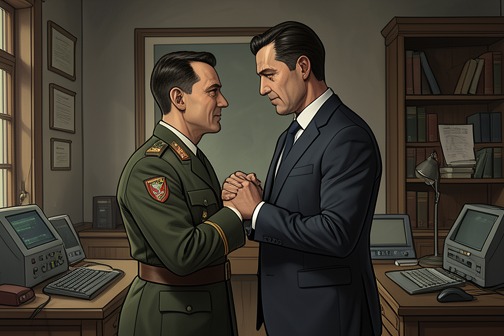
Eisenhower’s visit to [Spain](entity:location-recall-location-0fe76f866976) on 21 December 1959 became the public spectacle through which Francisco Franco appeared to win the war again: the American president’s arrival and affectionate embrace of the dictator transformed Spain’s international standing, while antifrancoists were left alone. The novel frames the visit as a political absolution made visible in a photograph that circulated around the world.
## Arrival at Torrejón
A day before [Valencia](entity:location-recall-location-760e70b8ce24) was due to receive the [Christmas](entity:time-recall-time-0cffe7da2c4d) Lottery’s top prize, Franco received what the narrative calls a still greater prize. On 21 December, Air Force One landed at the newly built [Torrejón de Ardoz Air Base](entity:location-recall-location-5ce235a494a5). Franco was waiting at the foot of the steps, and he and Eisenhower embraced with unmistakable warmth. The scene’s carefully emphasized gestures—the aircraft’s arrival, the dictator waiting, the embrace—made diplomatic recognition legible as a public image.
## A photograph of rehabilitation
The embrace was captured in a photograph that, unlike an earlier image invoked by the narration, went around the world. Its symbolic force lay in the contrast between Eisenhower, victor of the Second World War, and Franco, the dictator who had been protected by and allied with Hitler and Mussolini. The image seemed to absolve Franco of his past and present him as a legitimate partner of the Western world. The visit therefore did more than stage cordial diplomacy: it supplied a visual endorsement that could be read as moral and political rehabilitation.
## Franco’s victory and the opposition’s isolation
The narrative compresses the visit’s significance into a stark judgment: on 21 December 1959, Franco won the war again. The wording recasts the encounter not as a battlefield victory but as a renewed triumph in the political struggle over Spain’s place in the postwar world. Franco gained the recognition he had most desired: integration into the West and acceptance as a leader of the free world against communism.
That recognition came at a cost to his opponents. Antifrancoists were left utterly and definitively alone in the world, but the account stresses that isolation did not end their resistance. The visit thus marks both Franco’s international rehabilitation and the abandonment of those still fighting his dictatorship. Its decisive turn is contained in the contrast between a globally circulated image of the dictator embraced by an Allied leader and the continuing struggle of Spaniards excluded from that new political alignment.
Event 73
1955 Argentine coup d'état
The [1955 Argentine coup d'état](entity:event-recall-event-1955-cfd8acf1dbc5), which deposed [Juan Perón](entity:character-recall-character-a454ccbc4368), altered the conditions that had allowed European Nazi fugitives to find refuge in [Argentina](entity:location-recall-location-27e2c37f5c3d). In the novel’s account, the coup is more than a change of government: it interrupts the protection and escape arrangements linking Perón’s Argentina with Clara Stauffer’s network in [Madrid](entity:location-recall-location-madrid-8acd4123f416).
## Background and Perón’s rule
The coup belongs to a longer history of political exile. After being overthrown by fellow officers in September 1955, Perón lived in exile in Venezuela, where he began his relationship with Isabel, then a cabaret dancer performing under the stage name Isabel Gómez. She shared his exile across several countries before they settled in Madrid and married in 1961. Their lives thus connect Argentina’s political upheaval with the Spanish setting of the novel’s postwar escape networks.
## The coup and its consequences
The account identifies the 1955 military coup as the event that displaced Perón and sent him into exile. Its importance extends beyond the personal fate of the former president: Perón’s government had offered hospitality to European fugitives, and Argentina had served as a destination for people helped along by Nazi escape networks. The regime change therefore undermines the political shelter on which those routes depended.
## The refuge network
The book places Stauffer’s Madrid organization alongside networks operating through the [Vatican](entity:location-recall-location-416dda4866db), describing their habitual cooperation and their shared reliance on the refuge Argentina afforded their protégés. The Vatican-linked route carried fugitives through Italy toward [South America](entity:location-recall-location-93067fb0ae2c); Stauffer’s organization was larger and more effective still. Together, the networks represent a practical system of escape and impunity, rather than the all-powerful organization imagined in the later myth of [ODESSA](entity:organization-recall-organization-odessa-c706862dc8c9).
That system’s success, the narrative says, was interrupted in 1955 when the military coup overthrew Perón. The coup thus supplies a political endpoint to a period in which Madrid-based assistance and Argentine hospitality reinforced one another. Its significance lies not only in who held power in Argentina, but in how a change of government could constrict the routes and protections available to fugitives.
Event 74
Juan Perón's death and Isabel Perón's succession to the presidency
[Juan Perón's death and Isabel Perón's succession to the presidency](entity:event-recall-event-a83dc50dff2d) mark a decisive political transition in [Argentina](entity:location-recall-location-27e2c37f5c3d): after Perón died on 1 July 1974, his vice president took office, remaining president for more than a year and a half before the military coup of 24 March 1976. The account sets that succession within Isabel’s passage from exile and political partnership with Perón to the presidency, then traces the junta’s seizure of power and the regime that called itself the National Reorganization Process.
## Isabel Perón’s path to the presidency
María Estela Martínez de Perón, known as Isabel or Isabelita, had been a dancer using the stage name Isabel Gómez at the Passapoga cabaret in Caracas when she began her relationship with Juan Domingo Perón in late 1955. Perón was then living in exile after being deposed by fellow officers that September. Isabel shared his exile in several countries before settling with him in [Madrid](entity:location-recall-location-madrid-8acd4123f416), where they married in 1961.
From 1965, Isabel made several trips to [Buenos Aires](entity:location-recall-location-caf56b79d5c4) to prepare for Perón’s return. When he won the 1973 presidential election, she stood second on his electoral list, placing her directly in line to succeed him. That political role became the constitutional hinge between his death and her accession to the presidency.
## Death and succession
Perón died on 1 July 1974. Within hours, Isabel, then vice president, became president of Argentina. She remained in office for more than eighteen months, until the armed forces overthrew her government on 24 March 1976. The compressed interval between the death and transfer of office gives the succession its immediate force in the narrative: private bereavement and public continuity are followed, within less than two years, by military seizure of power.
## The coup and its aftermath
The coup leaders deposed Isabel and detained her, confining her to a villa in Neuquén Province in remote Patagonia. They then established a dictatorship under the name National Reorganization Process. Its governing structure was a three-service junta: Lieutenant General Jorge Rafael Videla represented the Army as its commander general, Admiral Emilio Eduardo Massera the Navy, and Brigadier General Orlando Ramón Agosti the Air Force.
Although authority was presented as a three-way arrangement, Videla acted as the Process’s leader until 1981, when a new junta headed by Lieutenant General Roberto Eduardo Viola replaced the first. Two further juntas followed. The military rulers eventually had to relinquish power and call elections after Argentina’s defeat in the [Falklands War](entity:event-recall-event-9773fc8ba7cf), the spread of protests within the country, and the loss of international support; the elections took place in October 1983.
## Narrative and historical significance
The succession is presented not as an isolated change of office but as the brief interval before a dictatorship. Isabel’s rise from exile alongside Perón to the presidency connects the story’s account of political displacement with the immediate vulnerability of the government she inherited. The coup’s detention of the former president and the military junta’s changing leadership extend that transition into a prolonged period of rule, while the final return to elections supplies the episode’s political endpoint.
Event 75
Golpe de Estado en Uruguay de 1973
The 1973 Uruguayan coup is identified as part of a regional sequence of military takeovers that precedes [Argentina](entity:location-recall-location-27e2c37f5c3d)’s 1976 dictatorship. Its significance in the novel is contextual: Uruguay’s authoritarian turn helps establish that Argentina was not an isolated case, but one country in a South American landscape increasingly shaped by military rule and anti-communist politics.
## Regional Background
In the account of the political conditions surrounding Argentina’s March 1976 coup, Uruguay is described as having entered dictatorship in 1973, when the far-right politician Juan María Bordaberry established authoritarian rule with the army’s support. Uruguay is set beside Chile, where Augusto Pinochet seized power in a coup that same year, and Bolivia, under Hugo Banzer’s dictatorship from 1971. Paraguay had been ruled by Alfredo Stroessner since 1954, while Brazil’s military dictatorship, established by Humberto de Alencar Castelo Branco in 1964, continued under other generals after his death.
The comparison makes the Uruguayan coup one element in a longer regional chronology, not an event whose causes or course are narrated independently. By contrast, in March 1976 Argentina is described as the only country in the Southern Cone that still retained a democratic regime. The contrast gives the 1973 Uruguayan dictatorship a specific place in the novel’s framing: it marks how far the regional shift toward military government had already advanced before Argentina’s own democratic order was overthrown.
## [Cold War](entity:time-recall-time-700d9e46b459) Context
The regional sequence is linked to the National Security Doctrine, a policy orientation adopted by [United States](entity:location-recall-location-5d55e9152db1) diplomacy in Latin America to combat left-wing movements and organizations at any cost. In the novel’s account, Cold War anti-communism made military dictatorships instruments of a wider political project, supported from Washington. Uruguay’s 1973 coup therefore belongs to the setting in which Argentina’s later military rule becomes intelligible, although the supplied account does not detail the Uruguayan regime’s policies or the coup’s immediate consequences.
The narrative’s emphasis falls on the pattern and its stakes: a military-supported dictatorship in Uruguay, a coup in Chile, and established dictatorships elsewhere make Argentina’s eventual seizure of power part of a wider continental realignment. The coup’s role is thus less that of a fully developed episode than of a historical marker, locating the Argentine story within a region where anti-communism had already been used to justify military rule.
Event 76
1973 Chilean coup d'état
The [1973 Chilean coup d'état](entity:event-recall-event-1973-a274c2fccdd3) is presented as a pivotal precedent in the regional spread of military rule: Augusto Pinochet’s seizure of power in Chile forms part of the political backdrop against which the novel explains [Argentina](entity:location-recall-location-27e2c37f5c3d)’s 1976 coup and the dictatorship that followed.
## Regional Context
The account situates Chile alongside several neighboring countries that had already moved away from democratic government. Uruguay’s far-right president Juan María Bordaberry established a dictatorship with military support in 1973, the same year Pinochet staged his coup in Chile. Bolivia had been under the dictatorship of Hugo Banzer since 1971; Paraguay had been ruled personally by Alfredo Stroessner since 1954; and a military dictatorship established in Brazil in 1964 persisted under successive generals after Humberto de Alencar Castelo Branco’s death in 1967. Against this regional pattern, Argentina in March 1976 was the only country in the Southern Cone still retaining a democratic regime.
## Connection to Argentina’s Coup
The Chilean coup is not narrated as a separate scene with a detailed account of its participants or course. Its significance lies in the historical comparison: it helps establish that Argentina’s 1976 military takeover did not occur in isolation. The novel identifies the National Security Doctrine, adopted by [United States](entity:location-recall-location-5d55e9152db1) diplomacy in Latin America to combat left-wing movements and organizations, as a broader framework behind the promotion and support of military dictatorships. Chile’s 1973 coup belongs to the regional landscape through which the Argentine dictatorship is understood.
## Repression and Historical Significance
The surrounding account traces Argentina’s own escalation of state violence from the 1975 [Operativo Independencia](entity:event-recall-event-779bd0b4e451), officially directed against guerrillas in Tucumán but used to repress civilians and a broad range of social groups, to the military regime established in 1976. Between the spring of 1976 and the autumn of 1982, the Argentine dictatorship forcibly disappeared thousands of people; estimates put the number of victims at about thirty thousand. Its clandestine machinery encompassed abduction, secret detention, torture, execution, concealment of bodies, and the theft and reassignment of children born to detained women. The novel’s juxtaposition of Chile’s coup with this account of Argentina presents military rule as a regional political pattern while specifying the distinctive machinery and consequences of Argentina’s repression.
Event 77
1964 Brazilian coup d'état
The 1964 Brazilian coup d’état appears in the novel as an early landmark in the spread of military rule across [South America](entity:location-recall-location-93067fb0ae2c). Brazil’s dictatorship, established by Humberto de Alencar Castelo Branco, is set within a regional history of coups and authoritarian governments that helps explain the political climate surrounding the 1976 Argentine coup.
## Brazil in a Regional Pattern
The account dates Brazil’s military dictatorship to 1964, when Castelo Branco established it. After his death in an accident in 1967, other generals continued the regime until 1985. Brazil thus provides an earlier example of military rule than the coups in Uruguay and Chile in 1973 and [Argentina](entity:location-recall-location-27e2c37f5c3d) in 1976, while Paraguay had been under Alfredo Stroessner’s personal dictatorship since 1954.
This chronology makes the Argentine coup neither an isolated rupture nor the beginning of the region’s turn toward dictatorship. By placing Brazil among several countries governed by military or personal regimes, the narrative establishes the broader political setting in which Argentina’s generals took power.
## [Cold War](entity:time-recall-time-700d9e46b459) Context
The novel connects the regional pattern to the [United States](entity:location-recall-location-5d55e9152db1)’ National Security Doctrine in Latin America, a policy directed at combating left-wing movements and organizations across the continent. In its account, military dictatorships were treated as instruments of that campaign and received support from Washington. The Brazilian regime is named as one instance within this larger context, though the passage does not describe direct U.S. involvement in the 1964 coup itself.
The coup’s significance in the narrative therefore lies in its place in a sequence of authoritarian governments that preceded Argentina’s 1976 military takeover. That broader sequence sets the context for the National Reorganization Process and the state terror that followed in Argentina, without equating the specific history of Brazil with the Argentine regime’s particular methods or consequences.
Event 78
Operativo Independencia
[Operativo Independencia](entity:event-recall-event-779bd0b4e451) was a military intervention launched in [Argentina](entity:location-recall-location-27e2c37f5c3d) in 1975 under the stated aim of defeating guerrillas in Tucumán. By dividing the country into five military zones and giving their commanders virtually unlimited authority to repress supposed subversives, it extended counterinsurgency into a broader assault on civilian life and became a prologue to the systematic state terror of the dictatorship that followed.
## Political Background and Authorization
On 5 February 1975, President María Estela Martínez de Perón issued what the narrative identifies as the first decree of annihilation, establishing the operation. Its formal justification was the fight against guerrillas in the jungle of Tucumán province. In practice, the decree enabled the country to be divided into five military zones, each under a commander with sweeping power to repress people classified as subversive.
The operation took shape amid a regional and international turn toward military rule in the name of combating communism. The account places Argentina among neighboring countries already governed by dictatorships and describes the National Security Doctrine as a policy embraced by [United States](entity:location-recall-location-5d55e9152db1) diplomacy in Latin America. In this [Cold War](entity:time-recall-time-700d9e46b459) framework, military dictatorships were treated as instruments for defeating left-wing movements, with support from Washington despite the consequences for those subjected to their rule.
## From Counterinsurgency to Social Repression
The operation’s commander, Brigadier General Acdel Vilas, described its objective as eminently cultural: in his view, guerrilla warfare was only one aspect of subversion, and not the most important one. That formulation widened the target beyond armed opponents. The resulting terror reached civilians in San Miguel de Tucumán, including teachers, students, intellectuals, artists, scientists, and religious figures.
The operation therefore joined a claim of security to an expansive definition of the threat. Once opposition could be designated as a cultural problem rather than a narrowly military one, people’s work, ideas, and social roles could place them within the reach of repression. The narrative emphasizes this change in scope as central to understanding how an operation ostensibly directed against guerrillas became a model and precursor for wider state violence.
## Consequences and Historical Significance
The operation is presented as a rehearsal for the repression intensified and refined under the [Proceso de Reorganización Nacional](entity:state-recall-state-proceso-de-reorganizaci-0d5fed00088e), the dictatorship established after the 1976 coup. In the account, the transition is not simply from one government to another: methods and powers already tested under Operativo Independencia formed part of the context for a clandestine apparatus that would make disappearance a central instrument of rule.
From the spring of 1976 through the autumn of 1982, the dictatorship forcibly disappeared thousands of people. Because many bodies were never recovered, estimates vary; the narrative gives an approximate total of thirty thousand victims. It describes a system organized into task groups responsible for distinct stages of repression, including abduction, secret detention, torture, execution, concealment of bodies, and the theft and reassignment of children born to detained women. Among its extreme methods were death flights, in which military pilots dropped living, bound, drugged prisoners from aircraft over the open sea.
Operativo Independencia’s significance lies in the connection the narrative draws between counterinsurgency language, expanded military authority, and the later machinery of clandestine terror. The operation began with a stated military objective in Tucumán; its commander’s cultural rationale brought civilians into the definition of the enemy. That enlargement of the target made the campaign a precursor to a dictatorship whose violence extended beyond killing to suppressing legal protection, concealing deaths, and erasing identities.
Event 79
1976 Argentine coup d'état
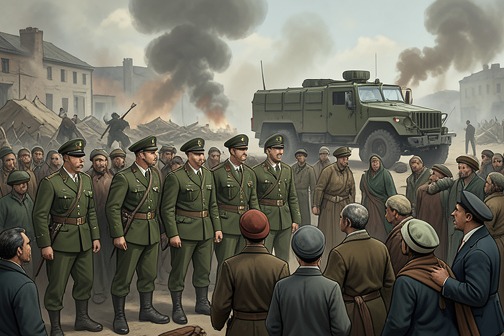
The 1976 Argentine coup d’état began on March 24, 1976, when a group of generals overthrew President María Estela Martínez de Perón and established a military dictatorship. In the novel, the coup is both a decisive political rupture and the culmination of a longer pattern of repression: the new regime institutionalizes state terror, while the surrounding [Cold War](entity:time-recall-time-700d9e46b459) politics help shield that violence from meaningful international opposition.
## Causes and Regional Context
The coup took place in a [South America](entity:location-recall-location-93067fb0ae2c) already marked by military rule. Uruguay had become a dictatorship in 1973, the same year Augusto Pinochet seized power in Chile; Bolivia had been under Hugo Banzer since 1971, Paraguay under Alfredo Stroessner since 1954, and Brazil under military rule since 1964. [Argentina](entity:location-recall-location-27e2c37f5c3d) was the last country in the Southern Cone still governed democratically. Its overthrow therefore completed a regional shift rather than standing as an isolated seizure of power.
The narrative connects that shift to the National Security Doctrine, which treated the suppression of left-wing movements throughout Latin America as a Cold War priority. It describes Washington as favoring and supporting military dictatorships in pursuit of that objective. Two days after the coup, former U.S. Secretary of State [William](entity:character-recall-character-13581a833d6e) P. Rogers anticipated severe repression and urged that the search extend beyond guerrillas to union dissidents and members of the regime’s own parties. His successor, Henry Kissinger, likewise expressed a desire to give the new rulers support rather than make them feel besieged. These reactions frame the coup’s international setting as one in which anti-communism could outweigh concern over repression.
## From Pre-Coup Repression to Military Rule
The novel presents the coup as an intensification of policies already underway, not the beginning of political violence in Argentina. On February 5, 1975, Isabel Perón issued what the account calls the first decree of annihilation, establishing Operation Independence. Officially directed against guerrillas in the Tucumán jungle, the operation divided the country into five military zones and gave their commanders sweeping power to repress those labeled subversive.
Brigadier General Acdel Vilas described the operation’s aim as primarily cultural, because he considered guerrilla warfare only one part of subversion. In practice, the campaign terrorized civilians, including teachers, students, intellectuals, artists, scientists, and religious figures in San Miguel de Tucumán. Its methods and intensity foreshadowed the repression that the dictatorship would expand and refine after taking power.
## The Junta and Its System of Terror
The new government called itself the National Reorganization Process. It was headed by a three-member junta representing the Army, Navy, and Air Force: Lieutenant General Jorge Rafael Videla, Admiral Emilio Eduardo Massera, and Brigadier General Orlando Ramón Agosti. Videla became the leading figure until 1981, when another junta, headed by Lieutenant General Roberto Eduardo Viola, replaced the first. Two further juntas followed before defeat in the [Falklands War](entity:event-recall-event-9773fc8ba7cf), mounting domestic protests, and declining international support compelled the military rulers to call elections in October 1983.
The dictatorship made state terrorism a central instrument of government and operated with what the narrative describes as near-total impunity. From the spring of 1976 through the autumn of 1982, it forcibly disappeared thousands of people; estimates reach approximately thirty thousand, although the number remains uncertain because many bodies were never found. In May 1977, [Buenos Aires](entity:location-recall-location-caf56b79d5c4) provincial military governor General Ibérico Manuel Saint-Jean publicly set out an escalating sequence of targets: first alleged subversives, then their accomplices, supporters, and finally the indifferent.
Repression was organized through specialized task groups. Their functions included kidnapping and disappearance, secret detention, torture, execution, disposal of bodies, and clandestine maternity wards where detained women gave birth to children they were never allowed to see again. Other personnel erased the children’s identities and arranged their adoption by military or civilian families aligned with the dictatorship. The system thus attacked people both physically and administratively: violence was paired with the concealment or reassignment of identity, making the destruction of evidence part of the machinery of repression.
The death flights represented an especially extreme form of that system. Military pilots transported living prisoners, bound and drugged, in fighter aircraft and threw them into the open sea from thousands of meters above. The terror began on the night of March 24, when hundreds of illegal arrests took place. From then on, finding a way out of the country became an urgent concern for thousands of Argentines.
## Aftermath and Exile
The coup’s immediate consequence was not only a change of government but the closing of ordinary protections and the spread of clandestine state violence. The dictatorship’s trajectory ended in a return to electoral politics in 1983, after military defeat, protests, and international isolation weakened its hold on power. Its victims, however, included thousands who remained missing, alongside families deprived of knowledge about the disappeared and children whose identities had been deliberately altered.
Mexico received the largest number of Argentine exiles, aided by its relative proximity and long tradition of asylum. [Spain](entity:location-recall-location-0fe76f866976) was the second-largest destination, a pointed historical irony: Francisco Franco had recently died, yet Spain had previously protected and then sheltered [Juan Perón](entity:character-recall-character-a454ccbc4368). The novel links the practices of the new Latin American dictatorships—including the theft of children from political prisoners—to techniques already used in postwar Spain. The coup therefore closes one chapter of the book’s political history while carrying its recurring concerns with state violence, concealed identities, and the limits of international solidarity into another continent.
Event 80
Terrorismo de Estado en Argentina
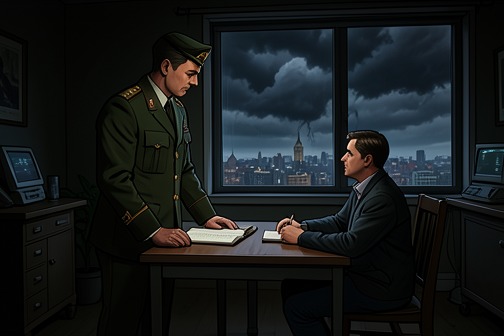
Argentine state terrorism is presented as a systematic policy of disappearance and repression, enabled by [Cold War](entity:time-recall-time-700d9e46b459) anti-communism and carried out through clandestine state structures. The novel explains its political preconditions, describes the division of violence into specialized operations, and links the resulting flight from [Argentina](entity:location-recall-location-27e2c37f5c3d) to an earlier history of Spanish exile and state secrecy.
## International and Domestic Preconditions
The account places the 1976 Argentine dictatorship in a regional landscape already marked by military rule. It identifies a broader doctrine of national security, adopted in [United States](entity:location-recall-location-5d55e9152db1) diplomacy toward Latin America, whose stated objective was to defeat left-wing movements and organizations throughout the continent. In this Cold War framework, military dictatorships were treated as instruments of victory against communism and received support from Washington, with consequences that the narrative presents as central to understanding the Argentine regime.
That support is made concrete through statements by senior American officials. On March 26, 1976, two days after the coup, [William](entity:character-recall-character-13581a833d6e) P. Rogers anticipated extensive repression and warned that the regime would target not only people it described as terrorists but also dissidents in unions and within the governing political parties. His successor, Henry Kissinger, expressed a desire to support the coup-makers and avoid making them feel isolated. The contrast between such reassurance and the violence that followed helps explain the international conditions in which the dictatorship could act with impunity.
The crackdown had a prehistory in the government of María Estela Martínez de Perón, who sought to demonstrate her anti-communist commitment amid the same international pressures. On February 5, 1975, she issued the decree described in the novel as the first decree of annihilation, establishing Operation Independence. Officially directed against guerrillas in the forests of Tucumán province, the operation divided the country into five military zones and granted their commanders sweeping authority to repress those labelled subversive. Its commander, Brigadier General Acdel Vilas, characterized its purpose as cultural as well as military: in his account, guerrilla activity was only one aspect of subversion. The operation consequently targeted civilians, including teachers, students, intellectuals, artists, scientists, and religious figures in San Miguel de Tucumán. The novel presents this campaign as a precursor to the repression later intensified and systematized under the military regime.
## The Repressive System
The dictatorship’s campaign ran from the spring of 1976 through the autumn of 1982. During that period, thousands of people were forcibly disappeared. Because many bodies were never recovered, estimates vary; the account gives an approximate total of 30,000 victims. A statement attributed to General Ibérico Manuel Saint-Jean, military governor of [Buenos Aires](entity:location-recall-location-caf56b79d5c4) province, makes the regime’s declared logic explicit: it would move from eliminating those called subversives to their supposed accomplices and sympathizers, and ultimately to the indifferent and the politically lukewarm. Repression was thus represented not as a limited response to armed opposition but as a project capable of expanding across society.
An indefinite state of siege and repressive laws suspended civil rights and freedoms, while also denying citizens the ability to leave the country. Alongside these public measures, the regime established a clandestine apparatus organized into task groups, each assigned a particular function. The listed operations form an integrated chain: abductions and disappearances; secret detention centers; torture; executions; disposal of bodies; clandestine maternity wards where detained women gave birth and were separated from their babies; and offices tasked with erasing the identities of stolen children and arranging their adoption by military families or civilians aligned with the dictatorship. The organization’s specialization joined the attack on a person’s body to the destruction or appropriation of identity and evidence.
The so-called death flights exemplify the system’s extreme division of labor. Military pilots transported living prisoners, tied and drugged, in fighter aircraft and threw them into the sea from great heights. The account places this practice within the same structure as secret detention and the disappearance of bodies: it was not an isolated act but one component of a machinery designed to conceal what had happened to those taken into custody.
## Coup and Flight
The terror began on the night of March 24, 1976, when hundreds of illegal arrests took place. From then on, many Argentines prioritized finding a way to leave the country. The novel emphasizes the coercive setting of that flight: the regime’s indefinite state of siege and suspension of rights included a prohibition on leaving, even as the scale of clandestine arrests made escape an urgent concern.
The account also looks backward to earlier scenes of repression in [Spain](entity:location-recall-location-0fe76f866976). During the [Spanish Civil War](entity:event-recall-event-spanish-civil-war-dafa813888d4), the [Madrid Defense Council](entity:organization-recall-organization-e616bdf60130) had closed the city’s unofficial detention centers, yet illegal sites continued to operate without oversight; when one was shut down, another opened. A wounded man carrying credentials from the council’s Public Order Department was to be kept alive at any cost, but not admitted to a hospital under his own name, because someone might try to kill him again. These episodes are not equated in scale with the later Argentine campaign. They establish a recurring mechanism of concealed detention, denied identity, and violence outside ordinary safeguards, while the Argentine account describes a dictatorship that organized such practices across the country.
The novel makes the concealment legible through another [Madrid](entity:location-recall-location-madrid-8acd4123f416) episode: after a search of a home, the narrator finds the family papers trampled and the gold taken, while an envelope of politically sensitive material remains locked in a desk drawer. Years later, an unidentified corpse bearing a fatal gunshot wound to the neck is processed under a false account of death and assigned to a common grave among people whose deaths are routinely recorded as cardiac arrest. The false cause, hurried burial, and administrative handling turn disappearance into a procedure as well as an act of violence. These Spanish episodes provide a historical and narrative counterpoint to the Argentine system’s deliberate separation of abduction, detention, killing, disposal, and erasure.
## Exile and Historical Reversal
Mexico received the largest number of Argentine exiles, while Spain was the second most common destination—a striking reversal in a book shaped by [Spanish Republican exile](entity:state-recall-state-spanish-republican-exil-ec1bca3edd8a). By the time Argentines began arriving, Francisco Franco had died. The account recalls that Franco had first been protected and later protected General [Juan Perón](entity:character-recall-character-a454ccbc4368), whose example was invoked by Latin American dictators of the later twentieth century. It also links practices such as taking children from political prisoners to methods already used in Spain’s postwar repression.
The return to Spain could therefore mean arrival in a country marked by an older displacement rather than simple refuge. Spanish Republicans who had gone into exile in 1939 and built new lives across the ocean were, nearly forty years later, forced into another exile. They returned to their former homeland as foreigners and empty-handed. In this final reversal, the novel connects political terror not only to the immediate loss of life and freedom, but also to recurring displacement: repression drives people across borders, and the borders they cross lead back into histories of violence that have not been left behind.
Event 81
Falklands War
The [Falklands War](entity:event-recall-event-9773fc8ba7cf) is identified as the decisive military defeat that helped end [Argentina](entity:location-recall-location-27e2c37f5c3d)’s dictatorship. In the novel’s account, the junta’s collapse followed not only the loss of the war but also growing domestic protest and the erosion of international support, leading the military to call elections in October 1983.
## The Junta and Its Rule
The conflict belongs to the final phase of Argentina’s National Reorganization Process, the military dictatorship established after the coup of March 1976. Its first governing junta brought together representatives of the army, navy, and air force: Lieutenant General Jorge Rafael Videla, Admiral Emilio Eduardo Massera, and Brigadier General Orlando Ramón Agosti. Despite the three-service structure, Videla acted as the process’s leader until 1981, when a new junta headed by Lieutenant General Roberto Eduardo Viola succeeded the first. Two further juntas followed.
The novel places Argentina’s dictatorship within a wider regional shift away from democracy. By March 1976, Argentina was the only country in the Southern Cone still governed democratically. Uruguay and Chile had undergone coups in 1973; Bolivia had been under General Hugo Banzer’s dictatorship since 1971; Paraguay had been ruled by General Alfredo Stroessner since 1954; and Brazil’s military dictatorship, begun in 1964, continued after the death of Humberto de Alencar Castelo Branco. This context casts Argentina’s coup not as an isolated rupture but as another instance of military rule spreading across the region.
## Defeat and the End of the Dictatorship
The account gives the Falklands War a specific political consequence: the military’s defeat weakened its ability to remain in power. The junta was already challenged by protests spreading through the country and by a lack of international support. The war’s outcome intensified these pressures; together, defeat, public opposition, and external isolation compelled the armed forces to relinquish power and announce elections.
The transition did not happen immediately after the first junta took office. Videla led until 1981, and successive military governments retained power before the defeat in the Falklands War helped force the final retreat from rule. Elections were held in October 1983, marking the endpoint of the dictatorship described in this account.
## Political Significance
The war functions in the narrative as the turning point that exposes the limits of military authority. The dictatorship had arisen amid a regional anti-communist order in which military governments were treated as instruments of national security; the novel describes that doctrine as encouraged and supported by Washington. Yet the junta’s rule proved vulnerable to the consequences of its own military defeat and to the domestic and international pressures that followed. The Falklands War therefore marks the point at which the armed forces could no longer sustain their claim to govern, even as the return to elections came only after years of successive juntas.
Event 82
1983 Argentine general election and democratic transition
The [1983 Argentine general election and democratic transition](entity:event-recall-event-1983-90fea4e3e706) brought military rule in [Argentina](entity:location-recall-location-27e2c37f5c3d) to an end and returned the country to elections after years of dictatorship. In the novel’s historical account, the transition follows the junta’s loss of authority amid defeat in the [Falklands War](entity:event-recall-event-9773fc8ba7cf), widespread protest, and waning international support; it also closes a period in which the military justified repression through the [Cold War](entity:time-recall-time-700d9e46b459) language of national security.
## The Junta and Its Succession
The regime that took power in March 1976 was organized around a governing triumvirate representing Argentina’s three armed services. Lieutenant General Jorge Rafael Videla assumed power as commander-in-chief of the Army, Admiral Emilio Eduardo Massera as commander-in-chief of the Navy, and Brigadier General Orlando Ramón Agosti as commander-in-chief of the Air Force. Despite this formally shared structure, Videla acted as the leading figure of the dictatorship until 1981.
A second junta, headed by Lieutenant General Roberto Eduardo Viola, succeeded the first. Two further juntas followed, extending military rule through successive leadership changes rather than restoring civilian government. This succession kept power within the armed forces, while the dictatorship’s eventual end depended on pressures that the internal changes at the top could not resolve.
## Regional Context and State Security
The Argentine coup took place in a region where military and authoritarian governments had already gained ground. Uruguay came under dictatorship in 1973 with the support of its army; Chile’s 1973 coup brought Augusto Pinochet to power. Bolivia had been ruled by Hugo Banzer since 1971, Paraguay by Alfredo Stroessner since 1954, and Brazil’s military dictatorship, begun under Humberto de Alencar Castelo Branco in 1964, continued after his death in 1967.
In March 1976, Argentina was the only country in the Southern Cone that still retained a democratic regime. The novel presents its dictatorship as a further success for the National Security Doctrine, a Cold War political approach adopted in [United States](entity:location-recall-location-5d55e9152db1) diplomacy in Latin America to combat left-wing movements and organizations. Within this framework, military dictatorship became an instrument for pursuing victory over communism, backed and favored by Washington. The election and transition therefore ended not only a national military government but a particular political order that treated suppression of the left as a security imperative.
## The Return to Elections
The junta’s authority ultimately collapsed under several pressures identified in the account: Argentina’s defeat in the Falklands War, the spread of protests within the country, and a lack of international support. Together, these developments compelled the military rulers to relinquish power and call elections. The election was held in October 1983, marking the institutional return to electoral politics after the juntas’ successive rule.
The transition is presented as the outcome of accumulated military and political failure, rather than as a voluntary reform initiated from within the junta. Its significance lies in the reversal from a state organized around military command and anticommunist repression to one in which national leadership would once again be determined through elections. The account establishes the election and the transfer of power, while leaving the subsequent democratic period outside the scope of this particular event.